
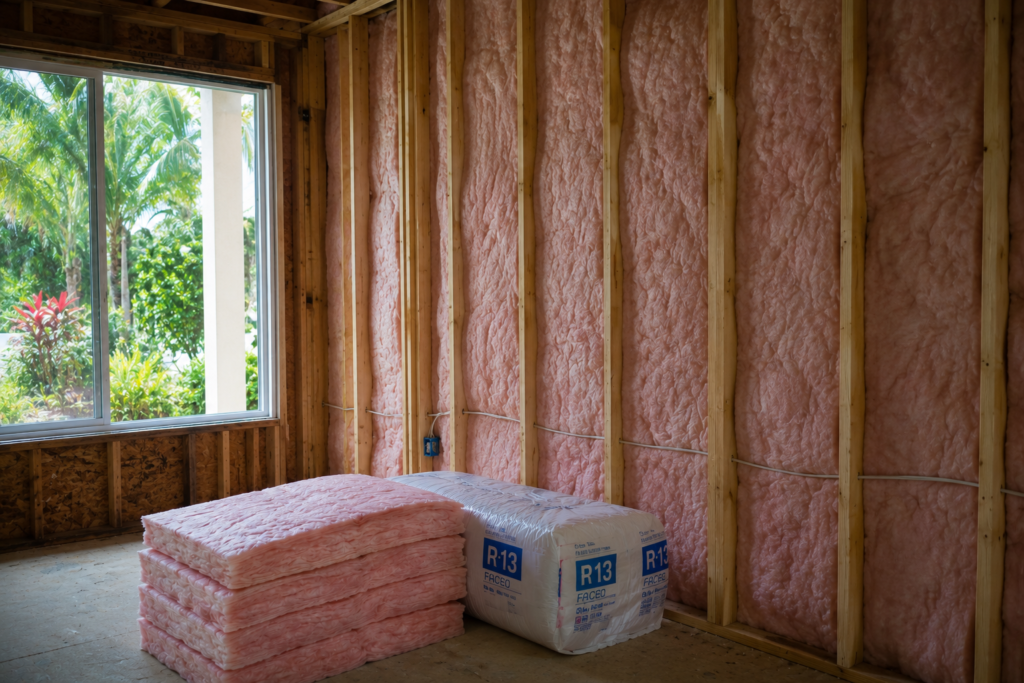
Most homeowners think about insulation as a temperature issue. It keeps heat out in the summer, holds warmth in during the winter, and helps the air conditioner or heating system work more efficiently.
That is true, but it is not the whole story.
In a humid climate, insulation is part of a larger moisture and comfort system. It affects how heat moves through the home, how long surfaces stay warm or cool, how hard the air conditioner has to work, and whether certain rooms feel stable or uncomfortable. It can also influence where condensation is more likely to form, how quickly wet building materials dry, and why one part of a house may feel completely different from another.
Insulation does not remove humidity from the air. It is not a dehumidifier, and it cannot correct every moisture problem by itself. But when a home still feels humid after the obvious issues have been checked — the air conditioner is working, windows are closed, doors are sealed, and there is no obvious leak — insulation deserves a closer look.
In many humid-climate homes, the problem is not one single failure. It is the way heat, moisture, air movement, construction type, insulation, and HVAC performance interact.
Insulation Is Not Just About Temperature
Insulation slows heat transfer. That is its primary job.
Different insulation materials do this in different ways, but the basic goal is the same: reduce the rate at which heat moves through ceilings, walls, floors, and other parts of the building enclosure. The U.S. Department of Energy describes common insulation materials as ranging from bulky fiber materials such as fiberglass, rockwool, and cellulose to rigid foam boards and radiant barriers, each designed to resist heat flow in different ways. (The Department of Energy’s Energy.gov)
In a hot, humid climate, slowing heat gain matters because outdoor heat is not just uncomfortable. It changes how the entire home behaves.
When heat moves into the house too quickly, the air conditioner has to run more often. When the air conditioner runs longer under the right conditions, it usually has more opportunity to remove moisture from the air. But if the house has uneven insulation, leaky ducts, air leakage, or poorly controlled moisture sources, the system may run constantly and still leave the home feeling damp or unstable.
That is why insulation is not just a comfort upgrade. It is part of the home’s ability to maintain stable indoor conditions.
The Difference Between Heat, Humidity, and Moisture
Before looking at insulation problems, it helps to separate three ideas that often get blended together.
- Heat is thermal energy. It moves from warmer areas toward cooler areas.
- Humidity is water vapor in the air.
- Moisture is the broader category. It can include water vapor, liquid water from leaks, damp materials, condensation, wet insulation, or moisture stored in porous building materials.
Insulation mostly affects heat flow. It does not directly pull water vapor out of the air. However, because temperature and humidity are closely connected, insulation can still affect how humid a house feels.
Warm air can hold more moisture than cool air. When warm, humid air reaches a cooler surface, condensation can occur if that surface is below the dew point. In a home, this can happen around ducts, poorly insulated ceilings, cold surfaces, wall cavities, or other areas where temperature differences are not well controlled.
Good insulation helps reduce extreme surface temperature differences. Poor insulation, missing insulation, compressed insulation, or wet insulation can make certain areas of the home hotter, colder, or more vulnerable to condensation and comfort problems.
That is the connection.
Insulation does not remove humidity, but it helps control the temperature conditions that influence how moisture behaves.
Why Humid Climates Make Insulation More Complicated
Homes in humid climates face a different set of pressures than homes in dry or cold climates.
In Florida and other hot-humid regions, the home spends much of the year trying to keep outdoor heat and moisture from overwhelming the indoor environment. The air conditioner is not only cooling the air. It is also removing moisture as humid indoor air passes over the cold evaporator coil.
That means the house has two major goals: control heat gain and control moisture.
Insulation helps with the first goal. Air sealing, vapor control, drainage, HVAC sizing, duct design, and ventilation strategy all help with the second. Building Science Corporation notes that vapor barriers are intended to slow vapor movement, while air barriers control air movement — and the two should not be confused. (Building Science)
This distinction matters because humid air often moves through leaks, gaps, chases, attic bypasses, duct leaks, and pressure differences. Insulation alone does not stop that air movement unless the material is also functioning as part of an air barrier system.
That is one of the biggest misunderstandings homeowners have about insulation.
A wall, attic, or floor can technically have insulation and still perform poorly if air is moving around it, through it, or behind it.
Insulation and Air Sealing Are Not the Same Thing
This is one of the most important concepts in a humid-climate home. Insulation slows heat flow. Air sealing slows uncontrolled air movement.
They are related, but they are not interchangeable.
Fiberglass batts, for example, can reduce conductive heat flow when properly installed. But fiberglass does not stop air leakage by itself. If humid outdoor air is leaking through gaps around wiring, plumbing penetrations, attic hatches, recessed lights, duct chases, or wall cavities, the insulation may not be enough to prevent comfort or moisture problems.
In humid climates, this matters because moving air can carry moisture with it.
A tiny gap can allow warm, humid air to reach cooler surfaces. A leaky return duct can pull humid attic, garage, or wall-cavity air into the HVAC system. A poorly sealed attic hatch can allow hot attic air to affect the conditioned space below. An unsealed chase can connect the attic to interior walls.
The homeowner may think, “But I have insulation.” The better question is, “Is the insulation part of a complete air, thermal, and moisture control system?”
How Insulation Can Affect Indoor Humidity
Insulation affects indoor humidity indirectly.
It does this by changing the conditions around the air conditioner, the building materials, and the surfaces inside the home.
Here are the main ways insulation can matter.
- Insulation affects heat gain. If heat enters the home too quickly through the attic, walls, garage connection, or poorly insulated spaces, the air conditioner may struggle to keep temperatures stable.
- Insulation affects surface temperatures. Poorly insulated surfaces may become warmer or cooler than surrounding areas, depending on the season and location. In humid conditions, temperature differences can influence where condensation is more likely.
- Insulation affects comfort. A room can feel humid even when the indoor humidity number is not extreme if the room is warm, stagnant, or exposed to radiant heat from a hot ceiling or wall.
- Insulation affects drying potential. When insulation becomes wet from a roof leak, plumbing issue, condensation, or wind-driven rain, it may dry slowly in a humid environment. Some materials handle moisture better than others, but wet insulation should never be ignored.
- Insulation affects HVAC workload. A home with weak insulation may force the air conditioner to run harder, but not necessarily better. If the system is oversized, short cycling, poorly ducted, or pulling air from humid spaces, insulation alone will not fix the issue.
This is why insulation problems can feel confusing. They may not show up as one obvious failure. They may show up as a house that never quite feels stable.
Insulation can help slow temperature changes, but it does not necessarily prevent moisture problems. The same principle applies to smaller enclosed spaces, including insulated gun safes and padded musical instrument cases, where humid air can become trapped around sensitive materials. Learn more about protecting valuables from damaging humidity.
Different Types of Insulation Behave Differently
Not all insulation performs the same way.
The right insulation depends on where it is installed, how the home is built, whether the assembly can dry, whether air sealing is included, and how moisture is managed.
Fiberglass
Fiberglass is one of the most common insulation materials. It is often used in batts, rolls, or blown-in form. It works by trapping air in tiny pockets, which slows heat transfer.
Fiberglass can perform well when it is installed correctly and protected from air movement. The problem is that gaps, compression, poor fitting, and air leakage can reduce its effectiveness. Fiberglass also does not act as an air barrier on its own.
In humid climates, fiberglass in attics and walls needs careful attention to air sealing. If humid air moves through or around it, the home may still have comfort and moisture problems even though insulation is technically present.
Fiberglass that becomes wet from a roof leak, plumbing leak, or condensation event may lose performance while wet and may need evaluation or replacement depending on contamination, drying, and damage.
Cellulose
Cellulose is typically made from treated recycled paper products and is often installed as loose-fill or dense-pack insulation. It can do a good job filling irregular cavities when properly installed. ENERGY STAR notes that blown-in cellulose and spray foam can be used to fill wall cavities and can work around wires and obstructions better than some batt installations. (ENERGY STAR)
Cellulose can help reduce air movement more than loosely installed batt insulation, especially when dense-packed, but it is still not a substitute for a complete air barrier unless designed as part of a specific assembly.
Because cellulose is fiber-based, bulk water intrusion matters. If it becomes wet, it needs to be assessed carefully. In humid climates, slow drying can be a concern if the surrounding assembly does not allow moisture to escape.
Spray Foam
Spray foam is different because it can provide insulation and air sealing in one material when properly installed.
There are two main categories: open-cell and closed-cell.
Open-cell spray foam is lighter and more vapor-permeable. It can reduce air movement but allows more vapor diffusion than closed-cell foam.
Closed-cell spray foam is denser, has a higher R-value per inch, and is much less vapor-permeable. It can also add rigidity and provide stronger resistance to moisture vapor movement.
Spray foam can be useful in humid climates, but it must be used thoughtfully. The location of the foam, the roof or wall assembly, drying potential, ignition or thermal barrier requirements, and HVAC design all matter. A sealed attic, for example, changes the way the attic behaves. It is not simply a matter of spraying foam and assuming every humidity problem is solved.
Rigid Foam
Rigid foam boards are often used on exterior walls, foundations, roof assemblies, or specific areas where continuous insulation is needed. Rigid foam can reduce thermal bridging because it can cover framing members rather than only insulating between them.
This matters because wood or metal framing can conduct heat differently than insulated cavities. When insulation exists only between studs, heat can still move through the framing itself. Continuous insulation helps reduce that pathway.
In humid climates, rigid foam can be helpful when used as part of a properly designed wall or roof assembly. But vapor permeability, drainage, flashing, cladding, and drying direction matter.
Mineral Wool
Mineral wool, sometimes called rock wool, is a fiber insulation made from stone or slag. It is often valued for fire resistance, sound control, and moisture resistance. It does not absorb water in the same way some other fiber materials can, though water can still move through gaps or around the material depending on the assembly.
Mineral wool can be useful in wall cavities, exterior insulation systems, and certain assemblies where moisture tolerance is important. Like fiberglass, however, it does not automatically solve air leakage.
Attic Insulation Matters More Than Many Homeowners Realize
In many hot-humid homes, the attic is one of the most important areas for insulation.
This does not mean homeowners care about the attic itself. Most people do not. They care about high cooling bills, hot bedrooms, musty smells, ceiling stains, and a house that never feels quite right.
The attic can influence all of those things.
A vented attic in Florida can become extremely hot. If the attic floor is poorly insulated, heat can move down into the living space. If ducts run through the attic, the HVAC system may be trying to deliver cool air through one of the hottest parts of the house. If the attic hatch is unsealed, hot humid air can affect the conditioned space. If insulation is missing, compressed, uneven, or disturbed, some rooms may feel different from others.
Attic insulation also matters after roof leaks. A small roof leak may not only stain the ceiling. It can wet insulation, roof decking, framing, and ceiling materials. In a humid climate, those materials may dry more slowly, especially if airflow is poor or the wet area is hidden.
This is why attic insulation should not be thought of as a passive layer that can be ignored forever. It is part of the home’s temperature and moisture behavior.
Upstairs, Downstairs, and Uneven Comfort
Insulation problems often show up as uneven comfort.
The upstairs may feel warmer than the downstairs. A bonus room over the garage may feel humid or uncomfortable. Bedrooms may be hotter than the main living area. A room with more sun exposure may never cool as well as the rest of the house.
Sometimes this is an HVAC balancing issue. Sometimes it is ductwork. Sometimes it is windows, solar gain, or air leakage.
But insulation can be part of it.
Second floors and rooms under attics are more exposed to attic heat. Rooms over garages may be affected by heat and air leakage from an unconditioned space below. Exterior walls with poor cavity insulation or thermal bridging may allow more heat gain. Knee walls, bonus rooms, and sloped ceilings are especially vulnerable when insulation and air sealing are incomplete.
This is where a home can technically be insulated but still perform poorly.
The problem may not be the amount of insulation alone. It may be where the insulation is missing, how well it touches the air barrier, whether it is compressed, and whether hot humid air is bypassing it.
Block Homes vs. Wood-Frame Homes
Construction type matters.
In Florida, many homes are built with concrete block walls, wood-frame walls, or a combination of both. Neither type is automatically good or bad. They simply manage heat and moisture differently.
Concrete block has thermal mass, meaning it can absorb and store heat. That can affect how walls behave throughout the day. Block walls may also have different insulation strategies than wood-frame walls. Some block homes have insulation on the interior side, some use furring strips with insulation, and some may have limited wall insulation depending on age and construction.
Wood-frame walls typically have stud cavities filled with insulation. But the framing itself creates thermal bridges, and the quality of installation matters. Gaps, compression, misaligned batts, and unsealed penetrations can all reduce performance.
In both construction types, insulation cannot be separated from air sealing, water control, vapor control, and drying potential.
A block home with poor air sealing can still feel humid.
A wood-frame home with poorly installed insulation can still feel hot.
A well-insulated home with leaky ducts can still pull humid air from the attic, garage, or outdoors.
The construction type matters, but it is only one part of the system.
Foundation and Floor Conditions Matter Too
Humidity problems are not always coming from the attic or walls.
In some homes, the lower part of the building matters just as much.
Slab-on-grade homes are common in Florida. A slab can influence indoor comfort depending on moisture control below the slab, flooring materials, drainage around the home, and indoor humidity conditions. If moisture is moving through or around the slab, the homeowner may notice flooring issues, musty odors, or persistent dampness.
Raised homes and homes over crawlspaces have another set of concerns. Crawlspaces in humid climates can become major moisture reservoirs if they are vented, poorly drained, or not properly sealed. Floor insulation over a humid crawlspace may perform poorly if air and moisture are not controlled below it.
Garage-adjacent rooms also deserve attention. A bedroom above or beside a garage may be affected by heat transfer, air leakage, and incomplete insulation between conditioned and unconditioned spaces.
This is why a humid home cannot always be understood from the thermostat alone. The source of discomfort may be above, below, beside, or inside the building assembly.
When Insulation Gets Wet
Wet insulation is a different issue from ordinary insulation performance.
Insulation can become wet from roof leaks, plumbing leaks, condensation, wind-driven rain, poor flashing, air leakage, or moisture trapped inside an assembly.
Once insulation is wet, several things can happen.
- Its thermal performance may decrease while wet.
- It may take longer to dry in a humid climate.
- It may hold moisture against wood, drywall, or other building materials.
- It may become contaminated depending on the source of water.
- It may support mold growth if organic dust, paper facings, or adjacent materials remain damp.
Not every damp insulation situation is identical. The material, amount of water, duration of wetting, contamination level, and surrounding assembly all matter. But wet insulation should never be dismissed just because it is hidden.
A ceiling stain may be the visible symptom. The insulation above it may be the part that keeps the area damp longer.
What Insulation Can and Cannot Do
Insulation can do a lot, but it cannot do everything.
- Insulation can slow heat transfer.
- It can improve comfort.
- It can reduce heat gain through ceilings, walls, and floors.
- It can help the air conditioner maintain more stable temperatures.
- It can reduce radiant discomfort from hot surfaces.
- It can help prevent some condensation risks by moderating surface temperatures.
- It can make rooms feel more even when properly installed.
But insulation cannot remove humidity from the air.
- It cannot fix an oversized air conditioner.
- It cannot seal every air leak unless it is specifically installed as part of an air barrier system.
- It cannot repair duct leakage.
- It cannot correct drainage problems.
- It cannot dry a wet crawlspace.
- It cannot fix a roof leak.
- It cannot compensate for poor HVAC design.
This is not a weakness. It is simply the reality of how homes work.
Insulation is powerful when it is part of a complete system. It is limited when expected to solve problems outside its role.
Signs Insulation May Be Contributing to Humidity or Comfort Problems
Insulation may deserve attention if the home has persistent comfort or humidity issues and the more obvious causes have already been checked.
Possible signs include:
- Rooms that are consistently hotter than the rest of the house.
- A second floor that never feels as comfortable as the first floor.
- High indoor humidity even when the air conditioner appears to be working.
- Hot ceilings or walls during the afternoon.
- A bonus room, garage-adjacent room, or room over an unconditioned space that feels uncomfortable.
- High cooling bills without a clear explanation.
- An air conditioner that runs often but does not create stable comfort.
- Musty odors near attic access points, closets, knee walls, or rooms under rooflines.
- Visible gaps, thin areas, or disturbed insulation in the attic.
- Compressed or missing batts.
- Insulation moved by trades, pests, storage, or previous repairs.
- Ceiling stains or known roof leaks.
- Ducts running through a very hot attic.
- A home addition or renovated room that feels different from the original house.
These signs do not prove insulation is the only problem. They mean insulation should be part of the investigation.
Common Insulation Problems in Humid Homes
One of the most common problems is missing insulation. Even small missing areas can create noticeable comfort differences, especially in ceilings and rooms exposed to attic heat.
Another common problem is compressed insulation. Many insulation materials depend on trapped air pockets. When the material is compressed, it cannot perform as intended.
Gaps are also common. Batts that are cut poorly around wiring, plumbing, electrical boxes, or framing irregularities may leave empty spaces where heat can bypass the insulation.
Poor contact with the air barrier is another issue. Insulation should generally be aligned with the surface it is intended to protect. If air can move behind or around it, performance can drop.
Attic hatches are often overlooked. A large, uninsulated, unsealed attic access panel can act like a weak spot in the ceiling.
Soffit vents can be blocked by insulation, reducing attic ventilation in vented attic designs.
Recessed lights, duct chases, dropped ceilings, and plumbing walls can create hidden bypasses between the attic and living space.
Ductwork can disturb insulation or create additional problems if it leaks in an attic or unconditioned space.
In humid climates, these details matter because small weaknesses can affect both comfort and moisture behavior.
The Role of Ductwork
Ductwork deserves special attention because it often works directly against the insulation strategy.
In many homes in humid climates, ducts run through the attic. That means cool air is being delivered through a very hot space. If the ducts are poorly insulated, damaged, disconnected, or leaking, the HVAC system may lose cooling capacity before air reaches the room.
Leaky return ducts can be even more problematic. They may pull hot, humid air from the attic, garage, crawlspace, or wall cavities into the HVAC system. That can increase indoor humidity and reduce comfort even if the home has insulation.
This is why insulation and ductwork should not be evaluated separately.
A homeowner may add attic insulation and still feel uncomfortable if the ducts are leaking.
A homeowner may replace the air conditioner and still feel humid if return leaks are pulling in attic air.
A homeowner may blame humidity on the outdoor climate when the real issue is a pressure imbalance inside the house.
Insulation and the Air Conditioner
The air conditioner is the main dehumidifier in most humid-climate homes. But it can only perform well when the house gives it a manageable load.
Insulation helps reduce the sensible cooling load, which is the heat the system must remove. Humidity is part of the latent load, which is the moisture the system must remove.
A well-insulated, well-sealed home can help the HVAC system maintain stable indoor conditions because less outdoor heat and humid air are constantly entering the space.
But there is nuance.
If an air conditioner is oversized, it may cool the house quickly without running long enough to remove enough moisture. If the home is poorly air sealed, humid air may keep entering. If ducts leak, the system may pull in moisture from unconditioned areas. If insulation is poor, rooms may feel warm even when the thermostat says the temperature is acceptable.
This is why homeowners often say, “The AC is working, but the house still feels humid.”
The system may be cooling, but the building may not be supporting stable humidity control.
Insulation, Vapor Movement, and Drying
Vapor movement is one of the more technical parts of building science, but the basic idea is simple.
Water vapor can move through materials by diffusion, but it can also move with air. In many real homes, air leakage moves far more moisture than vapor diffusion alone. That is why air barriers are so important. Building Science Corporation specifically distinguishes vapor barriers from air barriers and explains that vapor barriers are not typically intended to stop air movement. (Building Science)
This matters when choosing insulation or evaluating an existing home.
Some assemblies need to dry inward.
Some need to dry outward.
Some need vapor control on a specific side.
Some should avoid trapping moisture between low-permeance materials.
What works in a cold climate may not be appropriate in a hot-humid climate. Building Science Corporation’s moisture guidance emphasizes that vapor control strategies vary by climate, assembly, and interior conditions. (Building Science)
For homeowners, the takeaway is not to memorize vapor permeability ratings. The takeaway is that insulation should not be chosen in isolation.
The wall, roof, attic, or floor assembly has to manage water, air, vapor, and heat together.
When Insulation Is Not the Problem
A trustworthy insulation article should also say this clearly: sometimes insulation is not the reason a house is humid.
The problem may be an oversized air conditioner.
- It may be a duct leak.
- It may be poor ventilation.
- It may be a bathroom fan that does not exhaust properly.
- It may be a kitchen range hood that is not used or not vented outdoors.
- It may be a crawlspace problem.
- It may be a roof leak.
- It may be plumbing.
- It may be drainage around the foundation.
- It may be wet building materials after a storm or repair.
- It may be indoor moisture from cooking, bathing, laundry, plants, aquariums, or many people living in a tight home.
- It may be open windows and doors during humid weather.
Insulation should be investigated when the pattern points toward the building enclosure, uneven comfort, attic influence, wall or ceiling heat gain, wet materials, or persistent instability after the usual causes have been addressed.
It should not become a catch-all explanation for every humidity problem.
What Homeowners Can Check First
A homeowner does not need to become a building scientist to notice useful clues.
Start with the attic if it is safely accessible. Look for thin, missing, uneven, compressed, or disturbed insulation. Check whether the attic hatch is insulated and weatherstripped. Look for signs of roof leaks, staining, dampness, pest disturbance, or areas where insulation has been moved and never replaced.
Look at rooms that feel different from the rest of the house. Are they under the attic? Over the garage? On the west side of the home? Near a knee wall? Beside an unconditioned space? These details can point toward insulation or air-sealing weaknesses.
Pay attention to timing. Does the room feel worse in the afternoon? After rain? During long humid stretches? When the AC runs constantly? When doors are closed? Patterns matter.
Check for duct issues. If ducts are in the attic, damaged duct insulation, disconnected ducts, or air leaks can mimic insulation problems.
Notice musty smells. A musty smell near closets, attic accesses, ceiling stains, or rooms under rooflines can suggest hidden moisture or air movement.
Review any past leaks. If the home had a roof leak, plumbing leak, or ceiling repair, insulation may have been wet, removed, compressed, or replaced poorly.
If the issue is persistent, an energy audit, blower door test, duct leakage test, infrared scan, or evaluation by a qualified insulation, HVAC, or building-performance professional may be useful.
What to Do If Insulation Is Part of the Problem
| If the Problem is… | What to do |
| Missing insulation | Add insulation to meet the recommended level for your climate and home design. |
| Compressed insulation | Correct or replace the compressed insulation so it can perform as intended. |
| Wet insulation | Fix the moisture source first, then evaluate whether the insulation needs to be dried or replaced. |
| Air leakage | Seal gaps and penetrations before simply adding more insulation. Air sealing is often just as important. |
| Leaky ductwork | Repair and seal duct leaks before expecting insulation upgrades to noticeably improve comfort. |
| Blocked attic ventilation | Restore proper attic ventilation according to the home’s design. |
| Hot room over a garage or beneath the roof | Evaluate insulation, air sealing, duct balancing, and HVAC airflow, as one or more may be contributing. |
| Spray foam insulation | Evaluate the attic or roof assembly as a complete system rather than focusing only on the insulation product. |
| Unresolved moisture problem | Never install new insulation over a moisture problem. Identify and correct the source of the moisture first. |
| Unsure where the problem is coming from | Consider an energy audit, blower door test, duct leakage test, or infrared inspection to identify hidden issues before making |
Frequently Asked Questions
Can poor insulation make my house feel more humid?
Yes, it can contribute. Insulation does not remove moisture from the air, but it helps regulate heat transfer throughout the home. When insulation is missing, damaged, compressed, or poorly installed, certain areas of the home may become much warmer than others. That extra heat increases the workload on your air conditioner and can make your home feel less comfortable, even if the indoor humidity level has not changed dramatically.
In many cases, humidity problems are caused by a combination of factors, including insulation, air leakage, HVAC performance, and moisture sources.
Does adding more insulation reduce indoor humidity?
Not directly.
Insulation slows heat transfer, but it does not remove water vapor from the air. However, improving insulation can make it easier for your HVAC system to maintain consistent indoor temperatures, which may improve overall comfort and help the air conditioner operate more efficiently.
If excessive indoor humidity is caused by air leaks, oversized HVAC equipment, duct leaks, plumbing leaks, or other moisture sources, adding insulation alone will not solve the problem.
Can old insulation stop working?
Insulation does not typically “wear out” simply because of age, but its performance can decline if it becomes wet, compressed, disturbed, damaged by pests, or installed improperly.
For example, insulation that has been flattened by storage, displaced during renovations, or saturated by a roof leak may no longer perform as intended.
What type of insulation is best for humid climates?
There is no single insulation that is best for every home.
The right choice depends on several factors, including your climate, construction type, attic design, wall assembly, budget, and whether air sealing is also being addressed.
Fiberglass, cellulose, spray foam, mineral wool, and rigid foam can all perform well when they are installed correctly and used in an appropriate building assembly.
Can wet insulation dry out?
Sometimes, but it depends on the type of insulation, how much water entered the material, how long it remained wet, and whether it became contaminated.
Even if insulation appears dry on the surface, moisture may remain trapped deeper within the material or surrounding building components. Any insulation that has been affected by a roof leak, plumbing leak, or flooding should be evaluated before assuming it is still performing properly.
Why is my upstairs hotter than my downstairs?
Several factors can contribute to this, but insulation is often one of them.
Upper floors are typically located directly beneath the attic, where temperatures can become extremely high during the summer. If attic insulation is insufficient or uneven, more heat may transfer into the rooms below. Other possible causes include ductwork issues, air balancing problems, solar heat gain, and differences in airflow between floors.
Can insulation help lower my electric bill?
In many homes, yes.
Properly installed insulation helps reduce heat gain, allowing the air conditioner to work more efficiently. While the amount of energy savings varies from one home to another, improving insulation can reduce unnecessary cooling demand when combined with good air sealing and an efficient HVAC system.
Is insulation enough to solve humidity problems?
Usually not.
Insulation is one part of a home’s overall performance system. Indoor humidity can also be affected by HVAC sizing, duct leakage, air sealing, ventilation, plumbing leaks, roof leaks, drainage problems, crawlspaces, and everyday household activities.
If your home continues to feel humid despite having adequate insulation, it may be worth evaluating these other factors as well.
The Bottom Line
In a humid climate, insulation is not just about keeping heat out. It is part of the way a home manages temperature, comfort, air movement, surface conditions, HVAC workload, and moisture risk.
Insulation does not remove humidity by itself. It cannot replace dehumidification, air sealing, drainage, duct repair, or proper HVAC design. But when insulation is missing, damaged, wet, compressed, poorly installed, or disconnected from the rest of the building system, a home can feel hotter, damper, less stable, and harder to cool. That is why insulation can be the missing piece for homeowners who have already checked the obvious causes of indoor humidity.
The question is not simply whether a home has insulation.
The better question is whether the insulation is installed correctly, protected from moisture, connected to an air barrier, suited to the construction type, and working with the HVAC system instead of against it.