
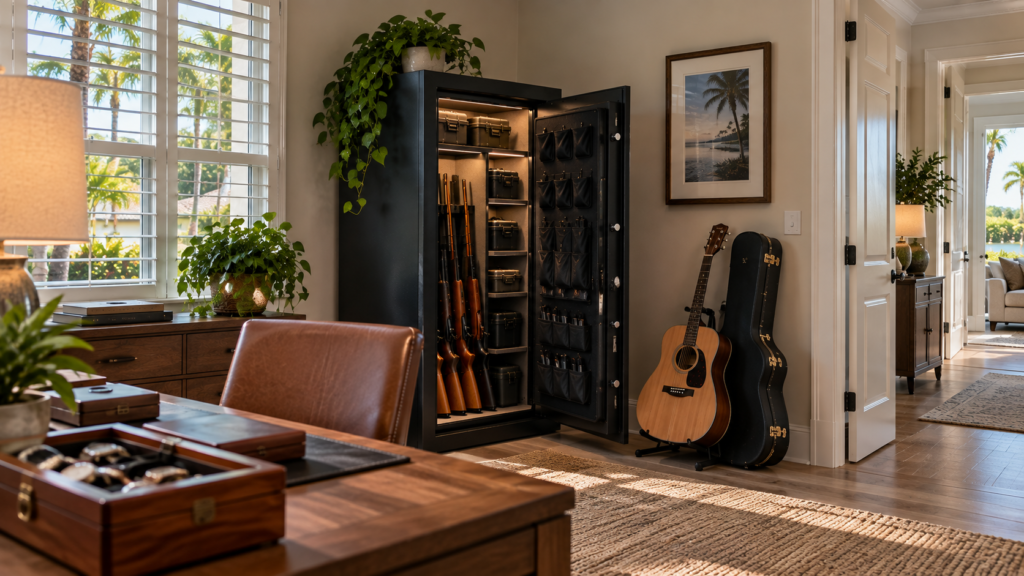
Humidity is usually discussed as a comfort issue inside the home. But for certain belongings, moisture in the air can become a preservation problem long before the house itself shows obvious signs of trouble.
Firearms can corrode. Wooden musical instruments can swell, warp, crack, or develop structural problems. Silver can tarnish more quickly. Photographs and documents can deteriorate or support mold growth. Cameras, electronics, watches, and other sensitive items may also be affected by prolonged exposure to damp conditions.
The challenge is that there is no single “perfect” humidity level for everything stored in a home. A relative humidity level that works well for a guitar may not be ideal for bare metal. Some materials can even be damaged by conditions that are too dry.
That makes humidity control less about making a space as dry as possible and more about three things:
knowing what the item needs, measuring the environment around it, and choosing the right method of humidity control.
This article contains affiliate links. If you make a purchase through one of these links, The Humid House may earn a small commission at no additional cost to you.
Why Humidity Damages Certain Stored Items
Relative humidity, or RH, describes how much moisture is present in the air compared with the maximum amount that air could hold at the same temperature.
Many materials continually interact with that moisture.
Wood absorbs and releases water vapor as relative humidity changes. Metals generally become more vulnerable to corrosion as humidity rises. Paper, photographs, leather, adhesives, and other organic materials can absorb moisture and deteriorate more quickly in damp conditions.
The EPA recommends keeping indoor humidity between about 30% and 50%, and keeping it below 60% when possible, in part to reduce condensation and mold growth.
That general household range is useful, but sensitive objects often have more specific requirements.
| Item | How humidity can damage it | General humidity consideration |
| Firearms and metal equipment | Rust, corrosion, tarnish, deterioration of finishes; wood components can swell or shrink | Stable, relatively dry conditions are generally beneficial |
| Guitars and wooden instruments | Swelling, shrinking, cracking, warped components, loose joints, finish problems, altered action | Many guitar manufacturers recommend about 45–55% RH |
| Pianos and larger wooden instruments | Dimensional changes in wood, tuning instability, effects on adhesives and felt | Stable, moderate RH is important |
| Silver jewelry and watches | Tarnish and some forms of corrosion accelerate as humidity rises | Silver benefits from relatively dry storage |
| Photographs and documents | Mold, sticking, curling, chemical deterioration, weakened emulsions and paper | Stable conditions are important; many photo collections are kept around 30–50% RH |
| Mixed collections | Different materials respond differently to moisture | Do not assume one RH is ideal for everything |
The important distinction is that humidity sensitivity is determined by materials, not price.
A $900 firearm may need more careful humidity control than a $10,000 piece of furniture. A wooden guitar may need a much narrower humidity range than many ordinary household objects.
Firearms and Gun Safes
Firearms are especially vulnerable to poor storage conditions because they often combine several different materials.
A single firearm may contain steel, aluminum, wood, polymers, coatings, oils, and other finishes. Those materials do not all respond to moisture in the same way.
The metal components are the most obvious concern.
The Canadian Conservation Institute notes that relative humidity plays a major role in corrosion. Higher humidity allows salts, oils, pollutants, and other contaminants to cause corrosion more readily.
That matters for firearms because fingerprints, residue, dust, and salts can remain on metal surfaces. Humidity does not have to create visible water droplets before corrosion becomes possible.
What High Humidity Can Do to a Firearm
Long-term exposure to excess moisture can contribute to:
- Surface rust
- Pitting and deeper corrosion
- Tarnishing or discoloration
- Damage to metal finishes
- Corrosion around screws, sights, springs, and other small components
- Swelling or dimensional changes in wooden stocks and grips
- Moisture accumulation inside cases or safes
- Mold or mildew on leather, fabric, foam, or other organic storage materials
A firearm may still look fine externally while corrosion begins in less visible areas.
That is why storage conditions matter even when the firearm is rarely used.
A Gun Safe Is Not Automatically a Dry Environment
A gun safe provides physical security, but it does not automatically provide climate control.
Every time the door opens, the air inside exchanges with the surrounding room. If that room is humid, the safe is repeatedly filled with humid air.
Safe interiors can also contain:
- Carpet or fabric
- Foam
- Wood shelving
- Paper documents
- Leather cases
- Cleaning products
- Gun socks or soft cases
These materials may hold moisture and contribute to the interior microclimate.
The first step should therefore be simple:
Put a hygrometer inside the safe.
The humidity reading in the living room does not tell you what the RH is inside a closed safe.
A small digital hygrometer allows you to see what the firearms are actually experiencing.
The TempPro TP50 Digital Hygrometer is a good option.
Desiccants for Gun Safes
One of the simplest methods for reducing humidity inside an enclosed safe is a desiccant.
Desiccants are materials designed to absorb moisture from the surrounding air.
Silica gel is one of the most common.
Safe-specific products are available as:
- Loose silica gel containers
- Rechargeable canisters
- Rechargeable moisture-absorbing units
- Packets
- Beads or crystals housed inside protective containers
Hornady, for example, sells this rechargeable safe dehumidifier canister containing desiccant crystals that absorb moisture. The crystals change color as they become saturated and can then be dried and reused.
Where Desiccants Work Best
Desiccants are particularly useful in:
- Gun safes
- Handgun cases
- Ammo cabinets
- Small tool cabinets
- Camera cases
- Sealed storage bins
- Other relatively enclosed spaces
The enclosure matters.
A small desiccant packet sitting in an open garage cabinet will constantly be exposed to new humid air and may become saturated quickly.
Inside a relatively tight safe, the moisture load is much smaller and easier to manage.
The Limitation of Desiccants
Desiccants do not work forever.
Once they have absorbed as much water as they can hold, they become ineffective until they are:
- Replaced, or
- Regenerated according to the manufacturer’s instructions.
Some rechargeable products provide a visual color indicator showing when regeneration is necessary.
This is why a hygrometer should still be used even when a desiccant is present.
A desiccant sitting inside the safe does not prove that the humidity is controlled.
The RH reading does.
Electric Dehumidifier Rods for Gun Safes
Another common option is the electric dehumidifier rod, sometimes called a dry rod or safe rod.
These devices work differently from desiccants.
They do not contain crystals that absorb water, and they do not collect liquid water like a household dehumidifier.
Instead, the rod produces a small amount of continuous heat.
That heat gently warms the air around the bottom of the safe and creates natural convection. Warm air rises, helping circulate air through the enclosure while lowering relative humidity around the stored contents.
For a full size gun safe, the GoldenRod Electric Dehumidifier is a practical choice because it provides continuous humidity control if you don’t want the maintenance of replacing or recharging desiccants.
Why Rod Placement Matters
Because warm air rises, electric rods are generally installed near the bottom of the safe.
That allows the warmer air to move upward through the interior.
A rod placed incorrectly may not circulate air as effectively.
Always follow the safe or rod manufacturer’s installation instructions, particularly regarding clearance from stored materials.
Dehumidifier Rod vs. Desiccant
These two approaches are often grouped together, but they do different things.
Desiccant:
Absorbs moisture from the air.
Electric rod:
Warms and circulates air, lowering relative humidity and reducing conditions favorable to condensation.
For a larger firearm collection in a humid climate, using both can make sense.
A practical setup may include:
digital hygrometer + electric dehumidifier rod + rechargeable desiccant
The hygrometer tells you whether the system is actually working.
Do Not Confuse a Safe Light With a Dehumidifier Rod
Safe interiors often contain LED light kits, and some accessory packages include both lighting and humidity-control products.
They are not the same thing.
A standard LED safe light is designed to illuminate the interior.
A dehumidifier rod is specifically designed to create controlled warming and air circulation.
Do not assume that simply having lights inside a safe provides adequate humidity control.
Size the Humidity-Control Method to the Safe
A small handgun case and a large floor safe do not have the same moisture load.
Humidity-control devices should be selected based on:
- Enclosure volume
- How tightly the safe seals
- How frequently it is opened
- Room humidity
- Whether the safe is in a conditioned room or garage
- Amount and type of contents inside
A tiny silica packet may be perfectly useful inside a small pistol case but inadequate for a large safe filled with firearms.
The reverse problem exists too: aggressively drying a very small enclosure without monitoring it can create unnecessarily dry conditions for wood, leather, or other materials stored alongside metal.
Again, measurement matters.
Guitars and Wooden Musical Instruments
Musical instruments are one of the clearest examples of why humidity management is not simply about keeping things dry.
Wood is hygroscopic.
That means it absorbs and releases moisture depending on the surrounding environment.
As humidity rises, wood gains moisture and expands.
As humidity falls, wood loses moisture and contracts.
Because guitars are built from relatively thin, precisely shaped pieces of wood, even small dimensional changes can affect the instrument.
Taylor Guitars recommends maintaining guitars between approximately 45% and 55% RH.
Martin gives the same general recommendation and warns that conditions outside that range can contribute to cracking, warping, or other damage.
What Too Much Humidity Can Do to a Guitar
A guitar exposed to excessive humidity may absorb moisture through its wooden components.
Possible effects include:
- Swelling
- Changes in neck angle
- Higher string action
- Changes in top shape
- Loose or weakened glue joints
- Finish lifting
- Bridge problems
- Changes in tone or playability
Taylor notes that prolonged exposure to humidity in approximately the 60–70% range can eventually over-humidify a guitar, with more severe high-humidity exposure causing problems more quickly.
This matters particularly in humid climates, where ambient RH may remain elevated for months.
What Too Little Humidity Can Do
The opposite extreme is also dangerous.
Very dry wood contracts.
Potential symptoms can include:
- Cracks
- Sunken guitar tops
- Protruding fret ends
- Neck movement
- Changes in action
- Open joints
- Bridge problems
Taylor specifically warns that guitars kept outside the recommended humidity range may become vulnerable to cracking.
This is why simply placing strong desiccants inside a guitar case without monitoring the RH is not a good strategy.
A firearm and an acoustic guitar should not automatically receive the same humidity treatment.
Guitar Cases Create Their Own Microclimate
A hard-shell guitar case can provide excellent protection from rapid environmental changes.
It also creates an enclosed air space around the instrument.
That can be useful because a smaller environment is easier to control.
But it also means the humidity inside the case may differ from the rest of the room.
A small case hygrometer can show what the instrument is actually experiencing.
That is far more useful than assuming the house thermostat or room hygrometer tells the whole story.
Humidity Packs for Guitar Cases
For instruments, humidity-control packs can be more appropriate than ordinary desiccants because guitars can be harmed by both excessive moisture and excessive dryness.
Several products are specifically designed to regulate the microclimate inside a closed instrument case.
D’Addario, for example, offers different Humidipak systems for different conditions.
Absorb Packs
If a guitar or its case is already too humid, an absorb product can remove excess moisture.
D’Addario recommends its Humidipak Absorb system when an instrument or case is at approximately 60% RH or higher, with the goal of bringing it back toward the proper range before switching to a maintenance product.
This is particularly relevant for instruments stored in humid climates.
Maintain Packs
Once the guitar is in an appropriate range, two-way humidity-control packs can help maintain it.
D’Addario’s Maintain system is designed to keep the case around the mid-40s to low-50s by either releasing or absorbing moisture as needed.
This is different from simply throwing silica gel into a guitar case.
A two-way system is designed to respond in either direction.
Restore Packs
A guitar that has become too dry may need moisture added rather than removed.
D’Addarios Restore system is designed for instruments that are below the recommended range and need to be gradually returned toward normal humidity.
So there are really three different situations:
Too wet → remove moisture
Correct range → maintain it
Too dry → add moisture
That distinction is essential.
Ordinary Desiccants vs. Instrument Humidity Packs
Both may look like packets placed inside an enclosure, but they are not necessarily interchangeable.
Standard desiccant
Designed primarily to remove moisture.
Useful for:
- Metal equipment
- Gun safes
- Certain electronics
- Camera storage
- Other objects that benefit from relatively dry conditions
Two-way instrument humidity pack
Designed to regulate humidity around a target level.
Useful for:
- Wooden guitars
- Some other wooden instruments
- Enclosed instrument cases
Using a powerful moisture absorber inside a wooden instrument case without measuring RH could drive conditions too dry.
Using a guitar maintenance pack inside a very damp case may also be insufficient if the instrument is already heavily over-humidified. D’Addario specifically notes that its standard maintenance packs are not intended to remove large quantities of moisture from an already wet instrument.
This is why the proper sequence is:
measure → correct → maintain.
Amplifiers, Pedals, and Musical Electronics
Musicians often store much more than wooden instruments.
A music room may contain:
- Amplifiers
- Pedals
- Mixers
- Microphones
- Speakers
- Recording interfaces
- Cables
- Keyboards
- Computers
- Rack equipment
Electronic equipment introduces another set of concerns.
Moisture can contribute to corrosion on:
- Electrical contacts
- Circuit boards
- Connectors
- Jack sockets
- Switches
- Metal chassis
- Cable ends
Condensation is particularly concerning because liquid water can form on surfaces when warm humid air encounters a sufficiently cold surface.
Musical electronics generally do not require the same narrow 45–55% RH target as a wooden guitar, but they benefit from avoiding prolonged dampness and condensation.
For a large music collection, controlling the entire room may be more practical than trying to individually protect every amplifier, guitar, microphone, and pedal.
Pianos and Larger Instruments
Large instruments create a different challenge because they cannot simply be sealed inside a case.
Pianos contain:
- Wood
- Metal strings
- Felt
- Adhesives
- Mechanical components
Changes in humidity can affect several of these materials at once.
The larger lesson is that stability matters as much as the average RH.
Repeated swings between very humid and very dry conditions can cause wood to repeatedly expand and contract.
Avoid placing sensitive instruments immediately beside:
- Exterior doors
- Frequently opened windows
- HVAC supply vents
- Bathrooms
- Direct sunlight
- Damp exterior walls
- Other areas with large environmental swings
Jewelry, Watches, and Precious Metals
Jewelry requires more caution because different metals and gemstones behave very differently.
Silver is particularly sensitive to tarnishing.
The Canadian Conservation Institute notes that silver tarnishes more quickly as relative humidity rises and recommends dry storage, generally below approximately 50% RH.
Other metal jewelry and watches may also benefit from:
- Dry storage
- Clean storage surfaces
- Anti-tarnish materials when appropriate
- Avoiding damp bathroom storage
- Small humidity-control packs in suitable containers
- Regular inspection
But there is an important exception:
Not every gemstone benefits from extremely dry storage.
Some organic or moisture-containing gemstones may respond poorly to excessive drying.
That makes jewelry another category where the safest approach is to consider the specific materials rather than applying one humidity number to an entire jewelry collection.
Cameras, Lenses, and Electronics
Camera equipment is another category worth protecting from persistent humidity.
Lenses, camera bodies, metal components, and electronics can all suffer in poorly controlled storage.
For serious camera collections, photographers sometimes use enclosed dry cabinets that allow humidity to be controlled more precisely.
Smaller collections may use:
- Sealed camera cases
- Rechargeable desiccants
- Silica gel
- Hygrometers
- Climate-controlled rooms
The same principle applies here as with gun safes:
do not assume a closed container is dry simply because it is closed.
Measure the RH inside it.
Photographs, Documents, and Collectibles
Some of the most humidity-sensitive objects in a home may not be financially expensive at all.
Family photographs, historical documents, signed memorabilia, and paper collections may be irreplaceable.
The Library of Congress identifies temperature and relative humidity as major factors in photographic preservation.
It notes that fluctuations in RH can cause physical and chemical changes and recommends approximately 30–50% RH for mixed photographic collections, with minimal daily cycling.
High humidity can contribute to:
- Mold
- Sticking
- Softened photographic emulsions
- Curling
- Chemical deterioration
- Paper distortion
- Adhesive failure
For that reason, unconditioned attics, garages, sheds, and damp closets are poor long-term storage locations for important photographs and documents.
The Hidden Problem: Microclimates
One of the most important concepts in humidity-sensitive storage is the microclimate.
A house may read 48% RH while the environment inside a safe, guitar case, closet, cabinet, or storage bin is completely different.
Humidity can vary substantially:
- Inside a gun safe
- Inside a guitar case
- Inside a camera cabinet
- In a closed closet
- Against an exterior wall
- Inside a garage
- In an attic
- Behind furniture
- Inside foam-lined cases
- Inside sealed plastic containers
This is why monitoring the room alone may not be enough.
The RH reading that matters most is often the one where the item is actually stored.
How to Protect Humidity-Sensitive Items
1. Measure First
Before buying humidity-control products, measure the environment.
Use a digital hygrometer in:
- Gun safes
- Guitar cases
- Instrument rooms
- Storage closets
- Camera cabinets
- Collections cabinets
If possible, choose one that records minimum and maximum values.
A single reading at noon may miss a large overnight humidity spike.
2. Determine What the Item Actually Requires
Do not apply one RH target to every object.
A wooden guitar and a firearm may be stored under the same roof but have different ideal conditions.
Use:
- Manufacturer guidance
- Museum or conservation recommendations
- Instrument maker recommendations
- Jeweler or conservator advice where appropriate
The goal is not simply “low humidity.”
The goal is appropriate humidity.
3. Choose the Right Control Method
Different problems require different tools.
Desiccants
Best suited to relatively small enclosed spaces where moisture needs to be removed.
Examples:
- Gun safes
- Camera cases
- Tool cabinets
- Some jewelry storage
- Sealed storage containers
Electric dehumidifier rods
Useful primarily in gun safes and similar enclosed cabinets where continuous gentle warming and air circulation can help lower relative humidity.
Two-way humidity packs
Useful for items such as guitars where both excessive humidity and excessive dryness can cause damage.
Room dehumidifiers
Room dehumidifiers like the Midea Cube and Frigidaire are better when the entire room is humid.
This may be the most practical solution for:
- Large firearm collections
- Music rooms
- Camera collections
- Storage rooms
- Multiple safes or cabinets
4. Fix the Room When the Room Is the Problem
If a storage room routinely sits at 70% RH, replacing small silica packs every few weeks is addressing the symptom rather than the environment.
Investigate why the space is damp.
Possible causes include:
- Poor HVAC moisture removal
- Exterior air infiltration
- An oversized air conditioner that cools quickly but removes little moisture
- Damp garages
- Bathroom or laundry moisture
- Building-envelope leaks
- Poor airflow
- Plumbing problems
- HVAC condensate issues
- Long periods with the air conditioning turned off
EPA guidance recommends using air conditioning or dehumidification when necessary to keep indoor humidity controlled.
5. Avoid Unconditioned Storage When Possible
Garages, sheds, and attics may seem convenient for safes, equipment cases, instruments, and storage boxes.
But they are often among the hardest environments to control.
They may experience:
- High humidity
- High temperatures
- Large daily swings
- Seasonal fluctuations
- Condensation
- Greater outdoor-air exposure
For sensitive belongings, a conditioned interior space is usually easier to manage.
6. Prevent Condensation
Relative humidity is only part of the equation.
Temperature also matters.
Warm humid air that encounters a sufficiently cold surface can reach its dew point and form liquid condensation.
That is much more damaging than simply having moderately humid air.
The EPA recommends addressing condensation promptly because it indicates excess moisture and can contribute to mold growth.
Avoid placing sensitive storage directly against surfaces that repeatedly become cold or damp.
7. Inspect Stored Items Regularly
Humidity damage often develops slowly.
Inspect stored items periodically for:
- Rust
- Pitting
- Tarnish
- Mold
- Musty odors
- Warped wood
- Cracks
- Finish lifting
- Loose glue joints
- Damp case liners
- Condensation
- Corroded connectors
- Changes in guitar action
- Sticky photographs
- Curling or distorted paper
A hygrometer can warn about the environment before the damage becomes visible.
What Humidity Should a Storage Room Be?
For an ordinary conditioned room containing mixed household belongings, approximately 30–50% RH is a useful starting point and aligns with EPA indoor-humidity guidance.
But specialized storage should be based on what is actually being stored.
A room full of acoustic guitars may need to stay around the middle of the 40s to low 50s.
A metal-heavy collection may benefit from somewhat drier conditions.
A mixed collection may require separate environments.
A firearm safe might use a desiccant and electric rod while a guitar sitting six feet away uses a two-way humidity-control pack.
That is not contradictory.
It is appropriate humidity management for different materials.
When a Whole-Room Dehumidifier Makes Sense
Container-level humidity control works well when the problem is localized.
But controlling the entire room can be more practical when:
- Multiple safes are affected
- Several instruments are stored together
- Numerous cases continuously run humid
- RH throughout the room stays above the desired range
- A large collection would require many individual humidity-control products
- Seasonal humidity repeatedly overwhelms passive moisture absorbers
A room dehumidifier allows everything stored there to begin with better ambient conditions. The Midea Cube and Frigidaire are good options.
Then individual safes or cases can provide more precise control where needed.
A Simple Protection Strategy
For many homes, the solution does not need to be complicated.
For a gun safe:
Hygrometer → electric dehumidifier rod and/or rechargeable desiccant → monitor RH
For a guitar case:
Case hygrometer → determine whether it is too wet, too dry, or already correct → use the appropriate absorb, restore, or maintenance system
For a music room:
Room hygrometer → HVAC/dehumidifier control → case-level protection where needed
For cameras or electronics:
Hygrometer → dry cabinet or sealed storage with appropriate desiccant → regular inspection
The sequence is important.
Do not start by buying products.
Start by measuring.
The Bottom Line
Humidity damage is often quiet.
There may be no leak, puddle, or dramatic warning.
A firearm can slowly begin corroding inside a closed safe. A guitar can spend months absorbing moisture before its geometry noticeably changes. Camera equipment can sit inside a case with persistently damp air. Photographs can remain untouched in a humid closet until mold or adhesion becomes obvious.
The most important principle is simple:
Measure the environment where the item is actually stored.
Then choose the right method of control.
For firearms, that may mean rechargeable desiccants, an electric dehumidifier rod, or both inside the safe.
For guitars and other wooden instruments, it may mean a case hygrometer and two-way humidity-control system that can absorb or release moisture as conditions change.
For an entire room full of humidity-sensitive equipment, controlling the room itself may be more effective than treating every individual container.
The goal is not to make everything as dry as possible.
It is to maintain stable, appropriate humidity for the materials being protected.