
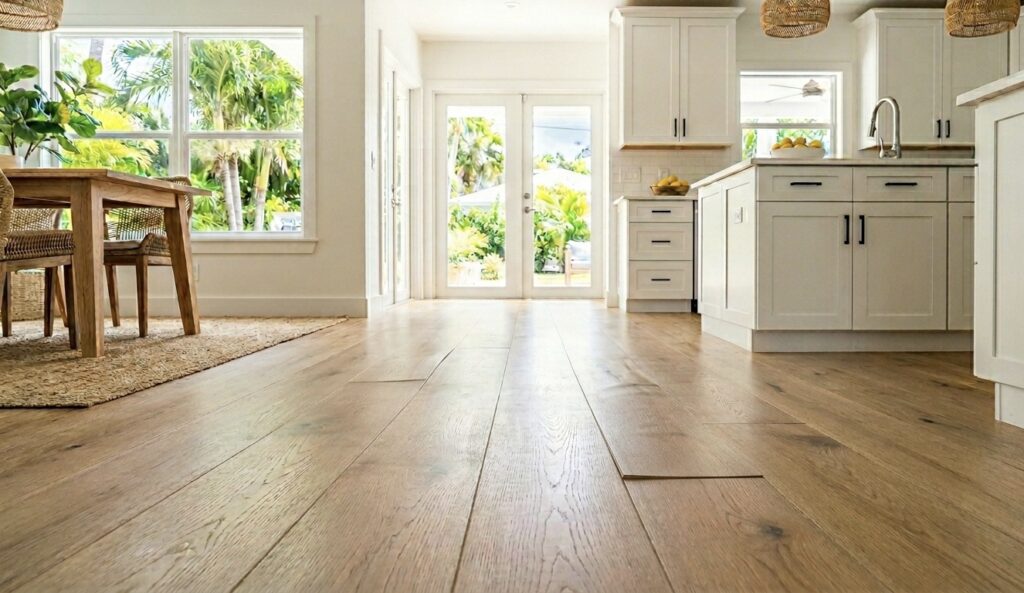
Wood problems inside a home rarely begin as obvious damage. More often, they show up as small, frustrating changes that seem unrelated at first. A door that suddenly sticks. Cabinets that stop closing properly. Floors that feel uneven underfoot. Trim that begins to bubble or separate.
These issues are often treated as isolated defects, but in humid climates, they tend to share the same underlying cause. The air inside the home carries more moisture than the materials were designed to handle, and wood responds to that moisture continuously. Over time, those small responses build into visible changes.
Understanding why these problems happen—and why they tend to return—starts with how wood behaves in humid indoor environments.
What Homeowners Usually Notice First
Wood-related humidity issues rarely begin with visible damage. They tend to appear as changes in how things feel or function.
Common Signs of Moisture-Related Wood Movement
| Problem Homeowners Notice | What It Feels Like | What’s Likely Happening |
| Doors sticking or not latching | Tight, dragging, or misaligned | Wood has expanded and shifted slightly |
| Cabinet doors not closing right | Gaps, rubbing, or misalignment | Panels or frames have absorbed moisture |
| Hardwood floors feeling uneven | Slight lifting or waviness | Boards are expanding at different rates |
| Trim or baseboards changing shape | Swelling, separating, or bubbling paint | Moisture is affecting surface layers and joints |
| Furniture joints loosening or tightening | Movement or instability | Wood components expanding or contracting unevenly |
These changes often seem sudden, but they typically develop gradually as humidity builds over time.
Why These Problems Happen More in Humid Homes
Wood is a hygroscopic material, meaning it continuously absorbs and releases moisture from the surrounding air. This process happens whether it is visible or not.
In humid climates, indoor air often holds enough moisture that wood remains slightly expanded for long periods. Even with air conditioning, humidity levels can stay high enough to affect materials.
This creates a few consistent conditions inside the home:
- Wood does not fully dry out between humidity cycles
- Expansion becomes more constant instead of occasional
- Moisture exposure varies across surfaces, causing uneven movement
The result is not just expansion, but uneven expansion, which leads to the warping, sticking, and shifting homeowners notice.
Why Doors Start Sticking and Cabinets Stop Closing Properly
Doors and cabinets are often the first places these issues show up because they rely on precise alignment to function properly.
As wood absorbs moisture:
- Panels and frames expand
- Hinges and hardware stay fixed
- Alignment shifts slightly
Even small changes can cause:
- Doors to rub against frames
- Latches to miss their strike plates
- Cabinet doors to sit unevenly
This is why these problems often seem worse during humid seasons and improve slightly when conditions dry out.
Why Hardwood Floors Cup, Warp, or Feel Uneven
Flooring issues tend to develop more gradually but can become more noticeable over time.
When one side of a board absorbs more moisture than the other, it expands unevenly. This leads to:
- Edges rising slightly (cupping)
- Boards bending or shifting (warping)
- Pressure building between boards
Repeated humidity exposure can make these changes more persistent, even if they seem subtle at first.
Why Trim, Baseboards, and Paint Start Changing
Trim and baseboards are especially sensitive because of how and where they are installed.
They are often:
- Located near floors where moisture can collect
- Painted or sealed, trapping moisture unevenly
- Installed in long runs where expansion creates stress
As the wood beneath the surface reacts to humidity, homeowners may notice:
- Bubbling or peeling paint
- Swelling along edges
- Separation at seams or joints
These changes are often mistaken for paint problems, but they usually begin within the material itself.
What’s Actually Happening Inside the Wood
At a microscopic level, wood is made up of fibers that absorb and release moisture.
When humidity rises:
- Moisture enters these fibers
- The fibers expand
- The material increases in size
When humidity drops:
- Moisture leaves
- The wood contracts
In humid climates, this cycle leans toward absorption more often than release, which is why expansion tends to dominate over time.
Why These Issues Keep Coming Back Even After Fixes
Many fixes focus on adjusting or repairing the visible problem.
Common attempts include:
- Sanding or trimming doors
- Adjusting hinges
- Refinishing floors
- Repainting trim
These can improve the symptoms, but they do not change the environment.
If humidity remains elevated, the same materials will continue reacting in the same way. That is why the issues often return.
What Homeowners Can Do to Reduce These Effects
The goal is not to stop wood from reacting, but to reduce how much it changes.
Practical Ways to Limit Wood Movement
| Approach | Why It Helps |
| Maintain consistent indoor humidity | Reduces expansion and contraction cycles |
| Improve airflow in closed spaces | Prevents moisture buildup around materials |
| Use exhaust fans in moisture-heavy areas | Limits humidity spreading through the home |
| Choose engineered wood when possible | Designed for better stability |
| Allow for expansion during installation | Prevents pressure buildup and damage |
These steps create more stable conditions, which reduces the intensity of wood movement.
Materials That Tend to Perform Better Than Wood in Humid Homes
Wood can still be used successfully, but it requires more control than many homeowners expect. Because of that, alternative materials are often used in areas where moisture exposure is more consistent.
These materials are not completely unaffected by humidity, but they are generally more stable and less reactive.
| Material | Where It’s Used | Why It Performs Better in Humidity |
| Engineered wood | Flooring, cabinetry | Layered construction reduces expansion and contraction |
| Luxury vinyl plank (LVP) | Flooring | Does not absorb moisture like natural wood |
| Tile (porcelain or ceramic) | Floors, walls | Non-porous and unaffected by humidity |
| MDF (sealed) | Trim, cabinetry | More stable than solid wood when properly finished |
| PVC or composite trim | Baseboards, trim | Resistant to moisture absorption and swelling |
Why Builders Often Limit Solid Wood in Humid Areas
In consistently humid environments, solid wood is more likely to:
- expand unevenly
- shift over time
- require repeated adjustments
Because of this, many homes use:
- engineered materials instead of solid wood
- Luxury Vinyl Plank to mimic solid wood look
- moisture-resistant products in certain areas
- alternative flooring or trim where exposure is higher
These decisions are not about avoiding wood entirely, but about reducing how much materials react to the environment.
When Wood Still Makes Sense
Wood is still widely used because of its durability and appearance.
It tends to perform best when:
- indoor humidity is relatively stable
- it is installed with proper spacing
- it is used in lower-moisture areas
In these conditions, wood can remain reliable even in humid climates.
Professional Perspective on Wood Movement in Humid Conditions
Building science consistently points to moisture exposure as the driver of wood behavior indoors.
“Wood is constantly interacting with its environment, taking on and releasing moisture in response to surrounding conditions. In interior spaces where humidity is not well controlled, this exchange becomes less balanced. The result is not simply expansion, but uneven movement that can affect fit, alignment, and surface stability over time. Managing indoor moisture is the most effective way to keep these changes within a predictable range, rather than trying to eliminate them entirely.”
This reflects a key idea: the goal is not to stop movement, but to keep it controlled.
When Wood Changes Are Normal vs. When They Need Attention
Not all movement indicates a problem.
Usually Normal
- Minor seasonal sticking
- Small changes in floor feel
- Slight expansion during humid periods
Worth Looking Into
- Rapid or severe warping
- Ongoing moisture exposure from leaks or condensation
- Structural shifting
- Consistently high indoor humidity
The difference is often the severity and consistency of the changes.
How This Connects to Other Humidity Problems in the Home
Wood movement is often one of several signs that indoor humidity is elevated.
The same conditions can also lead to:
- condensation on windows and surfaces
- longer drying times
- musty or damp air
Addressing humidity often improves multiple issues at once.
Frequently Asked Questions
Why does wood warp in a house even without water damage?
Wood does not need direct water exposure to change shape. In humid homes, moisture in the air is enough for wood to absorb over time. As the moisture content inside the wood increases, the fibers expand unevenly, which can lead to warping, swelling, or shifting even when everything appears dry on the surface.
Why do doors stick more in humid weather?
Doors are usually one of the first things to react because they rely on tight alignment within a frame. When humidity rises, the door or frame can expand slightly. Even a small change is enough to cause rubbing, sticking, or difficulty latching, especially during more humid seasons.
Why won’t my cabinets close properly anymore?
Cabinet doors and frames are made of multiple wood components that can absorb moisture at different rates. This can cause subtle shifting or expansion, which affects alignment. The hardware stays fixed, so even small changes in the wood can make doors appear uneven or difficult to close.
Why do hardwood floors cup or feel uneven?
Cupping happens when one side of a floorboard absorbs more moisture than the other. In humid homes, this often means the underside of the board expands more than the top surface, causing the edges to lift slightly. Over time, this uneven expansion can make floors feel wavy or inconsistent underfoot.
Is it normal for trim or paint to bubble in humidity?
In many cases, yes. When wood trim absorbs moisture, it can expand beneath the surface. This movement can stress paint layers, leading to bubbling, peeling, or separation at seams. It is often a sign of moisture movement rather than a simple paint failure.
Why do these wood problems keep coming back after I fix them?
Most fixes address the symptom, not the cause. Sanding a door or adjusting hardware can temporarily improve the issue, but if indoor humidity stays elevated, the wood will continue to absorb moisture and expand again. Without changing the environment, the problem often returns.
Does air conditioning prevent wood from warping?
Air conditioning helps, but it does not always remove enough humidity to fully stabilize wood. In humid climates, indoor moisture levels can remain high enough for wood to stay slightly expanded, especially if the system is not running long enough or is oversized for the space.
Is wood a bad choice for homes in humid climates?
Wood is not a bad choice, but it is more sensitive to environmental conditions than many other materials. It can perform well when humidity is managed and installation accounts for movement. Without those conditions, it is more likely to show changes over time.
What materials are more stable than wood in humid homes?
Materials like tile, luxury vinyl plank (LVP), and composite or PVC trim are generally more stable because they do not absorb moisture the same way wood does. Engineered wood products are also designed to reduce movement compared to solid wood.
How can I reduce humidity effects on wood in my home?
The most effective approach is keeping indoor humidity consistent. This can include improving airflow, using exhaust fans in moisture-heavy areas, and ensuring your HVAC system is managing humidity effectively. The goal is to reduce large or constant swings in moisture levels so wood movement stays minimal and predictable.
The Bottom Line
When wood begins to warp, swell, or stop fitting properly, it is usually responding to moisture in the air rather than failing on its own.
In humid homes, that response becomes more noticeable because the environment consistently pushes the material in the same direction. Small changes build over time, leading to the issues homeowners experience.
The most effective way to manage these problems is not repeated repairs, but creating more stable indoor conditions so that wood movement stays controlled and predictable.