
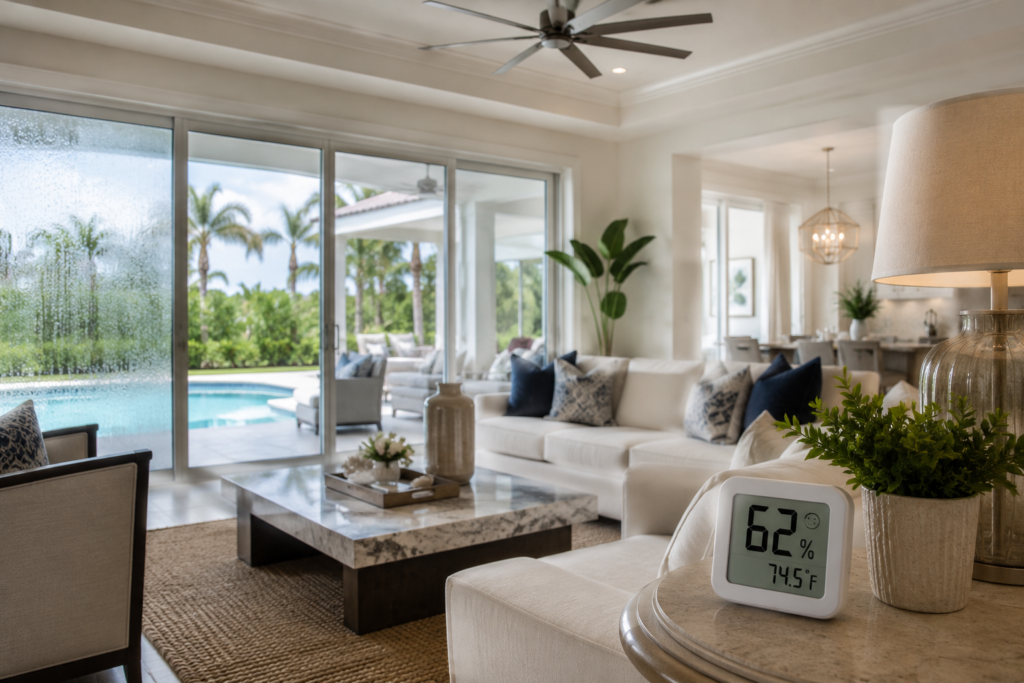
You check your thermostat, hygrometer, or smart home app and see the same number day after day: 60%, 62%, maybe even 65% humidity. At first, it may not seem like a big deal. Then the questions start. Is this normal? Is mold growing somewhere? Do you need a dehumidifier? Is your air conditioner failing?
The answer depends on more than the number itself.
Many homes spend at least part of the year above 60% humidity, especially in humid climates. Some experience few noticeable issues, while others develop musty odors, recurring bathroom mold, damp-feeling rooms, or persistent comfort problems. Understanding why humidity remains elevated is often more important than the humidity reading itself.
Before spending hundreds or thousands of dollars on equipment, it helps to understand what 60% humidity actually means, why some homes seem stuck there, and what homeowners can do first.
This article contains affiliate links. If you make a purchase through one of these links, The Humid House may earn a small commission at no additional cost to you.
Why Many Homes Get Stuck At 60–65% Humidity
If your home seems permanently stuck between 60% and 65% humidity, you’re not alone. In fact, this is one of the most common humidity ranges homeowners report.
Many people assume indoor humidity should automatically stay below 50%. While that may be possible in some climates and homes, real-world conditions are often more complicated. Outdoor air constantly carries moisture into the home through doors, windows, ventilation systems, attic leaks, and countless small openings throughout the building envelope.
In humid climates, your air conditioner is often fighting a continuous battle against outdoor moisture. Every time someone opens a door, takes a shower, cooks dinner, runs a dishwasher, or does laundry, additional moisture enters the indoor environment.
This is why many homeowners become frustrated. The air conditioner appears to be working properly. The temperature feels comfortable. Yet humidity never seems to drop below 60%.
That doesn’t necessarily mean something is broken.
Some homes naturally hover around this range because of local climate conditions, household activities, building design, and HVAC performance. The challenge is determining whether your home’s humidity is simply typical for your situation or whether it’s contributing to larger moisture-related issues.
Is 60% Humidity Actually A Problem?
There isn’t a single humidity threshold where a home suddenly becomes “health” or “unhealthy”, but persistently high humidity can affect health and comfort in several ways and can also create conditions that favor indoor allergens.
Humidity exists on a spectrum.
A home at 58% humidity is not dramatically different from a home at 60%. Likewise, a home at 60% humidity is very different from one sitting at 75% humidity for weeks at a time.
Many experts use 60% as a practical guideline because moisture-related problems tend to become more likely as humidity rises above that level. However, humidity readings should always be viewed alongside what is actually happening inside the home.
A house sitting at 60% humidity with no musty odors, no condensation, and no recurring moisture issues may be experiencing something very different from a house sitting at the same humidity level while dealing with mold, damp closets, and persistent moisture problems.
The number matters. The symptoms matter too.
| Indoor Humidity | What Homeowners Often Experience |
|---|---|
| Below 40% | Dry air, static electricity, dry skin |
| 40–50% | Often considered a comfortable range |
| 50–60% | Common in many homes, especially during humid seasons |
| 60–65% | Gray area where moisture-related issues become more likely |
| Above 65% | Increased risk of persistent moisture problems |
| Above 70% | Conditions become increasingly favorable for mold and mildew growth |
Why Some Homes Function Fine At 60% While Others Don’t
Two homes can have the exact same humidity reading and experience very different outcomes.
One home may remain comfortable with few noticeable moisture issues. Another may struggle with recurring shower mold, musty smells, damp closets, and rooms that never seem to fully dry out.
Several factors help explain the difference.
The first is where moisture tends to collect. Bathrooms, closets, laundry rooms, exterior walls, and other areas with limited airflow often show humidity-related problems long before the rest of the house.
The second is how quickly surfaces dry after becoming wet. A shower that dries within an hour experiences very different conditions than a shower that remains damp until the next day.
Air movement also matters. Homes with good airflow often dry faster and experience fewer localized moisture issues, even when average humidity readings are similar.
Building materials play a role as well. Carpeting, fabrics, drywall, wood, and stored belongings can absorb moisture over time, creating conditions that feel different from what a humidity reading alone might suggest.
This is why homeowners should avoid focusing exclusively on the number. The way the home behaves often reveals more than the humidity reading itself.
What Happens If You Do Nothing?
This is often the question homeowners are really asking.
If your home stays around 60–65% humidity and you make no changes, what happens?
In many cases, nothing dramatic happens immediately.
Your house is unlikely to suddenly develop major mold and moisture problems overnight simply because humidity reached 60%. Moisture-related issues generally develop over time and tend to appear first in the most vulnerable areas of the home.
Bathrooms may stay damp longer after showers. Musty odors may become more common in closets or storage spaces. Some homeowners notice that their homes feel warmer than the thermostat reading suggests because humid air often feels less comfortable than drier air.
Over longer periods, elevated humidity can make mold-prone areas more difficult to manage. Areas that already struggle with moisture may require more frequent cleaning or maintenance.
The important takeaway is that humidity-related problems usually develop gradually. This gives homeowners time to observe patterns, identify causes, and try practical solutions before assuming expensive equipment is necessary.
Before You Spend Money, Start Here
Many homeowners discover their humidity is above 60% and immediately begin researching whole-house dehumidifiers, HVAC replacements, or expensive moisture-control systems.
In some situations, those investments make sense. In many others, they are not the first step.
Before spending money, it helps to understand whether you actually have a humidity problem and, if so, where that moisture is affecting your home.
Verify The Humidity Reading
Humidity sensors are not perfect.
Thermostats, smart home devices, and inexpensive hygrometers can sometimes read several percentage points higher or lower than actual conditions. Before making decisions based on a single reading, consider verifying it with a second device placed nearby for several days.
Pay attention to trends rather than individual measurements. A home that occasionally reaches 60% humidity is very different from one that remains there around the clock.
If you want to verify your home’s humidity with a separate device, a simple digital hygrometer like the ThermaPro TP50 can give you an independent reading to compare against your thermostat or smart system.
Look For Signs Of A Real Humidity Problem
The number itself only tells part of the story.
Walk through your home and look for evidence that moisture is actually affecting the environment.
Common signs include:
- Recurring shower mold
- Persistent musty odors
- Damp-feeling closets
- Condensation on windows
- Sweaty toilets
- Stored items developing a musty smell
- Fabric that take unusually long to dry
- Rooms or entire floors that consistently feel sticky or uncomfortable
If none of these symptoms are present, the humidity reading may be less concerning than it first appears.
Determine Whether The Problem Is Seasonal Or Year-Round
Many homes experience higher humidity during certain parts of the year.
If humidity rises during summer but drops during cooler or drier months, the issue may be related to seasonal weather patterns rather than a building or HVAC problem.
On the other hand, humidity that remains elevated throughout the year may point toward airflow issues, HVAC performance concerns, moisture intrusion, or persistent indoor moisture sources.
Evaluate How Quickly Your Bathrooms Dry
Bathrooms often reveal humidity problems before the rest of the house.
After the final shower of the day, pay attention to how long moisture remains on surfaces.
If shower walls, doors, grout, and fixtures are still damp many hours later, the bathroom may not be drying efficiently. In humid climates, this can contribute to recurring mold and mildew even when the rest of the home appears relatively normal.
Pay Attention To Musty Odors
Musty odors often provide clues before visible moisture damage appears.
Closets, bathrooms, laundry rooms, and storage spaces like gun safes, and musical instrument cases, tend to be some of the first locations where excess humidity becomes noticeable.
A home with no musty odors may be experiencing a different situation than one where damp smells continue returning despite regular cleaning.
The Most Common Causes Of Humidity Above 60%
Once you’ve confirmed that humidity is consistently elevated, the next step is identifying where the moisture is coming from.
In many cases, the cause is not a single problem but a combination of factors working together.
Outdoor Humidity Entering The Home
In humid climates, outdoor air is constantly trying to move indoors.
Every time a door opens, moisture enters. Small leaks around windows, doors, attic penetrations, and other openings can also allow humid air to find its way inside.
The more humid the outdoor environment becomes, the harder your home’s systems must work to keep indoor humidity under control.
Air Conditioning Performance
Many homeowners assume that if their air conditioner is cooling properly, humidity should automatically stay low.
Cooling and dehumidification are related, but they are not exactly the same thing.
An air conditioner can successfully maintain temperature while still struggling to remove enough moisture from the air.
Professional Perspective
Air conditioners remove both heat and moisture. In building science, heat removal is often called sensible cooling, while moisture removal is called latent cooling. A system may keep a home at the desired temperature while still allowing humidity to remain higher than expected if moisture removal is limited.
Oversized HVAC Systems
An oversized air conditioner may cool the home very quickly, satisfying the thermostat before it has enough time to remove significant amounts of moisture.
The result can be a house that feels cool but remains more humid than expected.
Moisture Generated Inside The Home
Homes produce moisture every day.
Showers, cooking, dishwashers, laundry, drying clothes indoors, and even people breathing all contribute water vapor to the indoor environment.
Individually these sources may seem minor. Together they can have a meaningful impact on humidity levels.
Simple Things To Try First
If your home’s humidity stays above 60%, there is a natural temptation to start shopping for equipment.
Before doing that, it’s worth focusing on the simple factors that often contribute to elevated humidity. While these steps won’t solve every moisture problem, they can help homeowners better understand what’s happening and may improve conditions without a major investment.
Improve Bathroom Drying
Bathrooms are often the first place where excess humidity becomes noticeable.
If shower walls, glass, grout, and fixtures remain wet for hours after use, moisture is lingering in the space longer than necessary. Running the bathroom fan during showers and for at least 20 to 30 minutes afterward can help remove some of that moisture before it spreads into the rest of the home.
Opening the shower door after use, wiping down heavily used surfaces, and allowing air to circulate through the room can also improve drying.
If recurring shower mold is one of your primary concerns, improving drying may provide more benefit than focusing solely on the home’s average humidity reading.
Check Your Air Filter
A dirty HVAC filter can restrict airflow through the system.
While changing a filter won’t magically solve a humidity problem, poor airflow can reduce overall HVAC performance and make it harder for the system to operate as intended.
Make Sure Supply And Return Vents Are Open
Furniture, rugs, curtains, and household items sometimes block vents without homeowners realizing it.
Restricted airflow can contribute to comfort issues and reduce the effectiveness of the HVAC system.
Pay Attention To Indoor Moisture Sources
Take note of activities that regularly add moisture to the indoor environment:
- Long hot showers
- Frequent cooking
- Boiling water
- Running the dishwasher
- Drying clothes indoors
- Large numbers of houseplants
Most homes can handle these activities. The goal is simply to recognize that humidity does not only come from outside.
Focus On Patterns Rather Than Daily Fluctuations
One of the biggest mistakes homeowners make is becoming overly concerned with short-term changes.
Humidity naturally rises and falls throughout the day. Weather conditions change. Doors open. Air conditioners cycle on and off.
A home that briefly reaches 62% humidity is different from a home that remains there continuously for weeks.
When A Portable Dehumidifier Makes Sense
Portable dehumidifiers can be useful when humidity problems are concentrated in a specific area.
Examples include:
- A damp bedroom
- A musty closet
- A laundry room
- A bathroom that struggles to dry
- A storage area
In these situations, a portable unit may improve comfort and reduce moisture levels without requiring major changes to the home’s HVAC system.
However, homeowners should understand their limitations.
A portable dehumidifier treats the area where it is located. It does not necessarily solve the underlying reason humidity is entering or remaining in the home.
For localized humidity control, look for a portable dehumidifier with an adjustable humidistat and enough capacity for the space. The Midea Cube 35-Pint and Fridgidaire 35-Pint are both strong options.
Even when a dehumidifier is operating continuously, indoor humidity may still remain elevated. Restricted airflow, insufficient capacity, incorrect settings, or ongoing moisture infiltration can prevent the appliance from reaching it’s target humidity level. Understanding why a dehumidifier runs without effectively lowering humidity can help determine whether the problem involves the equipment or the home’s moisture conditions.
When A Whole-House Dehumidifier Makes Sense
Whole-house dehumidifiers are often discussed whenever humidity exceeds 60%, but they are not automatically necessary.
These systems are typically considered when:
- Humidity remains elevated despite normal HVAC operation
- Moisture problems affect multiple rooms
- Musty odors persist throughout the home
- Occupants consistently feel uncomfortable
- The home is located in an especially humid climate
- Other troubleshooting efforts have failed
For homeowners experiencing significant moisture-related issues throughout the house, a whole-house system can provide a level of humidity control that air conditioning alone may not achieve.
Because these systems represent a significant investment, most homeowners benefit from working through simpler troubleshooting steps first.
When High Humidity Signals A Larger Issue
Sometimes elevated humidity is not simply the result of weather or normal household activities.
In some cases, humidity can point toward a larger underlying problem.
Examples may include:
- Hidden water intrusion
- Roof leaks
- Plumbing leaks
- Duct leakage
- Significant air infiltration
- HVAC sizing problems
- Poor attic air sealing
- Insufficient insulation
If humidity remains elevated despite reasonable efforts to address it, or if moisture-related symptoms continue worsening, a more comprehensive evaluation may be worthwhile.
The goal is not to assume the worst. The goal is to recognize when humidity may be acting as a symptom of another issue rather than the root problem itself.
Frequently Asked Questions
Is 60% humidity too high in a house?
Not necessarily. Many homes spend at least part of the year around 60% humidity, particularly in humid climates. The more important question is whether moisture-related symptoms such as musty odors, recurring mold, condensation, or damp-feeling rooms are occurring.
Can mold grow at 60% humidity?
Mold growth depends on more than a single humidity reading, but elevated humidity can make mold growth more likely, especially in areas that stay damp for long periods such as bathrooms, closets, and laundry rooms.
Why is my house 60% humidity even with the AC running?
Cooling and dehumidification are related but not identical. Outdoor humidity, indoor moisture sources, airflow issues, HVAC sizing, and air leaks can all contribute to humidity remaining elevated even when temperature remains comfortable.
Should I buy a dehumidifier if my home stays above 60%?
Not automatically. Before purchasing equipment, it is worth verifying humidity readings, looking for signs of a real moisture problem, evaluating bathroom drying, and identifying potential sources of excess humidity.
What humidity level should I aim for indoors?
Many homeowners aim for roughly 40–60% indoor humidity, although actual conditions vary throughout the year depending on climate, weather, occupancy, and HVAC performance.
Why does my house feel humid even when the temperature is comfortable?
Humidity affects how warm air feels. Two homes can be the same temperature but feel very different depending on moisture levels. When humidity rises, the home can feel warmer and less comfortable even though the thermostat reading has not changed.
The Bottom Line
If your home humidity stays above 60%, the first step is not necessarily buying a dehumidifier.
Many homes spend at least part of the year in the 60–65% range, particularly in humid climates. Whether that humidity represents a meaningful problem depends on how the home behaves, where moisture is showing up, and whether symptoms such as musty odors, recurring mold, damp rooms, or condensation are occurring.
Before spending money, verify the reading, look for signs of moisture-related issues, evaluate how the home dries after everyday activities, and identify possible sources of excess humidity.
In many cases, understanding why humidity is elevated is more valuable than focusing on the number itself. Once the cause becomes clearer, deciding what to do next becomes much easier.