
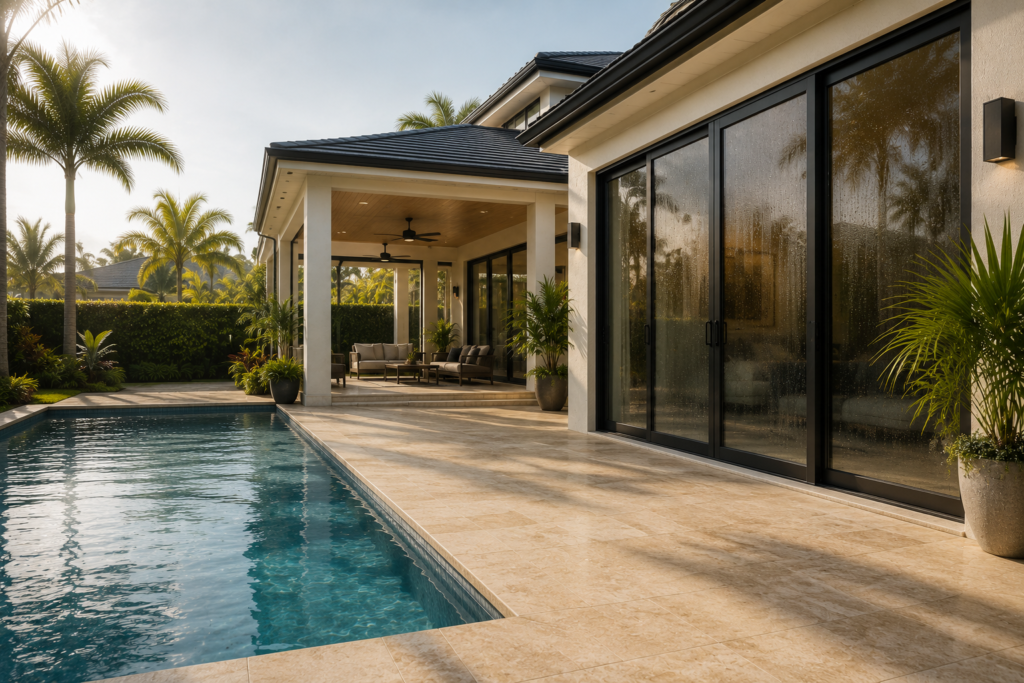
Most homeowners think of humidity as something imposed by climate—summer rain, coastal air, tropical weather, or an air conditioner that cannot keep up. What often gets overlooked is that humidity can also be influenced by the property itself. In some homes, one of the most persistent moisture sources is sitting just outside the back door.
Swimming pools are rarely discussed in conversations about residential humidity, yet they continuously release water vapor into the surrounding air through evaporation. In humid climates especially, that added moisture can influence how quickly outdoor surfaces dry, how much latent load reaches the home, and how comfortable nearby indoor spaces feel. A pool alone rarely causes a humidity problem, but under the right conditions, it can quietly become part of one.
Every Pool Is a Constant Evaporation Source
A swimming pool is not simply a reservoir of stored water. From a moisture-control perspective, it is a large exposed surface continuously exchanging heat and water vapor with the surrounding atmosphere. Every hour of every day, water molecules leave the surface and enter the air through evaporation, whether anyone is swimming or not.
Because evaporation happens invisibly, homeowners often underestimate its significance. Most notice it only indirectly when water levels drop and the pool needs refilling. What is easy to miss is that this “missing” water has not disappeared—it has become airborne moisture. That moisture changes the immediate environment around the home, influencing drying rates, surface temperatures, and the amount of latent moisture the surrounding air can carry.
In practical terms, a pool is constantly contributing to the local moisture load. Depending on the surrounding conditions, that contribution may be negligible—or surprisingly meaningful.
What Actually Controls Pool Evaporation
Pool evaporation is governed by thermodynamics, not guesswork. While many homeowners assume pool size alone determines water loss, evaporation rates are influenced by a much broader combination of environmental conditions.
The most important variables include water temperature, air temperature, dew point, solar exposure, wind speed, and airflow around the pool. These factors interact continuously, which explains why two similar pools can behave very differently despite being located in the same neighborhood.
Water Temperature
Warmer water evaporates more readily because a greater number of surface molecules possess enough energy to transition from liquid to vapor. This is why heated pools, spas, and hot tubs often contribute disproportionately to moisture generation.
Attached spas deserve special attention. Because of their elevated water temperature, they can release significant moisture despite their relatively small size. Many homeowners underestimate how much vapor a hot spa can introduce into a semi-enclosed lanai or patio environment.
Air Temperature
Warm air can hold more water vapor than cool air, which increases evaporation potential. However, air temperature alone does not determine moisture behavior.
The more important question is whether the surrounding air still has capacity to absorb additional moisture. Hot air that is already moisture-saturated behaves very differently from hot air that is relatively dry.
That distinction leads directly to relative humidity and dew point.
Relative Humidity and Dew Point
Relative humidity describes how full the air is relative to its moisture-holding capacity at a given temperature. Dew point, by contrast, reflects the actual moisture content of the air and is often the more useful metric in building science.
High dew points are especially important in humid climates because they indicate persistently moisture-heavy air. When outdoor dew points are already elevated, additional vapor from pool evaporation can push surrounding conditions closer to saturation. Once that happens, drying slows significantly.
That slowdown is critical because moisture-related damage is often less about surfaces becoming wet and more about surfaces staying wet.
Wind and Air Movement
Air movement plays a major role in evaporation dynamics. When air above the pool becomes saturated with moisture, evaporation naturally slows. Wind disrupts that saturated boundary layer by moving humid air away and replacing it with drier air.
This creates an important tradeoff. Strong airflow usually increases evaporation and water loss, but it also disperses moisture more effectively. Low airflow may reduce evaporation somewhat, yet it allows humidity to accumulate around the pool. For nearby structures, stagnant humid air is often more problematic than rapid evaporation.
Pool Conditions That Increase Humidity Risk
Not every pool affects surrounding humidity to the same degree. Certain property characteristics substantially increase the likelihood that a pool will contribute meaningful moisture to the home’s environment.
| Factor | Lower Humidity Impact | Higher Humidity Impact |
| Pool Water Temperature | Unheated or cool water | Heated pool or spa |
| Airflow | Open, breezy yard | Screened or stagnant air |
| Landscaping | Minimal obstructions | Dense tropical vegetation |
| Pool Size | Small plunge pool | Large exposed surface area |
| Door Exposure | Pool far from entrances | Large sliders facing pool |
| Climate | Dry, low dew point | Humid, high dew point |
Why Pools Matter More in Humid Climates
In humid climates, the issue is rarely dramatic evaporation alone. The more important concern is what happens after moisture enters already humid air.
In places like Florida, Louisiana, or the Gulf Coast, outdoor air frequently begins the day with elevated humidity and high dew points. Under those conditions, the atmosphere has limited capacity to absorb additional moisture before approaching saturation.
This matters because saturation changes drying behavior. Outdoor surfaces that would normally dry by late morning may remain damp for hours longer. Patio cushions, screen framing, pavers, thresholds, and metal hardware may repeatedly spend long periods near moisture levels that accelerate mildew growth or corrosion.
That prolonged exposure—not occasional wetness—is often what drives material deterioration over time.
Pools Create Microclimates Around Homes
One of the most overlooked concepts in residential moisture control is the microclimate: the localized environmental condition immediately surrounding a home.
Weather reports provide regional data, but a property’s actual moisture conditions can differ dramatically from official readings. Landscaping, hardscape, shade, walls, airflow restriction, and water features all influence localized humidity.
Pools can significantly alter this microclimate.
A property with dense landscaping, high privacy walls, limited wind exposure, and a covered lanai may effectively trap humid air near the structure. Even when regional humidity is manageable, the air immediately surrounding the home may remain warmer, wetter, and slower to dry.
This helps explain why two nearly identical homes on the same street can behave so differently. One feels comfortable and dries quickly. The other consistently feels heavy, muggy, and damp.
When Pool Humidity Starts Affecting Indoor Air
Outdoor humidity becomes an indoor problem when moisture crosses the building envelope. This happens more easily than many homeowners realize.
Common pathways include leaky sliders, worn weatherstripping, poorly sealed thresholds, window leakage, attic leakage, and pressure imbalances created by HVAC or exhaust systems.
Pool-facing elevations deserve particular attention because they often feature large glass openings between conditioned indoor air and moisture-heavy exterior air. Every door opening introduces latent moisture that the HVAC system must remove.
If moisture intrusion exceeds the home’s dehumidification capacity, indoor humidity begins rising even when temperature remains comfortable.
That is why many homeowners describe a house as feeling cool but clammy. The thermostat may be satisfied, but latent moisture remains elevated.
Oversized Air Conditioners Make Pool-Related Humidity Worse
Oversized HVAC systems are one of the most common contributors to persistent indoor humidity in humid climates.
Many homeowners assume a larger air conditioner improves comfort because it cools faster. In reality, rapid cooling can create a moisture problem.
Air conditioners remove both sensible heat (temperature) and latent heat (moisture). Moisture removal requires runtime. If a system reaches the thermostat setpoint too quickly, the cooling cycle ends before sufficient moisture is removed from indoor air.
This short-cycling effect becomes especially problematic when a nearby pool repeatedly increases latent moisture load. The result is a home that reaches target temperature while humidity remains elevated.
That mismatch often leaves homeowners confused because the thermostat appears normal despite poor comfort.
Why Screened Lanais Frequently Feel Heavier
Screen enclosures change airflow in ways many homeowners underestimate.
Although a screened lanai is not fully enclosed, it is also not fully open. That partial enclosure can substantially alter how air circulates around the pool.
When screens reduce wind speed, humid air generated by evaporation disperses more slowly. Add dense landscaping, overhead roofing, and limited cross-ventilation, and the enclosure can begin trapping warm moisture-rich air near the home.
The result is a lanai that feels noticeably heavier than the surrounding yard.
Many Florida homeowners recognize this sensation instantly. They step into the screened pool area and feel the air become thicker, warmer, and stickier, even if the broader outdoor conditions feel manageable.
That sensation is often the result of microclimate-driven humidity buildup.
Where Homeowners Notice Problems First
Pool-related humidity rarely presents as an obvious failure. More often, it reveals itself through subtle recurring symptoms.
Condensation on Glass
Glass is frequently the first warning sign because it readily reveals temperature and humidity differences. Fogging, moisture beads, or damp window tracks often indicate warm humid air contacting cooler surfaces.
Mildew on Outdoor Fabrics
Outdoor cushions, umbrellas, curtains, and woven furniture often reveal chronic humidity exposure early. Persistent musty odors or mildew spotting usually indicate fabrics are drying too slowly between moisture cycles.
Corrosion of Exterior Hardware
Repeated moisture exposure accelerates oxidation of susceptible metals. Hinges, latches, fasteners, handles, and screen hardware often show early signs of corrosion.
Slower Drying of Surfaces
One of the most overlooked warning signs is simply slow drying. If decking, towels, toys, or concrete remain damp long after expected drying times, a humidity-heavy microclimate may be developing.
Pools Can Increase Humidity in Dry Climates Too
Pools are not only relevant in humid climates.
In dry climates, evaporation can be even more aggressive because dry air readily absorbs moisture from exposed water surfaces. This leads to faster water loss and higher refill demand.
Although the surrounding regional climate may remain dry, the immediate air around the pool can become significantly more humid relative to baseline conditions.
That localized increase can still affect nearby structures, especially around patios, exterior walls, exterior doors, and shaded hardscape.
In other words, humid climates struggle with saturation, while dry climates often experience stronger evaporation-driven moisture loading.
When Pool Humidity Becomes a Serious Contributor
A pool alone rarely causes severe moisture problems. Significant issues usually emerge when multiple contributors overlap.
Pool-related humidity becomes more important when combined with oversized HVAC systems, poor air sealing, elevated dew points, limited airflow, screened enclosures, dense landscaping, heated spas, or drainage problems.
This cumulative effect is how many residential moisture problems develop.
Not from one catastrophic event.
From several moderate contributors quietly interacting over time.
Pools often fit into that pattern.
How Homeowners Can Reduce Pool-Related Humidity
Improve Airflow Around the Pool
Reducing stagnant air helps moisture disperse more effectively. Strategic landscaping adjustments, improved cross-ventilation, and outdoor fans can significantly reduce localized humidity buildup.
Cover Pools and Spas When Possible
Pool covers reduce evaporation and can substantially lower moisture generation, especially for heated pools and spas.
Maintain Door Seals
Weatherstripping, slider tracks, and thresholds should be inspected regularly. Even minor leakage can create repeated moisture intrusion.
Monitor Indoor Humidity
Indoor relative humidity ideally remains around 45–55%. Persistent readings above 60% warrant further investigation, particularly in pool-adjacent homes.
Professional Perspective
Building scientists often emphasize that moisture problems are rarely caused by a single dramatic event. More often, they arise from chronic imbalance between moisture entering a structure and moisture being removed.
That imbalance can develop slowly enough to go unnoticed for years.
Pools can contribute to that imbalance—not dramatically, but continuously.
And that persistence is exactly what makes them easy to overlook.
Frequently Asked Questions
Can a pool make my house feel humid inside?
Yes. Moisture can enter through open doors, air leakage, or HVAC pressure imbalances, particularly in pool-facing rooms.
Does a saltwater pool increase humidity more?
No. Saltwater pools do not inherently evaporate more than traditional chlorine pools. Temperature, airflow, and surface area remain the primary factors.
Does a screened lanai trap humidity?
It can. Screen enclosures may restrict airflow enough for humid air to linger around the pool area.
Can high humidity affect a pool pump?
Yes. High humidity can shorten the lifespan of pool pumps and other outdoor equipment by increasing exposure to moisture, especially around metal components and electrical connections.
The Bottom Line
Most homeowners never consider their pool when trying to solve humidity problems, which is understandable. Pools are associated with comfort and recreation, not moisture control.
From a building-science perspective, however, a pool is a persistent evaporation source located immediately adjacent to the home. In humid climates, that added moisture can compound already challenging conditions. In dry climates, it can create localized humidity where little previously existed.
A pool is rarely the sole cause of a humidity problem, but it can absolutely become one of the overlooked contributors that changes how a home dries, breathes, and performs.
Sometimes the better question is not simply, Why is my house humid?
It may be, What moisture sources around my home have I failed to account for?