
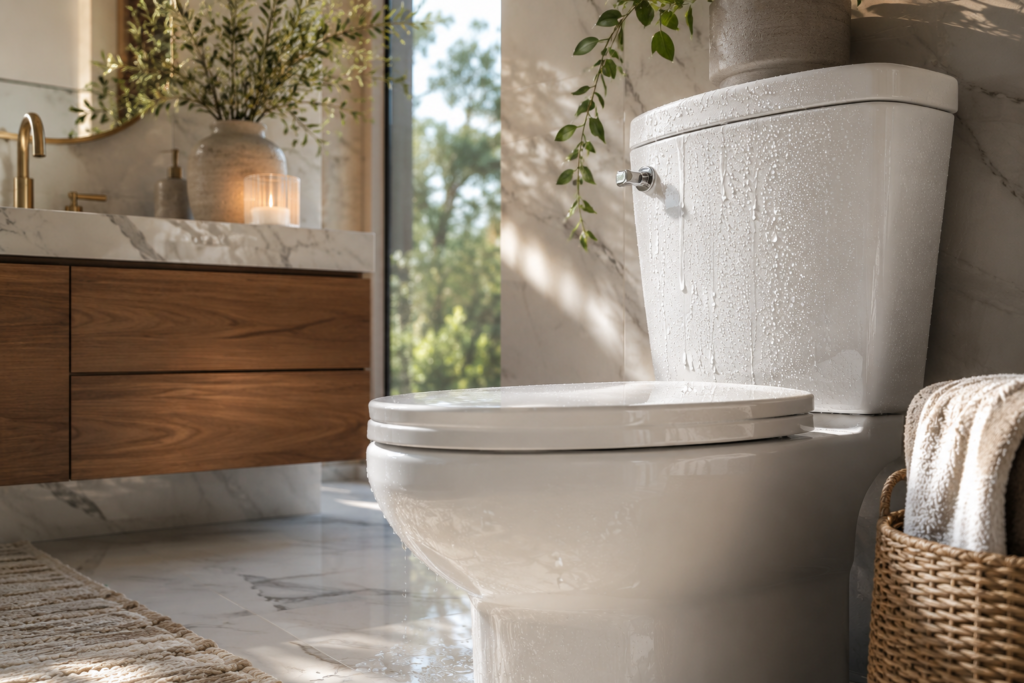
You walk into the bathroom and notice water dripping down the toilet tank, a puddle forming on the floor, or dampness collecting around the base. Naturally, most homeowners assume the worst: a leak, a failed wax ring, or a plumbing problem hiding behind the wall.
In humid climates, though, a “sweaty toilet” often has nothing to do with faulty plumbing. In many cases, your toilet is acting like a cold drink sitting outside on a hot summer day—collecting condensation because warm, moisture-laden air is hitting a cold surface. While the toilet itself may not be broken, persistent toilet sweating often reveals something more important: your indoor humidity may be higher than it should be.
What Does It Mean When a Toilet “Sweats”?
A toilet is considered “sweating” when moisture condenses on the outside of the toilet tank or bowl, causing visible water droplets or dampness.
The tank is especially prone to sweating because it constantly holds fresh incoming water from your supply line. In many homes, that water enters the tank significantly cooler than room temperature.
When warm, humid indoor air touches that cold porcelain surface, water vapor in the air condenses into liquid water.
That condensation can:
- drip onto flooring
- soak bath mats
- damage baseboards
- promote mold or mildew around the toilet
- mimic the appearance of a plumbing leak
This is why homeowners frequently misdiagnose toilet sweating as a leak.
The Real Cause: Humidity + Cold Surfaces
To understand toilet sweating, you need to understand one concept: dew point.
Dew point is the temperature at which air can no longer hold all of its water vapor, forcing moisture to condense into liquid.
If your toilet tank surface drops below your home’s dew point, condensation forms.
Think of it like this:
| Condition | Result |
|---|---|
| Indoor air is warm and humid | Air holds lots of moisture |
| Toilet tank is cold | Surface temperature drops |
| Tank temperature falls below dew point | Condensation forms |
Your toilet does not create moisture—it simply reveals moisture already present in your indoor air.
That distinction matters.
A sweaty toilet is often not a toilet problem.
It is an air moisture problem.
Why Toilets Sweat More in Humid Climates
Toilet sweating becomes far more common in humid climates because indoor air starts with a much higher moisture load.
In places like Florida, summer outdoor air regularly carries enormous amounts of water vapor. Every time humid outdoor air enters your home—through door openings, air leaks, duct leakage, poor ventilation, or negative pressure—your indoor humidity rises.
Even homes with air conditioning can struggle if the system is not removing moisture efficiently.
Common humid-climate contributors include:
1. Oversized Air Conditioning Systems
This is one of the most overlooked causes.
An oversized AC cools the house quickly and shuts off before completing enough runtime to remove meaningful moisture.
The home feels cool.
But the air stays damp.
This is why homeowners often say:
“My thermostat says 72°F, so why does everything feel sticky?”
Temperature and humidity are not the same thing.
A cool house can still be uncomfortably humid.
2. Poor Bathroom Ventilation
Bathrooms generate moisture constantly through:
- showers
- baths
- wet towels
- dripping fixtures
- damp rugs
Without proper exhaust, that moisture lingers.
Even if your toilet was not sweating before, elevated bathroom humidity can push the tank below dew point.
3. Hidden Air Leakage
Many homeowners never realize humid air is entering from:
- attic penetrations
- recessed lighting
- plumbing penetrations
- crawlspaces
- leaky ductwork
- poorly sealed exterior doors
Air leakage quietly raises indoor humidity.
The toilet simply becomes the first visible symptom.
4. Cold Water Supply Temperature
Some municipal water systems or well water arrive much colder than indoor air.
The larger the temperature difference between:
- tank surface temperature
and - room air dew point
…the greater the chance of condensation.
Is It Condensation or a Leak?
This is the question most homeowners actually need answered.
Here is how to tell.
Signs It’s Probably Condensation
- Water droplets appear on outside of tank
- Sweating worsens in summer
- Moisture increases after flushing
- Water appears clear and odorless
- Problem improves when humidity drops
Signs It May Be a Leak
- Tank surface is dry but floor stays wet
- Water appears near supply line connection
- Moisture persists even in cool dry weather
- Toilet refills periodically without flushing
- Water appears around base only
Use this comparison:
| Symptom | Condensation | Leak |
| Tank exterior wet | Yes | Sometimes |
| Worse in humid weather | Yes | Usually no |
| Constant dripping | Sometimes | Often |
| Wet near valve or hose | Rare | Common |
| Floor soaked daily | Possible | Common |
If the tank is bone dry but the floor is wet, investigate plumbing.
What Most Homeowners Don’t Realize
A sweaty toilet can be an early warning sign of broader moisture issues.
Many homeowners fixate on the bathroom and miss the bigger question:
What else in this house is reaching dew point?
If enough moisture exists for your toilet to sweat, other cold surfaces may also be condensing, including:
- AC supply vents
- metal door hardware
- windows
- duct boots
- chilled plumbing lines
- tile floors over cooled slabs
That matters because condensation on hidden surfaces can feed mold growth long before you notice obvious symptoms.
This is why sweating toilets deserve more attention than they usually get.
How to Stop a Toilet From Sweating
There are two ways to solve the problem:
- Raise the toilet surface temperature
- Lower indoor humidity
The second option usually matters more.
Lower Indoor Humidity
For most homes, this is the real solution.
Aim for indoor relative humidity around 45–55%.
If your bathroom or house consistently exceeds 60%, condensation becomes more likely.
Ways to reduce humidity:
- Run bathroom exhaust fans during and after showers
- Seal air leaks
- Improve AC dehumidification performance or get a dehumidifier
- Use a whole-home or portable dehumidifier
- Fix duct leakage
- Reduce outdoor air infiltration
If your home regularly runs above 60% RH, address that first.
Install an Anti-Sweat Toilet Valve
These valves mix a small amount of warm water into the tank supply.
That raises tank temperature enough to reduce condensation.
They can help—but they treat the symptom, not the root cause.
Insulate the Toilet Tank
Some homeowners install foam tank liners.
These reduce contact between cold water and porcelain.
They can work, but may:
- trap moisture
- degrade over time
- complicate maintenance
This is usually a secondary solution.
When You Should Worry
Occasional condensation during extremely humid weather is not unusual.
Persistent sweating is worth investigating if you notice:
- repeated puddles
- warped flooring
- musty odors
- mildew growth
- recurring condensation on multiple surfaces
Those signs suggest a house-wide moisture issue rather than a simple bathroom nuisance.
Frequently Asked Questions
Why does my toilet sweat only in summer?
Summer air carries much more moisture. Higher humidity raises dew point, making condensation far more likely.
Can toilet sweating cause mold?
Yes. Repeated moisture around flooring, trim, grout, or baseboards can support mold and mildew growth.
Should I call a plumber?
Call a plumber if you suspect a leak. If the problem clearly tracks with humidity, HVAC or moisture control may be more relevant.
Is a sweaty toilet bad?
The toilet itself is usually fine, but ongoing condensation can damage surrounding materials if ignored.
The Bottom Line
A sweaty toilet is usually not a plumbing emergency. It is condensation caused by warm humid air hitting cold porcelain.
More importantly, a sweating toilet often reveals something many homeowners miss: your indoor humidity may be too high.
In humid climates, that matters far beyond the bathroom.
If your toilet sweats regularly, treat it as useful feedback from your house. It may be telling you that moisture control—not plumbing repair—is the real issue.