
If your home feels humid, the attic probably is not the first place you think to look.
After all, attics are supposed to be different from the rest of the house. A traditional vented attic is outside the conditioned living space, so it can become extremely hot in summer, cold in winter, and much more affected by outdoor weather than the rooms below it.
But that does not necessarily mean your attic and your home are completely separate environments.
Air can move between an attic and the living space through gaps in the ceiling, attic access doors, recessed lights, plumbing and electrical penetrations, ductwork, and other openings. In homes with HVAC equipment or ducts running through the attic, the connection can be even stronger.
So, can a humid attic make your house humid?
It can contribute to indoor humidity under certain conditions, particularly when humid attic air is being pulled into the home through duct leaks or other air pathways. However, the relationship can also work in the opposite direction: moisture from inside the home can travel into the attic.
Understanding which is happening in your house starts with understanding how your attic is built.
This article contains affiliate links. If you make a purchase through one of these links, The Humid House may earn a small commission at no additional cost to you.
Not All Attics Work the Same Way
Before comparing attic humidity to indoor humidity, determine whether you have a vented attic or an unvented attic.
Vented attics
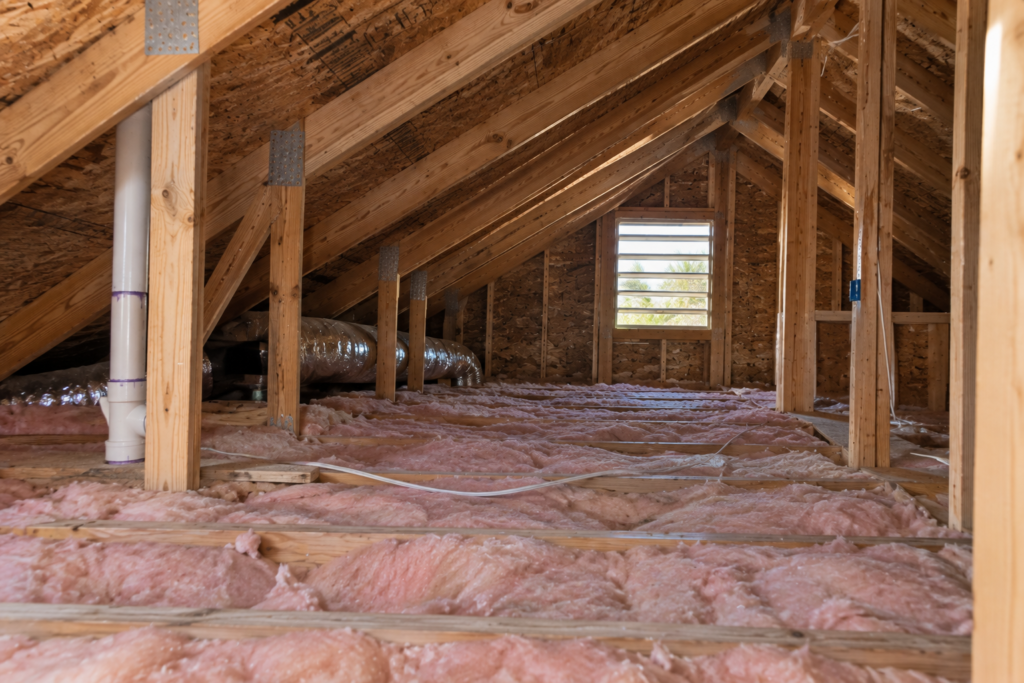
In a traditional vented attic, insulation is usually installed along the attic floor, directly above the ceiling of the rooms below.
The attic itself is therefore outside the home’s conditioned envelope.
Soffit, ridge, gable, or other roof vents allow outdoor air to move through the attic. This means attic temperature and humidity can vary considerably with outdoor conditions.
If it is hot and humid outside, a vented attic can also contain a considerable amount of moisture.
That alone does not mean something is wrong.
Unvented or conditioned attics
Some homes instead have insulation and an air barrier installed along the underside of the roof deck rather than on the attic floor.
These attics may be sealed from outdoor ventilation and brought partly or fully inside the home’s conditioned enclosure.
Humidity inside this type of attic should behave differently from humidity in a conventional vented attic.
That distinction matters.
A humidity reading that might be unsurprising in an outdoor-connected attic could be much more significant in an attic designed to function as part of the conditioned building envelope.
Why Attic Humidity Can Be Misleading
Suppose you place a hygrometer in your attic and see 70% relative humidity.
That number sounds alarming if you normally try to keep your home around 40% to 60% humidity.
But attic humidity cannot always be interpreted the same way as indoor humidity.
Relative humidity measures how close the air is to saturation at its current temperature. Warm air can hold considerably more water vapor than cool air.
That means attic relative humidity can change dramatically throughout the day even without a similarly dramatic change in the actual amount of water vapor in the air.
A hot attic may show a relatively modest RH during the afternoon. As the attic cools overnight, the relative humidity can climb.
This is one reason a single attic humidity reading rarely tells the whole story.
When evaluating attic moisture, it is useful to consider:
- relative humidity,
- temperature,
- dew point,
- how long elevated moisture persists,
- whether condensation is forming,
- and whether the attic is vented or conditioned.
The more important question for indoor comfort is not simply “Is my attic humid?”
It is:
Is humid attic air getting into my house?
Attic Humidity: What Different Signs Can Mean
| What You Notice | What It May Suggest | Why It Matters |
| High attic RH during humid outdoor weather | Normal outdoor influence in a vented attic | A high reading alone does not prove the attic is causing indoor humidity |
| Upstairs humidity higher than downstairs | Air leakage, duct issues, airflow differences, or added heat load | The attic may be contributing, especially if ducts or ceiling leaks are present |
| Condensation on attic ducts | Humid attic air contacting a cold duct surface | Can indicate damaged insulation, high dew point, or duct-surface temperatures below the dew point |
| Gaps around attic stairs or access panels | Air movement between attic and living space | Can allow attic air to enter the home or indoor air to escape upward |
| Leaky return ducts in the attic | Attic air being pulled into the HVAC system | Can add heat and moisture directly to the air being conditioned |
| Leaky supply ducts | Conditioned air escaping into the attic | May depressurize the home and increase humid outdoor-air infiltration elsewhere |
| Moisture problems mainly during cold weather | Indoor air leaking upward and condensing on cold attic surfaces | The house may be contributing moisture to the attic rather than the reverse |
| Visible wetness, staining, or mold-like growth | A persistent moisture problem | Requires further investigation beyond simply measuring attic humidity |
How Humid Attic Air Can Get Into Your Home
The ceiling separating your home from the attic may look solid from below, but it often contains dozens of small openings.
Common air pathways include:
- attic access panels and pull-down stairs,
- recessed lighting,
- electrical wiring penetrations,
- plumbing penetrations,
- gaps around framing,
- ceiling fixtures,
- duct boots,
- dropped ceilings and soffits,
- chases,
- and poorly sealed wall cavities.
Individually, some of these gaps may be small.
Together, they can create a surprisingly large connection between the attic and the rooms below.
This is why air sealing and insulation are related but not identical jobs.
Insulation slows heat transfer. An air barrier limits the movement of air.
A heavily insulated attic floor can therefore still allow significant air movement if gaps and penetrations were never properly sealed.
Attic Ductwork Can Be an Even Bigger Connection
If your HVAC ducts run through the attic, pay particular attention to them.
Ductwork located inside a vented attic operates in one of the most extreme environments in the house. During summer, the attic may be intensely hot and humid while the ducts carry cool, conditioned air.
That creates both an energy challenge and a moisture challenge.
Leaky return ducts
Return ducts pull air back toward the HVAC system.
If a return duct leaks in a humid attic, it can pull attic air directly into the HVAC system.
That warm, moisture-laden air is then mixed with indoor return air and sent through the cooling system.
In a hot-humid climate, this can increase the amount of moisture the air conditioner has to remove and contribute to elevated indoor humidity.
Leaky supply ducts
Supply ducts create a different problem.
If conditioned air leaks out of supply ducts into the attic, the house can become depressurized.
When air leaves the home, replacement air has to come from somewhere.
In humid climates, some of that replacement air may be warm, moisture-laden outdoor air entering through leaks in the building envelope.
So even though a supply leak is blowing conditioned air out of the duct rather than sucking attic air in, it can indirectly contribute to a more humid house.
This is one reason duct leakage can create comfort problems that are not obvious from simply looking at the thermostat.
Your air conditioner may still maintain the desired temperature while struggling with the home’s moisture load.
Why This Matters More in Hot-Humid Climates
Attic behavior is highly climate-dependent.
In a hot-humid climate, a vented attic is continually exposed to outdoor moisture through its ventilation openings.
That is exactly what those vents are designed to do: connect the attic to outdoor air.
But outdoor ventilation does not magically mean dry ventilation.
When the outdoor dew point is high, the air entering the attic carries substantial moisture with it.
This becomes particularly important when cold surfaces are located inside the attic.
Air-conditioning ducts are the obvious example.
If the surface temperature of a duct falls below the dew point of the surrounding attic air, water vapor can condense on the duct surface.
It is the same basic process that causes water to form on the outside of a cold glass.
This is why you may occasionally hear about attic ducts “sweating” in humid climates.
The underlying issue is not simply that the attic is hot. It is the combination of humid air + a sufficiently cold surface.
Proper duct insulation and an intact exterior vapor barrier help keep the outer duct surface from becoming cold enough for condensation to form.
Can Attic Humidity Make the Upstairs More Humid Than Downstairs?
It can be one contributor, but it should not automatically be blamed.
Upper floors already tend to experience different conditions from lower floors.
They are directly beneath the roof and attic, receive more heat from the building above them, and may have different HVAC airflow and return-air characteristics.
If the boundary between the attic and second floor also has substantial air leakage, attic conditions can become another piece of the puzzle.
For example, an upstairs with:
- poorly sealed ceiling penetrations,
- an unsealed attic hatch,
- attic duct leaks,
- inadequate return airflow,
- insulation problems,
- and high outdoor humidity
may experience a much stronger attic influence than an upstairs with a well-sealed ceiling plane and ducts located inside conditioned space.
So if the second floor consistently runs more humid than the first, the attic is worth investigating—but it should be evaluated alongside HVAC performance, airflow, air leakage, and other moisture sources.
The Relationship Can Work in the Opposite Direction
There is another important possibility:
Sometimes the attic is not making the house humid. The house is making the attic humid.
Air movement through buildings changes with temperature, pressure, wind, and HVAC operation.
During colder weather, warm indoor air naturally tends to rise. If the ceiling plane is leaky, warm indoor air carrying moisture from cooking, bathing, breathing, and other household activities can escape into the attic.
If that moisture reaches a sufficiently cold roof surface, condensation can occur.
This is a common reason attic moisture problems in colder climates are closely connected to ceiling air sealing.
Bathroom exhaust fans can create an even more direct moisture source if they terminate inside the attic rather than outdoors.
A bathroom fan may remove humid shower air from the bathroom—but if it simply dumps that air into the attic, the moisture has not actually left the house.
Kitchen, bathroom, and dryer exhaust should terminate outdoors rather than releasing moisture into an attic.
This is why determining the direction of moisture movement matters.
A humid attic does not automatically prove that attic air is causing high indoor humidity.
Does More Attic Ventilation Fix Humidity?
Not necessarily.
Attic ventilation is one of those topics where climate matters enormously.
In many traditional cold-climate roof assemblies, attic ventilation helps remove moisture and maintain appropriate roof conditions.
But in hot-humid climates, outdoor air itself may contain a large amount of moisture.
Increasing the amount of hot, humid outdoor air entering an attic is therefore not automatically a moisture solution.
Modern building science recognizes multiple successful attic designs, including properly constructed vented and unvented assemblies.
What generally does not work well is changing one part of the roof or attic system without understanding how the entire assembly was designed.
For that reason, homeowners should be cautious about automatically adding attic vents, blocking existing vents, installing spray foam, or converting a vented attic into a sealed attic as a DIY humidity fix.
The roof, insulation, air barrier, ventilation strategy, HVAC equipment, ducts, and climate all interact.
Does Attic Insulation Keep Humidity Out of the House?
Insulation helps, but insulation alone is not the entire moisture-control system.
This distinction is important enough to repeat:
Insulation primarily slows heat transfer. Air sealing controls air movement.
Because moving air can carry water vapor with it, controlling air leakage at the attic boundary is important for both comfort and moisture management.
For example, adding more blown insulation over an attic floor may improve thermal performance.
But if there is a large unsealed opening around an attic access panel, plumbing chase, recessed light, or duct boot underneath that insulation, air may still move between the house and attic.
A good attic boundary therefore needs both appropriate insulation and effective air sealing.
Signs the Attic May Be Contributing to Your Indoor Humidity
High indoor humidity has many possible causes, so attic conditions should be considered as part of a larger investigation rather than assumed to be the culprit.
The attic deserves closer attention if you notice several of the following together:
- the upstairs consistently has higher humidity than downstairs,
- HVAC ducts or the air handler are located in the attic,
- ductwork appears damaged, poorly sealed, or poorly insulated,
- the attic access door has obvious gaps,
- recessed lights or ceiling penetrations are not air sealed,
- indoor humidity rises noticeably during hot, humid weather,
- the HVAC system runs frequently but struggles to control humidity,
- you see condensation on attic ductwork,
- certain upstairs rooms are difficult to cool,
- or previous work has disturbed attic insulation or air sealing.
None of these proves the attic is the cause.
They simply make the attic-house connection worth investigating.
How to Tell Whether Your Attic Is Affecting Indoor Humidity
Start by looking for patterns rather than relying on one humidity measurement.
Compare indoor humidity by floor
Place reliable hygrometers on both levels of the home.
Place reliable hygrometers like the TempPro TP50 on both levels of the home, and keep them away from bathrooms, kitchens, supply vents, exterior doors, and direct sunlight.
If the upstairs repeatedly runs several percentage points higher than downstairs, particularly during humid weather, begin looking for differences in airflow, ductwork, insulation, and attic air sealing.
Monitor the attic separately
A sensor in the attic can provide useful context, but do not directly compare the attic RH percentage to the RH inside your living room without also considering temperature.
If possible, monitor temperature, relative humidity, and dew point.
Dew point can be particularly useful because it reflects the actual moisture level in the air more directly than relative humidity alone.
If the attic and outdoor dew points closely track one another in a vented attic, that may simply reflect the attic’s connection to outdoor air.
If indoor moisture rises at the same time and you have known air or duct leakage between those spaces, the relationship becomes more meaningful.
Inspect the attic access
An attic hatch or pull-down staircase is essentially a large hole in the ceiling.
It should be insulated and weatherstripped or otherwise air sealed appropriately.
If you can see obvious gaps around it, that is one of the simplest attic-to-house air pathways to identify.
Have the duct system evaluated
Duct leakage is difficult to diagnose accurately by sight alone.
If attic ducts are suspected of contributing to humidity or comfort problems, an HVAC professional or home-performance contractor can test the duct system for leakage and evaluate pressure imbalances.
This can be far more informative than simply adding a dehumidifier and treating the symptom.
Look at the entire building envelope
The attic is only one possible source of humid air.
Outdoor air can also enter through:
- doors and windows,
- wall penetrations,
- plumbing and electrical openings,
- poorly sealed exterior walls,
- crawl spaces,
- attached garages,
- and other gaps in the building envelope.
Humidity problems usually make more sense when the house is viewed as one interconnected system.
Should You Put a Dehumidifier in the Attic?
Usually, this is not the first question to ask.
In a conventional vented attic, attempting to dehumidify the entire attic can mean trying to dehumidify a space intentionally connected to outdoors.
That is generally very different from placing a dehumidifier inside the conditioned part of the house.
A properly designed sealed or conditioned attic is another situation entirely and may have specific humidity-control requirements depending on its construction.
If attic humidity is causing condensation or contributing to indoor moisture, identify why before adding equipment.
The underlying problem could be:
- duct leakage,
- inadequate duct insulation,
- ceiling air leakage,
- improperly vented exhaust,
- HVAC pressure problems,
- an incorrectly built attic assembly,
- or excessive indoor humidity migrating upward.
A dehumidifier cannot correct all of those problems.
What About Visible Moisture or Condensation in the Attic?
A humid attic and a wet attic are not the same thing.
Visible condensation, wet roof decking, damp insulation, staining, dripping ducts, mold-like growth, or deteriorating wood deserve further investigation.
At that point, the goal is no longer simply understanding why the attic has a high humidity reading.
There is a moisture problem somewhere in the system that needs to be identified.
Possible sources include condensation, HVAC equipment, improperly terminated exhaust, plumbing problems, or water intrusion through the roof.
That is where the topic begins to move beyond indoor humidity control and into attic or roofing diagnostics.
How to Reduce the Attic’s Influence on Indoor Humidity
There is no single attic humidity fix that works for every house.
The solution depends on how the attic was designed and how moisture is moving.
However, several principles apply broadly.
Seal air pathways between the attic and living space
Air sealing can reduce uncontrolled movement between the home and attic.
Common targets include attic access openings, plumbing and electrical penetrations, ceiling penetrations, chases, and other gaps.
Some attic penetrations—especially those involving combustion equipment, flues, or certain recessed lights—require fire-safe materials and proper clearances, so this is not always a DIY caulk-every-hole project.
Seal leaking ducts
If ducts run through an unconditioned attic, keeping the duct system tight is especially important.
Leaky return ducts can pull humid attic air into the HVAC system, while supply leakage can alter building pressure and increase infiltration elsewhere.
Make sure duct insulation is intact
Insulation helps keep the exterior surface of cold supply ducts warmer.
Damaged insulation or a compromised vapor jacket can increase the likelihood of condensation in a humid attic.
Exhaust indoor moisture outdoors
Bathroom fans, kitchen exhaust where appropriate, and clothes dryers should discharge outside—not into the attic.
Reducing unnecessary indoor moisture also reduces the amount available to migrate through the building.
Maintain appropriate indoor humidity
Even when the attic contributes to the problem, indoor moisture control still matters.
Air-conditioning systems remove both heat and moisture, but they must run long enough and operate correctly to provide adequate dehumidification.
An oversized air conditioner, HVAC problems, excessive outdoor-air infiltration, or large indoor moisture loads can all leave a home humid even when the thermostat says the temperature is comfortable.
Do not modify attic ventilation blindly
More ventilation is not automatically better, and sealing a vented attic is not a simple weekend humidity project.
Any major change to the attic’s ventilation, insulation, or roof assembly should consider local climate, current construction, building codes, combustion safety, and HVAC design.
So, Can Your Attic Be Part of a Humid-House Problem?
Yes—but not simply because the attic itself has high humidity.
A vented attic is intentionally exposed to outdoor conditions, so its temperature and humidity can vary much more than the conditioned rooms below it.
The important issue is how well the attic is separated from the living space.
If humid attic air is entering through leaky return ducts, gaps in the ceiling plane, an unsealed attic access, or other pathways, the attic can add to the home’s moisture load.
Supply duct leakage can also change pressure inside the house and encourage humid outdoor air to enter elsewhere.
On the other hand, moisture can travel in the opposite direction. Warm, humid indoor air can leak upward into an attic, particularly during colder weather, and create condensation problems there.
That is why attic humidity should rarely be evaluated in isolation.
Think of the attic as one part of your home’s larger moisture-control system.
The roof controls exposure from above. Insulation limits heat transfer. Air sealing limits uncontrolled air movement. The HVAC system controls temperature and removes moisture. And the building envelope determines how easily outdoor and attic air can reach the rooms where you live.
When those pieces work together, a hot or humid attic can remain exactly what it was designed to be—an attic—without turning the rest of the house into a humid one.
The Bottom Line
A humid attic does not automatically mean you have a humidity problem inside your home.
In a traditional vented attic, temperature and relative humidity can swing significantly because the attic is intentionally connected to outdoor conditions. What matters more is whether attic air and the conditioned living space are properly separated.
If humid attic air is entering through leaky ducts, an unsealed attic access, ceiling penetrations, or other gaps, the attic can contribute to elevated indoor humidity. Duct leakage can also change pressure inside the home and draw additional humid outdoor air through the building envelope.
But moisture movement can go the other way, too. Indoor humidity can travel upward into the attic and create problems when that moisture reaches cold surfaces.
The goal is not necessarily to make the attic match the humidity level inside your home. It is to make sure the attic, roof, insulation, ductwork, air barrier, and HVAC system are working together the way they were designed to.
If your house is consistently humid—especially if the upstairs is worse—your attic may be one piece of the problem worth investigating. Just make sure you are looking at the connection between the attic and the house, not the attic humidity reading by itself.