
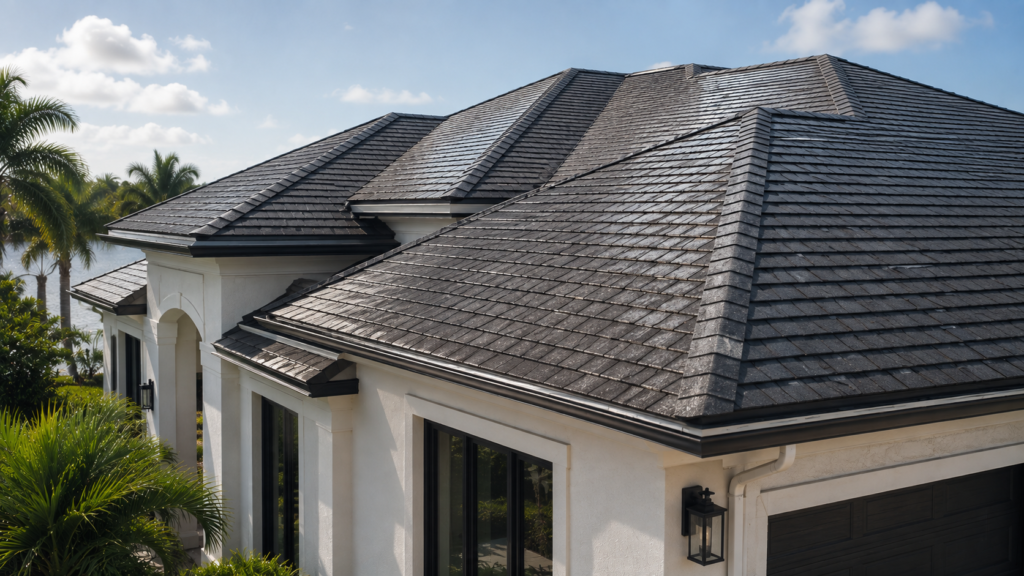
A roof may be marketed as lasting 20, 30, 40, or even 50 years, but its actual lifespan depends on far more than the number printed on a product brochure. Installation quality, roofing material, sunlight, temperature, wind, precipitation, attic conditions, maintenance, and the roof’s ability to dry all influence how well it ages.
Humidity belongs on that list—but its role is often misunderstood.
High humidity does not normally destroy an intact roof simply because the surrounding air feels damp. Roofing materials are designed to be exposed to outdoor weather. The greater concern is what happens when moisture repeatedly enters, condenses within, or becomes trapped inside the roof assembly.
Over time, persistent moisture can contribute to deteriorated roof decking, corrosion, mold growth, weakened fasteners, damaged insulation, and premature failure of certain roofing components. Heat, ultraviolet exposure, storms, poor installation, and inadequate drainage may still be the more visible causes of roof wear, but humidity can create the damp conditions that make other problems more damaging and more difficult for the roof to recover from.
The important question is therefore not only, “Is the climate humid?”
It is:
Is moisture reaching parts of the roof that are supposed to remain dry, and can those materials dry before damage develops?
The Short Answer: Can Humidity Shorten a Roof’s Life?
Yes, high humidity can contribute to a shorter roof lifespan, particularly when it leads to condensation, prolonged dampness, biological growth, corrosion, or moisture accumulation inside the roof assembly.
However, humidity is rarely the only reason a roof fails early.
A properly designed, correctly installed roof should be able to manage normal outdoor humidity. Problems are more likely when humid air combines with one or more vulnerabilities, such as:
● Air leakage from the living space into the attic
● Inadequate or obstructed attic ventilation
● Poorly designed unvented roof assemblies
● Roof leaks or failed flashing
● Wet insulation or underlayment
● Bathroom or dryer exhaust terminating in the attic
● Condensation on cold roof decking or metal components
● Minimal drying potential
● Persistent algae, moss, or organic debris
● Installation defects
● Repeated heat and moisture cycling
In other words, humidity often acts as a stress multiplier. It may not initiate the original defect, but it can increase how long materials remain damp and how quickly some forms of deterioration progress.
How Humidity Actually Reaches a Roof
Homeowners often think of roof moisture as rainwater coming through damaged shingles. That certainly happens, but a roof can also encounter moisture from inside the house, from outdoor air, and from materials that were enclosed before they had fully dried.
Water can move through a roof system in several forms:
1. Bulk water, such as rain entering through damaged roofing, flashing, or penetrations
2. Water vapor carried by moving air, particularly humid household air leaking into an attic
3. Vapor diffusion, in which water vapor moves through materials
4. Condensation, which occurs when humid air reaches a surface cold enough to fall below the air’s dew point
5. Stored construction moisture, such as moisture in framing or roof sheathing enclosed during construction
6. Moist outdoor air, which may enter a vented attic or roof cavity
These moisture sources do not affect every roof equally. Climate, season, roof color, insulation location, air-conditioning use, indoor humidity, roof design, and ventilation strategy all influence where condensation is likely to occur.
The U.S. Environmental Protection Agency explains that warm, humid air can form condensation when it contacts a colder surface. In a roof assembly, that colder surface may be the underside of the roof deck during winter, a chilled duct in a hot attic, metal fasteners, or another material whose temperature has dropped below the dew point. (US EPA)
How Humidity Can Affect Different Parts of a Roof
A roof is not one single material. It is a layered system that may include shingles or panels, underlayment, flashing, fasteners, roof decking, structural framing, insulation, air barriers, vapor-control materials, vents, sealants, and adhesives.
Humidity affects those components differently.
| Roof component | Potential moisture-related effect | What may make the problem worse |
| Roof decking or sheathing | Swelling, staining, loss of strength, fungal growth, delamination or decay | Repeated condensation, roof leaks, limited drying and high indoor humidity |
| Rafters and trusses | Mold growth, staining and eventual wood deterioration if repeatedly wet | Long-term roof leaks or chronic condensation |
| Asphalt shingles | Indirect stress from a wet or deteriorating substrate; possible problems associated with trapped moisture and excessive heat | Poor installation, extreme heat, aging, damaged ventilation or wet decking |
| Metal roofing and flashing | Corrosion of susceptible metals, coatings, cut edges, fasteners or dissimilar-metal connections | Salt exposure, standing moisture, damaged coatings and poor drainage |
| Fasteners | Rust, loss of coating or eventual reduction in holding performance | Condensation, wet insulation, incompatible metals and persistent dampness |
| Underlayment | Loss of performance, wrinkling, deterioration or trapped moisture, depending on the product | Installation over damp decking, leaks and inadequate drying |
| Insulation | Reduced thermal performance when wet, compressed material, mold contamination and slower drying | Roof leaks, condensation, humid air leakage and blocked ventilation |
| Sealants and adhesives | Reduced adhesion, curing problems or separation in some products | Damp installation surfaces, improper application conditions and trapped vapor |
| Attic surfaces | Mold, musty odors, rusted nail tips and damp sheathing | Air leakage, indoor moisture sources and inappropriate ventilation |
Not every stain, rusty nail, patch of algae, or curled shingle means humidity is responsible. The value of understanding this table is recognizing that roof longevity depends on the condition of the whole assembly, including components a homeowner cannot see from the ground.
Roof Decking Is Often Where Hidden Moisture Matters Most
Roof decking—typically plywood or oriented strand board, commonly called OSB—creates the structural surface beneath many residential roofing materials. Shingles may still look serviceable from outside while the decking underneath has been repeatedly exposed to moisture.
Wood does not need to be visibly dripping for moisture to matter. The risk increases when its moisture content remains elevated for extended periods or repeatedly rises without sufficient drying.
Possible consequences include:
- Swelling or distortion
- Soft or weakened areas
- Delamination of plywood
- Deterioration around fasteners
- Mold or fungal growth
- Reduced fastener-holding strength
- Uneven support beneath the roof covering
- Premature need for deck replacement during reroofing
The EPA notes that long-term moisture exposure can eventually damage building materials, including wood. Mold itself is usually evidence of a moisture problem rather than the original source, so cleaning visible growth without correcting the moisture pathway does not protect the roof from recurrence. (US EPA)
This distinction matters when homeowners compare roof replacement estimates. One contractor may quote only the visible roofing work, while another anticipates replacing deteriorated decking after the old roof is removed. The second estimate may appear unnecessarily expensive until the concealed wood is exposed.
How Indoor Humidity Can Reach the Attic
A roof can experience moisture from the house below it, even when there is no plumbing leak and no hole in the roof.
Everyday activities release water vapor indoors. Cooking, bathing, washing dishes, drying clothes, breathing, using unvented combustion appliances, and bringing outdoor air into the home all influence indoor moisture levels.
That humid air can move into an attic through openings such as:
- Attic access hatches
- Gaps around plumbing pipes
- Electrical penetrations
- Recessed lights
- Ceiling fixtures
- Wall top plates
- Chases and dropped ceilings
- Gaps around ducts
- Poorly sealed bathroom exhaust penetrations
Air movement can transport considerably more moisture into a building cavity than vapor diffusion alone. Once humid air reaches a colder roof deck, it may condense.
This is especially relevant in colder weather. Warm indoor air can leak upward and encounter cold roof sheathing. During warm, humid weather, condensation may instead develop on air-conditioning equipment, supply ducts, metal penetrations, or other surfaces cooled below the attic air’s dew point.
Building Science Corporation summarizes the basic cold-climate strategy this way:
“Air seal the attic and vent the attic. Make sure that moisture laden air does not get into the attic from inside the house.”
That guidance is valuable because attic ventilation is frequently treated as the complete solution. Ventilation may help remove moisture in an appropriately designed vented attic, but it is not a substitute for controlling the air leaks that continually deliver household moisture into the space. Building Science Corporation specifically emphasizes that air sealing takes precedence over simply adding ventilation. (Building Science)
Why More Attic Ventilation Is Not Always the Answer
When attic moisture appears, homeowners are often told that the roof “needs to breathe.” That phrase is common, but it can oversimplify a complex system.
Some roofs are designed with vented attics. Others are intentionally built as unvented or conditioned roof assemblies. Both approaches can work when the insulation, air control, vapor control, drainage, and drying strategy are appropriate for the climate and construction.
Adding vents without understanding the existing design can fail to solve the problem and, under some conditions, introduce more humid outdoor air.
In a traditional vented attic, soffit and ridge or roof vents can help remove heat and moisture. Air should be able to enter at lower vents, move through an unobstructed channel, and exit higher in the roof. Insulation should not block the soffit intake. Baffles are commonly used to preserve this air pathway near the eaves. (Building Science Education)
However, several conditions can limit the benefit of ventilation:
- The ceiling plane has extensive air leaks.
- Bathroom fans discharge into the attic.
- Soffit vents are blocked by insulation.
- Exhaust openings are unbalanced or poorly positioned.
- Outdoor air is already extremely humid.
- Duct leakage creates pressure differences.
- An unvented roof has been altered as though it were vented.
- The roof lacks an appropriate interior or exterior vapor-control strategy.
- Insulation has been installed incorrectly against the roof deck.
Research on unvented attics has repeatedly focused on moisture accumulating at roof sheathing, particularly where humid air finds leakage paths or the assembly does not have adequate vapor control and drying capacity. (Energy Efficiency and Renewable Energy)
The correct solution therefore depends on the roof’s design—not on a universal instruction to install more vents.
Does Outdoor Humidity Damage Shingles Directly?
Outdoor humidity alone is not usually the leading cause of asphalt shingle failure. Shingles are manufactured for exterior exposure, and a humid day does not automatically harm them.
Their aging is more directly influenced by factors such as:
- Ultraviolet radiation
- High roof-surface temperatures
- Thermal expansion and contraction
- Wind
- Hail
- Foot traffic
- Manufacturing characteristics
- Roof slope
- Installation quality
- Ventilation and insulation conditions
- Mechanical damage
- Organic growth
- Water entering beneath the roofing
Humidity becomes more relevant when it prevents materials from drying, supports algae or moss growth, contributes to condensation beneath the roof, or combines with high temperatures and trapped moisture.
It is therefore more accurate to say that humid conditions can affect the environment in which the shingles and roof assembly age, rather than claiming humidity simply attacks shingles from the outside.
This nuance protects homeowners from replacing an entire roof based on an incomplete explanation. If shingles are curling, blistering, losing granules, or cracking, the cause should be evaluated rather than automatically attributed to attic humidity.
Heat and Humidity Create Different Types of Stress
Heat and humidity are often mentioned together, but they do not affect a roof in the same way.
Heat raises roof-surface temperatures and accelerates thermal movement. Dark roofing materials exposed to direct summer sun can become far hotter than the outdoor air. Humidity describes the amount of water vapor in the air and influences dew point, condensation, drying, and biological growth.
A hot roof surface may dry quickly on a sunny day, while a shaded component or concealed layer remains damp. A roof can therefore experience intense heat on the exterior and persistent moisture within the assembly at the same time.
The combination becomes particularly important when:
- Wet materials are exposed to repeated heating.
- Solar heat drives stored moisture inward.
- Cool indoor surfaces sit beneath hot, humid outdoor conditions.
- Air conditioning creates cold ducts or surfaces in a humid attic.
- The roof dries in only one direction.
- Vapor-impermeable materials trap moisture between layers.
Roof performance is not determined by temperature or relative humidity alone. Building scientists often evaluate heat and moisture together because changing a material’s temperature changes its condensation and drying behavior.
Humidity, Algae and Moss on Roofing
Dark streaks on asphalt shingles are often associated with algae rather than roof rot. Algae growth is more common where roofs remain damp, shaded, or slow to dry. It may be most noticeable on north-facing slopes, beneath tree cover, or in climates with frequent moisture.
Moss presents a different concern. Dense moss can retain water against the roofing surface, lift shingle edges, collect debris, and interfere with normal drainage. Aggressive scraping or pressure washing can also damage roofing materials, so treatment should follow the roof manufacturer’s instructions.
Humidity can make the environment more favorable for organic growth, but it is not the only factor. Shade, roof orientation, nearby trees, temperature, rainfall, debris accumulation, surface chemistry, and roofing material all matter.
A stained roof is therefore not automatic proof that the roof has structurally failed. However, widespread growth or recurring dampness deserves attention because it can reveal that a section of the roof is not drying effectively.
Humidity and Metal Roof Corrosion
Metal roofs can perform well in humid regions, but “metal” includes many different materials, coatings, finishes, fasteners, and connection details.
Corrosion risk depends on:
- The type of metal
- Protective coatings
- Installation quality
- Cut or scratched surfaces
- Water drainage
- Contact between dissimilar metals
- Fastener compatibility
- Salt and chemical exposure
- Condensation beneath panels
- Trapped debris
- Persistent standing water
Humidity provides the moisture necessary for many corrosion reactions, but clean humid air is different from salty coastal air or moisture contaminated by pollutants. Salt can significantly increase the corrosiveness of moisture, making material selection and maintenance particularly important near coastlines.
Condensation beneath metal panels can also wet decking, insulation, or fasteners even when the exterior panels are not leaking. Appropriate underlayment, condensation control, ventilation or sealed-assembly design, insulation, and air sealing should be considered as part of the roof system.
Surface rust on an exposed fastener is not necessarily equivalent to structural failure. Widespread corrosion, loose fasteners, rust around panel seams, deteriorated flashing, perforation, or moisture entering beneath the roof warrants professional evaluation.
Can Humidity Damage Tile Roofing?
Clay and concrete roof tiles are not affected in exactly the same way as asphalt shingles. The tiles themselves may remain serviceable for a long time, while other parts of the roof system age sooner.
Potentially vulnerable components include:
- Underlayment
- Flashing
- Fasteners
- Battens
- Sealants
- Roof decking
- Mortar or adhesive attachment points
- Penetration details
This is why the visible tile should not be treated as the entire roof. A tile may appear intact while the water-shedding layer beneath it has deteriorated or moisture has reached the deck through damaged flashing or underlayment.
Humidity can slow drying and support organic growth, but premature tile-roof problems are often more closely connected to installation, underlayment age, broken or displaced tiles, drainage details, and flashing failures.
What About Wood Shakes and Shingles?
Wood roofing is particularly dependent on drying. Repeated wetting is not automatically destructive if the material can dry effectively, but prolonged dampness can support fungal decay, warping, splitting, moss, and fastener deterioration.
Roof pitch, exposure to sunlight, surrounding vegetation, air circulation, climate, wood species, installation spacing, treatment, and maintenance all affect performance.
A wood roof in a humid region is not destined to fail quickly. It does, however, require a design and maintenance approach that respects wood’s sensitivity to sustained moisture.
Why a Roof May Fail Before Its Advertised Lifespan
A product’s advertised lifespan is not a promise that every installed roof will remain problem-free for that exact number of years.
Actual service life may be shortened by:
- Installation errors
- Inadequate flashing
- Storm or hail damage
- Persistent roof leaks
- Poor drainage
- Ponding water on low-slope roofs
- Damaged or missing underlayment
- Improper nailing
- Incompatible materials
- Inadequate maintenance
- Tree debris and shade
- Excessive heat or ultraviolet exposure
- Moisture trapped during construction
- Chronic attic condensation
- Wet insulation
- Corrosion
- Alterations made after installation
- Poorly planned insulation or ventilation retrofits
Humidity should be viewed as one factor within this larger durability picture.
When a roof fails early, a useful inspection should look beyond the shingles. The contractor may need to evaluate the attic, decking, flashing, penetrations, ventilation pathways, interior moisture sources, insulation placement, and evidence of air leakage.
Simply installing new roofing over an unresolved moisture problem may conceal the symptoms temporarily without correcting the conditions that damaged the first roof.
Signs Moisture May Be Affecting the Roof Assembly
Homeowners cannot diagnose every roof problem themselves, but certain observations justify a closer inspection.
Possible signs include:
- A persistent musty attic odor
- Widespread rust on roofing nail tips
- Water droplets or frost on the underside of the roof deck
- Dark staining across multiple areas of sheathing
- Mold-like growth on rafters or decking
- Soft, swollen or delaminated wood
- Damp or compressed insulation
- Bathroom exhaust ducts ending in the attic
- Condensation on attic ducts or metal components
- Repeated ceiling staining
- Peeling paint near upper-floor ceilings
- Unusually high attic humidity
- Moss or heavy algae growth
- Corrosion around metal seams or fasteners
- Roof decking that requires extensive replacement during reroofing
Many of these signs have more than one possible cause. For example, dark roof sheathing may reflect old staining, current condensation, a past leak, active fungal growth, construction exposure, or another issue.
The pattern, moisture level, season, weather conditions, and condition of nearby components matter more than appearance alone.
Is Some Attic Moisture Normal?
An attic does not need to maintain the same humidity as the living space at every moment. In a vented attic, conditions naturally track outdoor weather to some degree. Brief humidity increases are not the same as chronic wetting.
A problem is more likely when:
- Condensation is visible.
- Wood remains damp for prolonged periods.
- Moisture recurs season after season.
- Mold growth is expanding.
- Insulation is wet.
- Fasteners are extensively corroded.
- Indoor humidity is consistently elevated.
- Moisture is causing stains or material deterioration.
- The attic has no effective path for drying.
- The source of the moisture is unknown.
A single humidity measurement also has limited meaning without temperature. Relative humidity changes as air temperature changes, even when the actual amount of water vapor remains the same. Dew point and surface temperature help determine whether condensation is likely.
A digital temperature and humidity monitor can reveal patterns, but it cannot identify the moisture source by itself.
What Homeowners Can Check Safely
Roof surfaces and unfinished attics present fall, electrical, heat, insulation, and respiratory hazards. Homeowners should not walk across attic drywall, climb onto steep roofing, disturb suspected asbestos-containing material, or enter an unsafe attic.
From a safe location, a homeowner may be able to check:
Indoor humidity
Monitor humidity in the living area over several days rather than relying on one reading. Pay attention to changes after bathing, cooking, doing laundry, or reducing air-conditioning operation.
The EPA commonly recommends managing indoor humidity and reducing condensation by controlling moisture sources, using ventilation appropriately, and using air conditioning or dehumidification when needed. (US EPA)
Exhaust fan termination
Bathroom and dryer exhaust should discharge outdoors, not into the attic. A disconnected, crushed, leaking, or poorly insulated duct can release moisture into the roof space.
Attic access
Look for obvious gaps around the hatch or pull-down stair. An attic access located inside the conditioned space can become a significant air-leakage pathway.
Soffit vents
From the exterior, note whether vents appear painted over, blocked by debris, damaged, or missing. Their presence does not prove that the airflow pathway is open inside the attic.
Gutters and drainage
Clogged gutters, poor roof drainage, damaged flashing, and backed-up water can create moisture problems unrelated to indoor humidity. These should not be overlooked simply because the home is in a humid climate.
Visible roof changes
Record when and where staining, moss, missing shingles, corrosion, ceiling marks, or other changes appear. Photographs taken over time can help a contractor distinguish active progression from old damage.
What Homeowners Should Not Assume
Several common assumptions can lead to unnecessary or incomplete repairs.
“The attic is humid, so I need more roof vents.”
Possibly—but not always. The problem may be air leakage, an exhaust duct, wet materials, duct condensation, a roof leak, an improperly designed unvented assembly, or humid outdoor air entering the space.
“The shingles look fine, so the roof is fine.”
The decking, flashing, underlayment, fasteners, and attic may still have moisture damage.
“The roof is leaking because the decking is wet.”
Condensation can wet decking without an exterior opening, although an actual roof leak must still be ruled out.
“The roof is old, so every stain is normal.”
Age increases the likelihood of deterioration, but active leaks, condensation, corrosion, and wet insulation should not be dismissed as ordinary aging.
“Mold treatment fixed the roof.”
Mold cleaning does not correct the moisture source. Without controlling the water or humidity pathway, growth may return.
“A new roof will solve the attic moisture.”
It may solve exterior water entry, but it will not automatically correct indoor air leakage, poor exhaust termination, duct condensation, inappropriate insulation, or an unsuitable ventilation strategy.
How to Protect Roof Longevity in a Humid Environment
The goal is not to eliminate all humidity around the roof. That is neither realistic nor necessary. The goal is to keep vulnerable materials from remaining wet and give the roof assembly a reliable way to drain and dry.
Control indoor moisture sources
Use bathroom and kitchen exhaust systems appropriately, vent clothes dryers outdoors, repair plumbing leaks, and address unusually high indoor humidity.
Air-seal the ceiling or roof plane correctly
Reducing uncontrolled airflow can limit the amount of humid indoor air reaching cold roof surfaces. Air sealing should be coordinated with insulation and combustion-safety considerations.
Preserve the intended ventilation pathway
In vented attics, soffit, ridge, and other vents should remain unobstructed and properly balanced. Insulation baffles can help keep airflow paths open at the eaves. (Building Science)
Do not casually modify an unvented assembly
Adding vents, changing insulation, or installing impermeable materials can alter the roof’s moisture behavior. Unvented roofs require climate-appropriate control of heat, air, and vapor.
Repair roof and flashing defects promptly
Humidity and condensation should not become an excuse to overlook bulk-water intrusion. Damaged flashing, penetrations, underlayment, drainage points, and roof coverings still need proper repair.
Keep the roof reasonably clean
Remove accumulated leaves and branches safely, maintain gutters, trim vegetation where appropriate, and address moss or algae using methods approved by the roofing manufacturer.
Use compatible materials
Metal fasteners, panels, flashing, coatings, sealants, underlayments, and membranes should be appropriate for the climate and compatible with one another.
Avoid enclosing wet materials
During construction or reroofing, decking and other materials should be sufficiently dry before being covered. Trapping construction moisture can create problems that are not apparent until later.
Inspect the attic as part of roof maintenance
An exterior roof inspection tells only part of the story. When accessible and safe, the underside of the roof can reveal condensation, staining, wet insulation, corrosion, and ventilation problems before extensive deterioration becomes visible outside.
When to Call a Professional
A roofing contractor should evaluate the home when there are missing or damaged roofing materials, active leaks, deteriorated flashing, widespread staining, soft decking, recurring ceiling marks, or uncertainty about the roof’s condition.
However, a roofer may not be the only professional needed.
Depending on the findings, the investigation may also involve:
- A qualified insulation or air-sealing contractor
- An HVAC professional
- A building-envelope consultant
- A home-performance specialist
- A structural engineer
- A mold-remediation professional
- An electrician, plumber, or exhaust-system contractor
Seek a broader building-envelope or building-science evaluation when multiple contractors offer conflicting explanations, when a new roof has not solved the problem, or when moisture continues despite ordinary repairs.
A useful inspection should answer three questions:
- Where is the moisture coming from?
- Why is it collecting in this location?
- What will allow the assembly to remain dry in the future?
Without those answers, a repair may address the visible symptom while leaving the underlying moisture pathway in place.
Frequently Asked Questions
Can high indoor humidity ruin a roof?
High indoor humidity can contribute to roof damage when humid air leaks into an attic or roof cavity and condenses on cold materials. The risk depends on temperature, air leakage, insulation, roof design, ventilation, climate, and the assembly’s ability to dry. Indoor humidity alone does not automatically ruin a roof.
Does humidity make asphalt shingles deteriorate faster?
Humidity is not usually the primary direct cause of asphalt shingle aging. Sunlight, heat, storms, installation, manufacturing, and mechanical damage are often more influential. Humid conditions can still contribute indirectly by slowing drying, supporting biological growth, or allowing moisture problems beneath the shingles.
Can attic condensation damage roof decking?
Yes. Repeated or prolonged condensation can keep wood sheathing damp enough to support mold, swelling, delamination, fastener corrosion, and eventual deterioration. Brief humidity changes are less concerning than persistent or recurring wetting.
Do rusty roofing nails mean the roof is leaking?
Not necessarily. Nail tips can corrode because of condensation inside the attic, particularly when warm, humid air reaches cold metal. Rust can also be related to roof leaks, material compatibility, age, or coastal exposure. The moisture pattern and surrounding conditions should be inspected.
Will adding a ridge vent fix attic humidity?
A ridge vent may help in a correctly designed vented attic with adequate soffit intake and open airflow pathways. It will not necessarily correct air leakage, bathroom exhaust, wet materials, duct condensation, or moisture problems in an unvented assembly.
Can a roof be damaged from the inside?
Yes. Moisture from indoor air, leaking ducts, improperly terminated exhaust, plumbing, or condensation can damage the underside of a roof assembly even when the exterior roofing appears intact.
Does a dehumidifier protect the roof?
Reducing excessive indoor humidity may lower the amount of moisture available to leak into the attic, but a dehumidifier does not repair roof leaks, air-sealing defects, blocked vents, wet insulation, or poor roof design. It should not be treated as a substitute for identifying the moisture pathway.
Are roofs in humid climates expected to have shorter lifespans?
Not automatically. Roofs can perform well in humid climates when the materials, installation, drainage, ventilation or unvented design, flashing, and maintenance are appropriate. Humidity becomes more damaging when moisture becomes trapped or materials remain wet.
Can humidity cause mold under a roof?
Humidity can create condensation or prolonged dampness that supports mold growth on wood, dust, paper facings, or other organic material. Mold indicates that moisture conditions need to be corrected; it does not identify the source by itself.
Should roof decking be replaced if it has mold?
Not every stained or mold-affected panel requires replacement. The decision depends on whether the wood is structurally sound, delaminated, softened, decayed, or unable to hold fasteners properly. The moisture source must also be corrected. A qualified contractor or structural professional should evaluate questionable decking.
Can roof moisture problems happen in cold climates?
Yes. Warm, humid household air can leak into a cold attic and condense or freeze on the underside of the roof deck. The moisture may become especially visible when frost melts.
Can roof moisture problems happen in hot, humid climates?
Yes. Humid outdoor air can enter attics, while air-conditioned ducts and other cool surfaces create condensation opportunities. Poorly designed sealed attics, duct leakage, low indoor temperature settings, wet construction materials, and unsuitable vapor-control strategies can also contribute.
The Bottom Line
High humidity can shorten the useful life of a roof, but not simply because humid air touches the shingles.
The greater risk develops when moisture enters the roof assembly, condenses on vulnerable surfaces, becomes trapped between layers, or repeatedly keeps wood, insulation, fasteners, adhesives, and other components damp.
That moisture may originate outdoors, indoors, or within the construction materials themselves. It may be carried by a roof leak, humid air leakage, vapor movement, wet insulation, improperly vented exhaust, or condensation.
A durable roof must do more than block rain. It must also manage heat, airflow, water vapor, drainage, and drying.
For homeowners, the most useful approach is not to blame every roofing problem on humidity—or to ignore humidity entirely. It is to investigate the roof as a complete system and determine whether moisture is reaching places that should remain dry.