
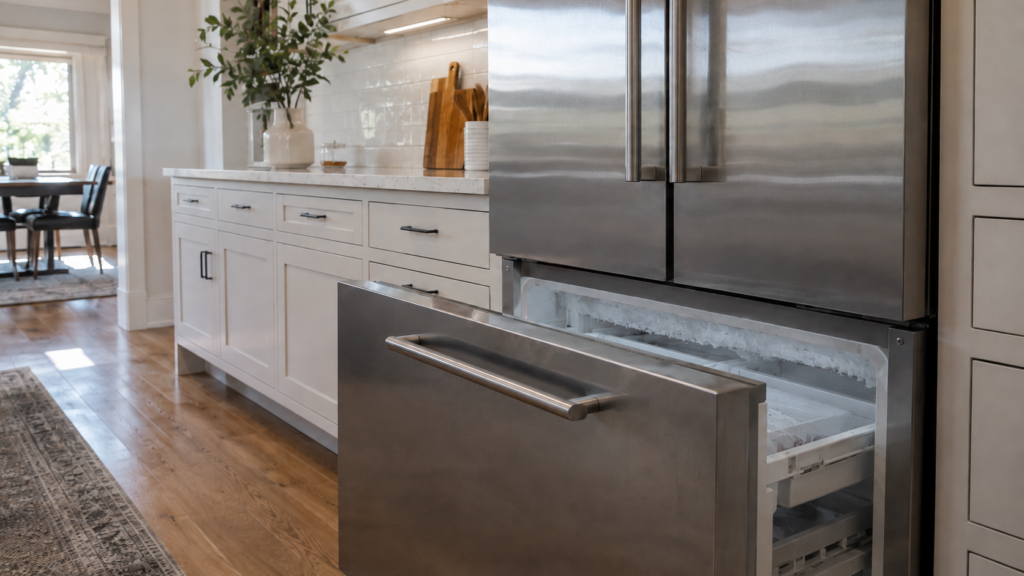
Your refrigerator may be one of the most familiar appliances in your home, but it is also a small cold-storage enclosure operating inside a warmer, more humid building.
That temperature difference creates a constant moisture challenge.
Every time you open the refrigerator or freezer, warm household air enters the cold compartment. If that air contains a lot of moisture, the appliance must handle more than the incoming heat. It must also manage the water vapor carried by the air.
Inside a refrigerator, that moisture can become condensation.
Inside a freezer, it can become frost or ice.
A properly functioning appliance is designed to manage the moisture created by normal household use. Refrigerators and frost-free freezers use door gaskets, insulation, fans, evaporator coils, defrost cycles, drains, and drip pans to keep that moisture under control.
However, high humidity can expose weaknesses in the system. A small gasket gap, misaligned door, blocked drain, failed heater, damaged insulation, or poorly ventilated installation may become much more noticeable when the surrounding air is humid.
Humidity may contribute to:
- Condensation on the outside of a refrigerator or freezer
- Moisture between refrigerator doors
- Frost around a freezer door
- Ice buildup on walls, vents, drawers, or packages
- Longer compressor run times
- More moisture for the defrost system to remove
- Water pooling inside or beneath the appliance
- Mold or mildew around gaskets and drain pans
- Corrosion of exposed metal components
- Reduced energy efficiency
- Difficulty maintaining a stable temperature when another problem is present
Humidity does not cause every refrigerator or freezer problem. It is often an added stressor rather than the original defect.
The key is understanding where the moisture is coming from, why it is condensing, and whether the appliance is managing it normally.
Does High Humidity Affect Refrigerators and Freezers?
Yes. High humidity increases the amount of moisture that can enter a refrigerator or freezer with the surrounding room air.
When the appliance door opens, cold air spills out and warmer room air moves in. The appliance must cool that replacement air. If the air is humid, some of its water vapor may condense onto cold surfaces or freeze into frost.
This can increase the moisture load on the appliance, especially when:
- The door is opened frequently
- The door remains open for several minutes
- A child leaves the door cracked
- The door gasket leaks
- A drawer or food package prevents complete closure
- The refrigerator is installed in a humid garage or basement
- Warm, uncovered food releases moisture inside
- The defrost or drainage system is not working correctly
ENERGY STAR advises keeping refrigerator and freezer seals airtight and minimizing the amount of time their doors remain open. Tight seals reduce warm-air infiltration, cooling demand, and frost accumulation. (ENERGY STAR)
A healthy appliance should still be able to operate in normal indoor humidity. Persistent sweating, thick recurring frost, water leaks, or unsafe food temperatures suggest that humidity may be revealing another problem.
How Humidity Can Affect Refrigerators and Freezers
| What you notice | How humidity may contribute | Other possible causes | Best first step |
| Refrigerator sweating on the outside | Humid room air condenses on a cold cabinet or door surface | Failed anti-sweat heater, damaged insulation, poor clearance, temperature set too low | Check room humidity, door seals, appliance settings, and required clearance |
| Frost around the freezer door | Warm, humid air is entering and freezing near the opening | Torn gasket, misaligned door, food blocking the seal, damaged dispenser flap | Clean and inspect the gasket, then confirm the door closes completely |
| Frost throughout the freezer | Moisture entered during prolonged or repeated door openings | Defrost-system failure, fan problem, sensor failure | Defrost according to manufacturer instructions and monitor whether frost quickly returns |
| Water under refrigerator drawers | Excess moisture is condensing inside the compartment | Blocked defrost drain, frozen drain, spilled liquids | Inspect for spills and have the drain checked if water repeatedly returns |
| Water beneath the appliance | Humidity may increase the amount of condensate the appliance produces | Leaking water line, ice maker, drain tube, or cracked drain pan | Identify whether the water is coming from plumbing or the condensate system |
| Refrigerator runs longer than usual | The appliance must cool incoming humid air and remove its moisture | Dirty condenser area, poor ventilation, bad gasket, fan or sealed-system problem | Check seals, clearance, temperature settings, and food temperatures |
| Ice on freezer drawers or tracks | Humid air entered and froze around moving parts | Door left open, misaligned drawer, gasket leak | Remove ice safely and correct whatever prevented the door from sealing |
| Condensation between French doors | The center divider is colder than the room’s dew point | Failed mullion heater, energy-saving setting, gasket or alignment problem | Check the manual for humidity-control settings and inspect both door seals |
| Mold around the gasket | Condensation keeps the gasket damp while food residue provides nutrients | Spills, dirty gasket folds, drainage issues | Clean the gasket and correct the recurring moisture source |
| Rust around seams or hinges | Repeated condensation wets exposed or damaged metal | Water leaks, scratched coating, coastal salt exposure | Stop the moisture source and evaluate spreading or structural corrosion |
| Freezer in a garage develops moisture problems | Hot, humid garage air increases condensation and frost potential | Appliance not rated for garage temperatures, poor airflow, direct sunlight | Confirm the approved operating range and improve room humidity and clearance |
| Heavy frost returns soon after removal | Humid air may be continually leaking into the freezer | Defrost failure, damaged gasket, fan or sensor problem | Arrange for service rather than repeatedly removing the frost |
Humidity may explain why condensation or frost becomes worse, but the location and persistence of the moisture often reveal whether the appliance also has a seal, drainage, insulation, or mechanical problem.
Why Humidity Turns Into Water Around Cold Appliances
Humidity is water vapor suspended in the air.
Warm air can contain more water vapor than colder air. When humid air cools, it may eventually reach its dew point—the temperature at which some of the vapor begins turning into liquid water.
That is why a cold drink sweats on a humid day. The water is not leaking through the glass. Moisture from the surrounding air is condensing on its cold exterior.
A refrigerator can experience the same process.
When humid household air touches a refrigerator surface that is colder than the air’s dew point, condensation can form.
If that surface is below freezing, the moisture can become frost or ice instead.
This may happen:
- On the exterior cabinet
- Around refrigerator doors
- On the center divider between French doors
- Inside the fresh-food compartment
- Along a freezer gasket
- On freezer walls
- Around air vents
- On evaporator coils
- On food packages
- Around an ice dispenser
The colder the surface and the more moisture contained in the surrounding air, the greater the potential for condensation or frost.
How Humidity Affects a Refrigerator
A refrigerator generally operates above freezing, so incoming moisture is more likely to become liquid condensation than solid ice.
Some condensation is normal. Fresh foods naturally release moisture, and humid room air enters each time the door opens. The refrigerator is designed to collect and remove much of that moisture.
Humidity becomes a problem when more moisture enters than the appliance can manage or when the normal drainage system is obstructed.
Homeowners may notice:
- Water droplets on shelves or walls
- Moisture under produce drawers
- Condensation around containers
- A wet door gasket
- Moisture between French doors
- Water beneath the appliance
- A musty or sour odor
- Mold in gasket folds
- Rust around seams or hinges
Condensation inside the fresh-food compartment can also increase when a door does not seal properly. GE advises checking refrigerator gaskets for cuts, tears, rips, and other damage when excess interior moisture develops. (GE Appliances)
However, interior water may also come from a blocked defrost drain, leaking water line, ice-maker problem, cracked drain pan, or other mechanical issue. Room humidity should not automatically be blamed.
How Humidity Affects a Freezer
Humidity is often more visible in a freezer because incoming moisture freezes.
When warm, humid air enters a compartment near 0°F, its moisture can quickly deposit on cold surfaces as frost.
You may see:
- Frost around the door opening
- Ice on drawer tracks
- Frost coating packages
- Ice crystals on shelves
- A frozen air vent
- Frost on the rear interior panel
- A freezer drawer that sticks
- Ice preventing the door from closing
- Water appearing after the appliance defrosts
A little frost may occur during normal use, particularly in a manual-defrost freezer. Thick frost that returns quickly is not normal.
Heavy frost can:
- Restrict airflow
- Cover the evaporator
- Interfere with fans
- Block vents
- Insulate the cooling coil
- Make drawers difficult to open
- Prevent a complete door seal
- Increase the amount of water created during defrosting
- Make compartment temperatures less consistent
Humidity may be supplying the moisture, but another defect often provides the pathway.
For example, a worn gasket may continuously allow room air into the freezer. The frost is the visible symptom, while the failed seal is the repairable cause.
Can Humidity Make a Refrigerator or Freezer Work Harder?
It can.
Every time warm air enters, the appliance must remove the heat from that air. When the air also contains substantial water vapor, the appliance must condense or freeze some of the moisture.
This additional moisture may accumulate on the evaporator and later need to be melted during a defrost cycle.
Humid conditions can therefore contribute to:
- Longer cooling cycles
- Greater frost accumulation
- Additional defrost demand
- More water entering the drain system
- Slower temperature recovery after door openings
- Higher energy consumption when air leakage is persistent
The effect is usually greatest when high humidity is combined with heat, frequent door use, or a poor seal.
Humidity alone should not cause a healthy refrigerator to run constantly.
Other possible causes of long or continuous operation include:
- Dirty condenser coils
- Inadequate clearance around the appliance
- A malfunctioning fan
- Incorrect temperature settings
- A damaged gasket
- A failing temperature sensor
- Heavy evaporator frost
- Defrost-system failure
- A sealed-system or refrigerant problem
- Loading a large amount of warm food
- Installation in a room outside the manufacturer’s approved conditions
If the appliance runs almost continuously and cannot maintain a safe temperature, it needs inspection rather than additional room dehumidification alone.
Why Is My Refrigerator Sweating on the Outside?
Exterior refrigerator condensation forms when part of the cabinet becomes colder than the surrounding air’s dew point.
This is more likely when:
- Indoor humidity is unusually high
- The refrigerator is in a damp basement
- The appliance is in an unconditioned garage
- Windows or exterior doors are open during humid weather
- The door gasket leaks
- The door has been left partially open
- The appliance is set excessively cold
- Air circulation around the cabinet is restricted
- A door-frame or anti-condensation heater is not operating
- Cabinet insulation is damaged
A temporary film of moisture during exceptionally humid conditions may not indicate appliance failure.
Persistent dripping, pooling, corrosion, or one unusually wet section should be investigated.
GE notes that exterior refrigerator moisture may be related to damaged gaskets, gasket gaps, or inadequate clearance around the appliance. (GE Appliances)
Some refrigerators intentionally warm the area around or between their doors to prevent condensation. GE explains that warm refrigerant may circulate around the front edge of the refrigerator and freezer compartments for this purpose, particularly during hot, humid weather. (GE Appliances)
Depending on the model, a refrigerator may also have a humidity-control or energy-saver setting that affects anti-condensation heating. Manufacturer instructions should be checked before changing it. (GE Appliances)
Why Does My Freezer Keep Building Up Frost?
Frost forms because moisture is reaching surfaces below freezing.
The most common ways moisture enters include:
- Opening the freezer frequently
- Leaving the door open
- A torn, dirty, or loose gasket
- A misaligned door or drawer
- Food packaging blocking the seal
- Ice buildup preventing closure
- A damaged ice-dispenser flap
- Placing warm food inside
- Very humid room conditions
The location of the frost can provide clues.
Frost concentrated near the door
This often indicates air leakage through the gasket or an improperly closed door.
Frost on packages near one side
A localized gasket gap or airflow issue may be allowing warm air into that section.
Thick frost behind the interior back panel
This may indicate a defrost-system problem rather than ordinary room humidity.
Frost throughout the compartment after the door was left open
This may be a one-time infiltration event. A complete defrost may resolve it if the door and appliance are otherwise functioning correctly.
Do not remove ice with a knife, screwdriver, or other sharp object. Refrigerant lines, evaporator coils, wiring, and plastic liners may be located just beneath the visible surface.
How Door Gaskets Control Humidity
The gasket around a refrigerator or freezer door acts as an air seal.
Its job is not only to keep cold air from escaping. It also limits the entry of warm, moisture-laden household air.
A gasket can leak because it is:
- Torn
- Cracked
- Loose
- Dirty
- Moldy
- Hardened with age
- Warped
- Folded
- Pulled away at a corner
The gasket may also be fine while the door itself is misaligned.
Check for:
- Uneven spacing around the door
- A corner that sits farther out than the others
- A drawer that does not slide fully inward
- A hinge that has shifted
- A refrigerator that is not level
- Heavy items weighing down the door
- A package caught between the gasket and cabinet
- Frost that forms repeatedly along one edge
A door seal should make continuous contact around the opening. ENERGY STAR recommends replacing refrigerator or freezer seals that are not airtight. (ENERGY STAR)
Cleaning or replacing a gasket may reduce frost, condensation, compressor run time, and temperature fluctuations if air leakage is the underlying problem.
Does Opening the Door Really Let That Much Humidity In?
One brief door opening is not likely to harm an appliance.
However, repeated or prolonged openings can create a meaningful moisture load, especially in a humid home.
When a refrigerator or freezer door opens:
- Dense cold air spills from the compartment.
- Warmer room air replaces it.
- The incoming air carries water vapor.
- That air cools inside the appliance.
- Some of its moisture condenses or freezes.
- The appliance must cool the air and manage the moisture.
The effect is increased when:
- The room is hot and humid
- The freezer is opened repeatedly
- The shelves are disorganized
- Someone leaves the door open while deciding what to take
- A door does not fully close afterward
- Large quantities of warm food are added
Homeowners do not need to rush frantically every time they open the door. The practical goal is simply to avoid unnecessary exposure.
Organizing the compartment and ensuring the door closes fully often matters more than shaving a few seconds off ordinary use.
Do Refrigerators and Freezers Remove Humidity?
In a limited sense, yes.
The cold evaporator attracts moisture from the air inside the appliance. That moisture condenses or freezes onto the evaporator.
In a frost-free system, the appliance periodically melts the accumulated frost. The resulting water moves through a drain to a condensate pan, where it eventually evaporates.
This does not mean the refrigerator dehumidifies the surrounding room. It only manages moisture that reaches the refrigerated compartment or cold internal surfaces.
If the defrost or drainage system stops working, homeowners may find:
- Ice on the freezer floor
- Water under refrigerator drawers
- Frost on the rear panel
- Water beneath the appliance
- A frozen drain opening
- A sheet of ice inside the compartment
Humidity can increase how much water the appliance must handle, but it does not cause a drain to become physically blocked or a defrost component to fail.
Can Humidity Cause Mold or Odors?
Humidity can help create the damp conditions that mold and bacteria need, but moisture alone is not enough. They also need organic material.
Inside or around a refrigerator, that material may include:
- Food spills
- Crumbs
- Produce residue
- Grease
- Dust
- Dirty drain pans
- Residue inside door-gasket folds
Likely areas for growth include:
- Gaskets
- Drain openings
- Drip pans
- Water dispensers
- Ice dispensers
- The floor beneath the appliance
- The wall behind it
- Areas where exterior condensation remains trapped
The refrigerator’s cold temperature slows many organisms, but it does not make the appliance sterile.
Cleaning visible growth without correcting recurring condensation, leaking water, or food residue may allow the problem to return.
Can Humidity Cause Rust or Corrosion?
Persistent moisture can contribute to corrosion of exposed or damaged metal.
Potentially vulnerable areas include:
- Hinges
- Fasteners
- Cabinet seams
- Scratched exterior panels
- Door frames
- Drain pans
- Water-line connections
- Ice-dispenser components
- Unfinished metal edges
The risk may be higher in coastal areas because airborne salt can make moisture more corrosive.
Humidity does not immediately ruin a refrigerator simply because the room is damp. Corrosion is more likely when condensation repeatedly wets metal, protective coatings are damaged, or water becomes trapped.
Small surface spots may be manageable. Spreading rust, swelling, perforation, or corrosion near electrical parts should be evaluated professionally.
Can Humidity Affect Food Storage?
Humidity influences food differently inside refrigerators and freezers.
In the refrigerator
High internal humidity can help some produce resist wilting, but excess moisture can also encourage decay, condensation, and mold.
Crisper drawers are designed to create different humidity conditions:
- Higher-humidity settings help retain moisture around leafy or wilt-prone produce.
- Lower-humidity settings allow more moisture and gases to escape from produce more prone to rotting.
These drawers do not control the humidity of the entire kitchen or refrigerator.
Uncovered food, freshly washed produce, and steaming containers can also add moisture to the appliance.
In the freezer
High room humidity can increase frost on packages, but it is not the direct cause of freezer burn.
Freezer burn occurs when moisture leaves the food and its exposed surface dries. It is more likely when:
- Packaging is not airtight
- Food contains a lot of trapped air
- Food remains frozen for a long time
- Temperatures fluctuate
- Food partially thaws and refreezes
- The freezer is opened frequently
Frost on the outside of a package and freezer burn inside the package are related to moisture movement, but they are not the same condition.
Refrigerators and Freezers in Humid Garages
Garages can be difficult environments for cold-storage appliances.
They often experience:
- High summer temperatures
- High humidity
- Large daily temperature swings
- Cold winter temperatures
- Dust and debris
- Limited air circulation
- Direct sunlight
- Frequent exterior-door openings
A refrigerator in a hot, humid garage must reject heat into an already warm room while also dealing with moisture infiltration.
Homeowners may notice:
- More exterior condensation
- Longer run times
- Greater frost accumulation
- Increased energy use
- Rust around seams or hinges
- Difficulty maintaining temperature
- Water collecting around the cabinet
Not every refrigerator is rated for garage installation.
The manufacturer’s approved ambient-temperature range matters. An appliance designed for a conditioned kitchen may not operate correctly through extreme garage temperatures.
A “garage-ready” model may tolerate a broader temperature range, but it still needs:
- Adequate clearance
- An intact gasket
- Clean condenser areas
- Protection from rain and direct water
- A suitable electrical supply
- Reasonable humidity control
- Space for heat to escape
Refrigerators and Freezers in Damp Basements
A basement may remain cooler than a garage but still have high humidity.
This can create exterior condensation when the appliance cabinet is colder than the basement air’s dew point.
A refrigerator or freezer may not be the only item showing symptoms. You may also notice:
- Sweating pipes
- Musty odors
- Damp walls
- Condensation on ductwork
- Rusting tools
- Mold on stored items
- A dehumidifier filling frequently
In this situation, controlling the basement’s overall moisture may help reduce appliance condensation.
However, room dehumidification will not repair a damaged gasket, clogged drain, water-line leak, or defrost-system failure.
What Commercial Cold Storage Can Teach Homeowners
Large commercial cold-storage facilities face the same basic moisture forces as household refrigerators and freezers, but on a much larger scale.
They must separate an extremely cold interior from warm, humid surrounding air. Even relatively small leaks around doors, panel joints, utility penetrations, or damaged seals can carry moisture toward cold surfaces.
That moisture can become condensation, frost, or ice.
Commercial facilities manage the problem by focusing on several principles:
- Tight air control
- Continuous insulation
- Limited door-opening time
- Sealed penetrations and joints
- Reduced thermal bridging
- Mechanical dehumidification when necessary
- Reliable defrosting and drainage
- Monitoring rather than waiting for visible failure
ASHRAE describes moist-air infiltration through openings and doors as an important moisture source in commercial and industrial spaces. Vapor-pressure differences can also drive moisture toward colder environments. (ASHRAE)
A homeowner does not need commercial equipment or an engineered insulated-panel system. But the same principles can help solve residential refrigerator and freezer problems.
How to Fix Humidity Problems Using Cold-Storage Principles
Commercial cold-storage buildings do not solve moisture problems by wiping away condensation indefinitely. They identify where moisture enters, maintain the enclosure, manage door traffic, remove moisture, and make sure water can drain.
Homeowners can apply the same approach on a smaller scale.
1. Stop uncontrolled air leakage
Commercial approach: Cold-storage facilities carefully seal doors, panel joints, and penetrations so warm, humid air cannot continuously enter.
Residential application: Inspect the refrigerator or freezer door seal.
Clean the gasket according to the manufacturer’s instructions and look for:
- Tears
- Cracks
- Hard or brittle sections
- Loose corners
- Warping
- Food residue
- Mold
- Areas that do not contact the cabinet
Check that shelves, drawers, and food packages are not interfering with closure.
If the gasket is damaged or does not seal continuously, replacement or door adjustment may be necessary.
2. Manage door openings
Commercial approach: Cold warehouses use high-speed doors, vestibules, strip curtains, and operating procedures to reduce how long openings remain exposed.
Residential application: Keep the refrigerator organized so food can be found quickly.
Remove several ingredients at once rather than repeatedly reopening the door. Make sure children do not leave the freezer open while choosing a snack.
The most important step is confirming that the door closes completely after use.
3. Maintain the insulated enclosure
Commercial approach: Continuous insulated panels prevent heat transfer and keep warm-side surfaces from becoming cold enough to sweat.
Residential application: Watch for signs of damaged cabinet insulation, such as:
- One unusually cold exterior spot
- Persistent condensation in one area
- A bulging cabinet wall
- Softness or deformation
- Rust that repeatedly returns
- Condensation that continues despite lower room humidity and a good gasket
Cabinet insulation is not normally homeowner-serviceable. Suspected insulation failure requires professional assessment and may make appliance replacement more practical than repair.
Never drill or screw into refrigerator or freezer walls. Refrigerant tubing, wiring, heaters, and other hidden components may be inside.
4. Reduce thermal bridges and cold exterior spots
Commercial approach: Designers limit metal connections and other conductive paths that create cold spots where condensation can develop.
Residential application: Homeowners cannot redesign the refrigerator cabinet, but they can identify where condensation appears.
Moisture concentrated around a door divider, frame, hinge, or dispenser may indicate:
- A failed anti-condensation heater
- A humidity-control setting
- A gasket leak
- A door-alignment issue
- Damaged insulation
- Exceptionally high room dew point
Check the appliance manual for an energy-saver, humidity-control, or anti-sweat setting. Some models reduce door-frame heating in energy-saving mode, which may allow condensation during humid conditions. (GE Appliances)
5. Control the humidity of the surrounding room
Commercial approach: Large facilities may use dedicated dehumidification to reduce the moisture available to enter refrigerated areas.
Residential application: Use air conditioning or a dehumidifier when the entire garage, basement, or utility room is excessively humid.
Room humidity is more likely to be the primary issue when:
- Other cold surfaces also sweat
- The space smells musty
- Tools or metal items rust
- Stored boxes feel damp
- Condensation is worse during humid weather
- Moisture improves when the room is dehumidified
A dehumidifier should not be positioned where it blocks the refrigerator’s required airflow.
It also should not be used as a substitute for repairing a leaking door, blocked drain, damaged cabinet, or mechanical problem.
6. Preserve airflow around the appliance
Commercial approach: Refrigeration systems need a reliable way to reject heat and circulate air.
Residential application: Leave the clearance required by the manufacturer around the refrigerator or freezer.
ENERGY STAR recommends leaving space between the appliance and surrounding walls or cabinets and keeping accessible condenser coils clean according to the owner’s manual. (ENERGY STAR)
Restricted airflow can cause:
- Longer run times
- Greater cabinet temperatures near mechanical components
- Reduced efficiency
- Difficulty recovering after door openings
- Added stress during hot, humid weather
Do not assume every modern refrigerator has homeowner-accessible condenser coils. Follow the instructions for the specific model.
7. Make sure water can drain
Commercial approach: Cold-storage buildings use drains and carefully managed defrost systems so condensation and melted frost do not collect inside the enclosure.
Residential application: Investigate water that repeatedly collects:
- Beneath produce drawers
- On the freezer floor
- Beneath the appliance
- Around the drain opening
- Near the drip pan
Possible causes include:
- A clogged defrost drain
- A frozen drain
- A cracked pan
- A shifted drain tube
- A failed defrost heater
- A leaking water supply
- An ice-maker problem
Humidity may increase condensate volume, but water should still move through the appliance’s intended drainage path.
8. Do not ignore recurring frost
Commercial approach: Large facilities monitor frost because accumulation can restrict airflow, reduce heat transfer, interfere with doors, and create water during defrosting.
Residential application: One frost event after a door was left open may resolve after a proper defrost.
Frost that rapidly returns may indicate:
- A leaking gasket
- A misaligned door
- Defrost-system failure
- A faulty sensor
- A damaged dispenser flap
- Blocked internal airflow
- A fan problem
Removing the frost without correcting its source is comparable to wiping condensation off a wall while leaving the air leak behind.
9. Monitor conditions instead of guessing
Commercial approach: Cold-storage operators monitor temperature, humidity, door operation, defrost performance, and ice accumulation.
Residential application: Use an appliance thermometer to confirm that the refrigerator and freezer are maintaining safe temperatures.
A room humidity monitor can also help determine whether exterior sweating is connected to unusually humid conditions.
Record:
- When condensation appears
- Indoor temperature and humidity
- Whether the door was left open
- Where frost forms
- How quickly it returns
- Whether food temperatures change
- Whether the compressor is running more often
Patterns can make it easier to distinguish temporary weather-related condensation from a developing appliance defect.
Is a Dehumidifier the Solution?
A dehumidifier can help when the appliance is operating correctly but the surrounding room remains chronically damp.
It may be useful in:
- Basements
- Humid garages
- Utility rooms
- Laundry areas
- Poorly ventilated storage rooms
It is most likely to help when condensation appears on multiple objects in the room, not only the refrigerator.
A dehumidifier will not fix:
- A torn gasket
- A door that does not close
- Failed anti-condensation heating
- Damaged cabinet insulation
- A clogged drain
- A broken fan
- Defrost-system failure
- A leaking water line
- A sealed-system problem
The correct repair depends on whether the moisture originates in the room, enters through a failed seal, or is collecting because an appliance component is malfunctioning.
Signs Humidity May Be the Main Issue
Humidity is more likely to be the primary contributor when:
- Exterior sweating appears only during humid weather
- Condensation improves when the room is air-conditioned or dehumidified
- Other cold surfaces in the room also sweat
- Frost appeared after the freezer door was left open
- The appliance maintains correct temperatures
- The door and gasket appear intact
- Moisture is temporary rather than steadily worsening
- The appliance is located in a damp garage or basement
Signs the Appliance May Need Repair
Arrange for service when:
- The refrigerator does not remain cold
- Frozen food begins softening
- Thick frost quickly returns after defrosting
- The compressor runs nearly continuously
- Water repeatedly pools beneath the appliance
- The door does not align
- The gasket is torn or permanently warped
- A fan is not operating
- One exterior section remains unusually cold and wet
- The cabinet is swelling or bulging
- Rust is spreading through the cabinet
- A water line or ice maker is leaking
- Electrical components become wet
- The appliance trips a breaker
- A burning smell develops
- The cabinet has been punctured
Food safety takes priority over diagnosing the humidity source. USDA identifies refrigeration as an essential part of keeping perishable food safe. (Food Safety and Inspection Service)
Frequently Asked Questions
Can high humidity damage a refrigerator?
High humidity can contribute to exterior condensation, interior moisture, corrosion, mold, longer run times, and frost. A properly functioning refrigerator should manage ordinary household humidity, so persistent moisture may also indicate a seal, heater, insulation, drain, or mechanical problem.
Does humidity affect a freezer more than a refrigerator?
Its effects are often more visible in a freezer because incoming water vapor becomes frost or ice instead of liquid condensation.
Why does my freezer frost up during humid weather?
Humid room air may enter when the door opens or leaks through the gasket. The moisture freezes when it reaches cold interior surfaces.
Why is my refrigerator wet on the outside?
The cabinet may be colder than the room air’s dew point. High room humidity, a leaking gasket, disabled anti-condensation heating, damaged insulation, poor clearance, or excessively cold settings may contribute.
Can humidity make my refrigerator run constantly?
Humidity may increase the appliance’s load, especially if humid air continually enters through a poor seal. Constant running can also indicate dirty coils, fan failure, defrost problems, sensor failure, incorrect settings, or a sealed-system problem.
Does opening a freezer let humidity inside?
Yes. Cold air spills out and warmer room air replaces it. The incoming air carries moisture that can become frost.
Will a dehumidifier stop refrigerator condensation?
It may reduce weather-related condensation when the entire room is humid. It will not repair a gasket, heater, drain, insulation, water-line, or mechanical defect.
Can humidity cause water under a refrigerator?
Humidity can increase the amount of condensate produced, but water beneath the appliance may also come from a clogged drain, cracked pan, leaking supply line, dispenser, or ice maker.
Can humidity cause mold in a refrigerator?
Humidity can create damp conditions, but mold also requires organic residue. Dirty gaskets, spills, crumbs, drain pans, and produce residue can provide a food source.
Can humidity rust a refrigerator?
Repeated condensation can contribute to corrosion, especially where coatings are scratched or damaged. Coastal salt exposure can increase the risk.
Is it safe to keep a refrigerator in a humid garage?
Only when the manufacturer permits operation within the expected garage conditions. A garage-rated model may tolerate broader temperatures, but it still needs intact seals, proper clearance, adequate airflow, and protection from excessive moisture.
Why is there condensation between my refrigerator doors?
That area may be colder than the room’s dew point. High humidity, a failed door-frame heater, a humidity-control setting, poor door alignment, or gasket leakage may be responsible.
Does humidity cause freezer burn?
Not directly. Freezer burn primarily results from moisture leaving inadequately protected food. Humidity entering the freezer may increase frost and temperature recovery demands, but airtight packaging is more important for preventing freezer burn.
The Bottom Line
High humidity affects refrigerators, freezers, and other cold-storage systems because warm air carries water vapor.
When that air enters a cold compartment or contacts a cold cabinet surface, its moisture can become condensation, frost, or ice.
Your refrigerator is designed to manage a normal amount of this moisture through insulation, door seals, cooling coils, defrost cycles, drainage, and sometimes heated door frames.
Problems appear when excessive humidity combines with:
- A leaking gasket
- Frequent or prolonged door openings
- Damaged insulation
- Poor installation clearance
- A blocked drain
- Defrost-system failure
- High room temperature
- A damp garage or basement
- Another mechanical defect
Commercial cold-storage facilities deal with these same forces on a much larger scale. Their approach offers a useful lesson for homeowners: do not merely remove the visible water or ice.
Control where humid air enters, preserve the insulated enclosure, limit unnecessary door exposure, maintain airflow, manage room humidity, and make sure condensation and defrost water have somewhere to go.
When the appliance is properly sealed and functioning correctly, ordinary household humidity should be manageable.
When condensation, frost, water, or long run times persist, humidity may be revealing a problem that deserves repair.