
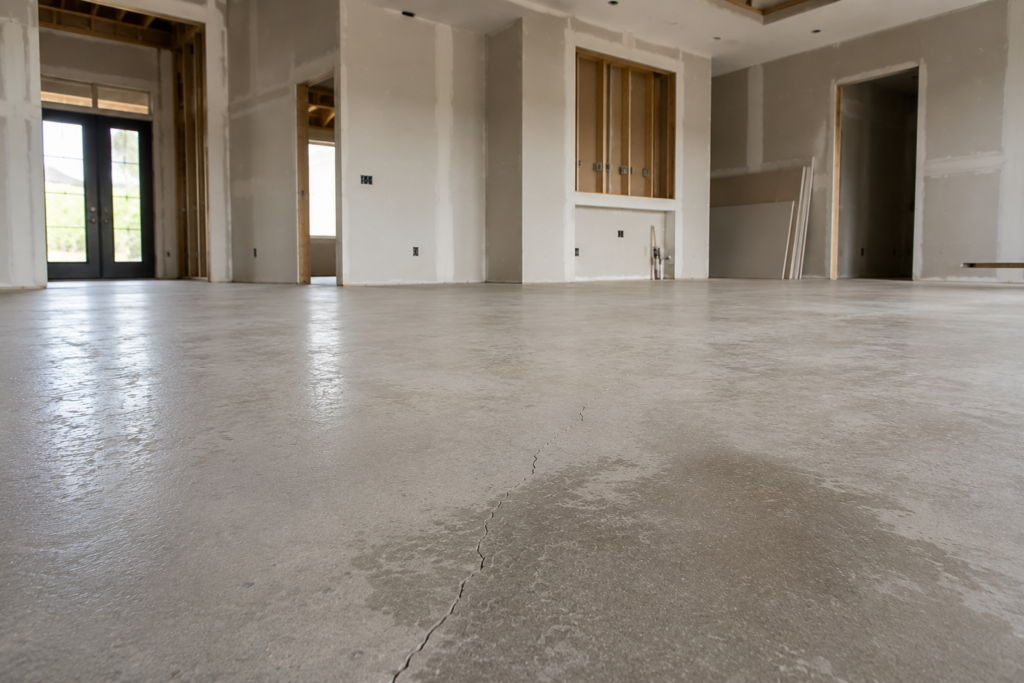
Concrete may appear solid and impermeable, but it is a porous material that continuously interacts with moisture in its environment. In humid climates, this becomes particularly important for homes built on concrete slabs, where moisture can move through the slab, accumulate beneath flooring systems, and contribute to problems that are easily mistaken for plumbing leaks or foundation defects.
High humidity does not automatically mean that a concrete slab is damaged, nor does every crack or flooring problem indicate excessive moisture. However, the relationship between concrete, water vapor, indoor relative humidity, soil moisture, temperature, and flooring materials can create persistent problems when moisture conditions are not properly controlled.
Understanding how moisture actually moves through concrete helps homeowners distinguish ordinary concrete behavior from conditions that warrant further investigation.
Why Concrete Slabs Are Affected by Moisture
Concrete is often described as a solid material, but hardened concrete contains a network of microscopic pores and capillaries. Water and water vapor can move through this pore structure depending on moisture conditions on either side of the concrete.
This means a slab-on-grade foundation is not completely isolated from the soil beneath it. Ground moisture can create a source of water vapor below the slab, while the conditioned living space above the slab typically represents a comparatively drier environment. When a properly installed and functioning vapor retarder is present beneath the slab, it substantially limits moisture migration from the ground. When that protection is missing, damaged, improperly installed, or otherwise ineffective, considerably more moisture may reach the slab.
The slab itself also contains moisture from the original concrete mixture. New concrete does not simply become completely dry once it hardens. Moisture gradually leaves the slab as environmental conditions allow, which is one reason flooring manufacturers and installers require concrete moisture testing before certain flooring systems are installed.
In humid climates, the drying process can be particularly challenging because the surrounding air may already contain substantial moisture.
Professional Building-Science Perspective: “Concrete should not be treated as a moisture-proof barrier simply because it appears dry at the surface. Successful slab and flooring performance depends on controlling moisture below the slab, understanding moisture conditions within the concrete, and maintaining appropriate environmental conditions above it.”
How Moisture Moves Through a Concrete Slab
Several different mechanisms can introduce or transport moisture in and around a concrete slab. Distinguishing among them is important because the appropriate solution depends on the actual moisture source.
Water Vapor Diffusion
Water vapor naturally moves from areas of higher vapor pressure toward areas of lower vapor pressure. If the soil beneath a slab contains significant moisture and the indoor environment above the slab is comparatively dry, a vapor-pressure difference can encourage vapor movement toward the interior.
A below-slab vapor retarder is specifically intended to limit this process.
Capillary Moisture
Concrete’s pore structure can also allow liquid water to move through very small spaces by capillary action. The ability of liquid moisture to reach the slab depends heavily on the construction of the foundation, drainage conditions, soil moisture, and capillary breaks incorporated into the building assembly.
This is different from water vapor diffusion and should not automatically be attributed to humid outdoor air.
Moisture Remaining Within the Concrete
Concrete requires water during mixing and curing. Some of this water becomes chemically involved in cement hydration, while excess moisture must eventually leave the concrete.
A slab may therefore contain substantial internal moisture even when its exposed surface looks completely dry.
This distinction becomes especially important before installing moisture-sensitive flooring.
Does High Humidity Make Concrete Slabs Wet?
High humidity can contribute to damp conditions around concrete, but the answer depends on where the humidity is located and why moisture is accumulating.
When warm, moisture-laden air contacts a concrete surface that is cooler than the air’s dew point, condensation can develop directly on the concrete. This phenomenon is sometimes called sweating slab syndrome. In this situation, moisture is forming on the surface rather than necessarily traveling through the concrete.
This same condensation pattern is common in basements, where cool concrete surfaces and humid air often meet.
High indoor relative humidity can also reduce the rate at which moisture leaves a slab. Concrete dries according to the moisture gradient between the material and its surrounding environment. When the surrounding air remains very humid, that gradient becomes less favorable for drying.
However, consistently damp concrete should never automatically be blamed on atmospheric humidity. Plumbing leaks, groundwater, drainage problems, missing or compromised vapor retarders, and other sources of liquid water must also be considered.
Garage floors are a particularly common place for this confusion because high garage humidity, wet vehicles, rain intrusion, and moisture moving through or beneath the slab can all produce damp-looking concrete for very different reasons.
Concrete Moisture vs. Condensation: Why the Difference Matters
One of the most common sources of confusion is determining whether moisture is coming through the slab or forming on top of it.
These conditions can look surprisingly similar.
| Condition | What Is Happening | Common Clues | What Should Be Investigated |
| Condensation | Humid air reaches a concrete surface below the dew point | Surface dampness may correspond with weather or HVAC conditions | Indoor RH, slab temperature, dew point, ventilation and HVAC operation |
| Vapor movement through slab | Moisture vapor moves from below/within the slab toward the interior | Flooring or adhesive problems may develop without obvious standing water | Concrete moisture testing and below-slab vapor protection |
| Liquid water intrusion | Water enters because of drainage, groundwater, plumbing, or another bulk-water source | Localized or persistent wet areas, staining, recurring moisture | Plumbing, drainage, grading, groundwater and building-envelope conditions |
| Residual construction moisture | Moisture remains within newer concrete | Problems may appear after flooring is installed too early | Slab age, drying conditions and appropriate concrete moisture testing |
The distinction matters because a dehumidifier may help control condensation caused by elevated indoor humidity but cannot repair a plumbing leak or replace a missing below-slab vapor retarder.
Can Humidity Cause Concrete Slabs to Crack?
This is where homeowners should be particularly cautious about assigning a cause.
High humidity alone is generally not an adequate explanation for a significant concrete slab crack. Concrete cracking can result from numerous factors, including drying shrinkage, thermal movement, settlement, soil movement, loading, inadequate reinforcement, construction practices, restraint, and changes in the supporting soils.
Moisture nevertheless plays an important role in concrete’s dimensional behavior.
Concrete generally experiences some degree of shrinkage as it loses moisture. Changes in environmental moisture conditions can therefore contribute to dimensional changes within the material. Temperature fluctuations can occur simultaneously, creating additional expansion and contraction.
This does not mean that a humid day suddenly causes a foundation crack. Rather, moisture conditions are one component of a much larger system affecting concrete performance over time.
Drying Shrinkage and Concrete Cracking
Concrete contains more water when it is placed than remains in the material indefinitely. As excess moisture leaves hardened concrete, the material undergoes drying shrinkage.
If the concrete could shrink completely without restraint, cracking would be less likely. In real structures, however, slabs are restrained by their geometry, reinforcement, friction against underlying materials, adjoining structural components, and other factors.
When tensile stresses created by restrained shrinkage exceed the concrete’s tensile capacity, cracking can occur.
This is one reason control joints are intentionally incorporated into many concrete installations. They are designed to create predetermined locations where shrinkage-related cracking can occur in a more controlled manner.
Humidity affects the rate and extent of drying, but it is only one factor in this process.
How Concrete Slab Moisture Damages Flooring
For many homeowners, the concrete itself is not where the first obvious problem appears.
The flooring installed over it is.
Modern flooring assemblies can include vapor-impermeable or relatively low-permeability materials over concrete. If excessive moisture is present within or beneath the slab, installing certain flooring systems can trap moisture or expose flooring components and adhesives to conditions outside their intended performance range.
The resulting damage varies substantially depending on the flooring material and installation system.
Luxury Vinyl Plank and Concrete Moisture
Luxury vinyl plank is frequently marketed as waterproof, but this terminology can be misleading when discussing moisture beneath a flooring system.
A waterproof flooring surface may resist water spilled on top of it, but that does not necessarily mean the entire flooring assembly is immune to moisture originating from the concrete below.
Excessive slab moisture can create conditions beneath low-permeability flooring where moisture becomes trapped. Depending on the product and installation, this may contribute to odor, microbial growth on susceptible dust or organic materials, adhesive problems, or deterioration of components that are not themselves moisture resistant.
Manufacturers commonly establish specific requirements for substrate moisture and installation conditions. Those requirements should take precedence over assumptions that a flooring product is safe over any concrete slab simply because it is advertised as waterproof.
Wood and Engineered-Wood Flooring
Wood is hygroscopic, meaning it gains and loses moisture as environmental conditions change.
When wood flooring is installed over concrete with excessive moisture, the flooring may absorb moisture and experience dimensional changes. Depending on the severity and distribution of moisture, homeowners may notice:
- Cupping
- Crowning
- Buckling
- Gaps or movement
- Finish deterioration
- Discoloration
- Adhesive failure in glue-down installations
Engineered wood is generally designed to provide greater dimensional stability than traditional solid wood, but it is not immune to excessive moisture.
Controlling both slab moisture and indoor relative humidity is important for long-term performance.
Laminate Flooring
Laminate flooring can be particularly vulnerable when moisture reaches moisture-sensitive core materials.
Depending on the product, excessive moisture may cause:
- Edge swelling
- Raised seams
- Warping
- Delamination
- Permanent dimensional changes
Once certain fiber-based components swell significantly from moisture exposure, simply drying the area may not restore the flooring to its previous condition.
Tile and Grout
Ceramic and porcelain tile themselves are generally highly moisture resistant, but the overall tile assembly still interacts with moisture.
Excessive moisture moving through concrete can sometimes contribute to:
- Efflorescence
- Darkened grout
- Mineral deposits
- Problems involving certain adhesives or setting materials
- Persistent dampness at grout lines
A dark grout line does not automatically prove that moisture is traveling through the slab. Cleaning products, staining, ordinary water exposure, plumbing leaks, and other conditions can produce similar symptoms.
Persistent or widespread changes deserve further investigation.
Why Flooring Problems Can Appear Long After Installation
A floor may perform normally for months or even years before a moisture-related problem becomes obvious.
That does not necessarily mean moisture suddenly appeared.
Environmental conditions can change. HVAC operation may change, indoor humidity may increase, drainage around the house may deteriorate, groundwater conditions may fluctuate, or a plumbing problem may develop. Renovations can also change how easily moisture can evaporate from a slab.
Replacing a relatively vapor-open flooring system with a low-permeability material can significantly alter the drying potential of the assembly.
This is why the history of the home and flooring installation can be extremely valuable when investigating unexplained moisture problems.
Efflorescence on Concrete Slabs
White, powdery or crystalline deposits on concrete are often efflorescence.
Efflorescence develops when moisture dissolves soluble salts within or adjacent to masonry or concrete materials. As the moisture moves toward the surface and evaporates, the salts remain behind.
Efflorescence itself is often primarily cosmetic, but its presence provides useful information:
Moisture has been moving through the material.
Repeated efflorescence should therefore prompt investigation of the moisture source rather than simply repeated cleaning of the visible deposits.
Possible contributors can include soil moisture, drainage conditions, construction moisture, water intrusion, and other sources depending on where the deposits occur.
Can Moisture Under a Concrete Slab Cause Mold?
Concrete itself is inorganic and does not provide the same food source for mold that materials such as paper-faced drywall, wood, or some flooring components do.
However, moisture associated with a concrete slab can create conditions that support microbial growth on organic material located above or around it.
Potential food sources include:
- Dust and debris
- Flooring adhesives containing susceptible components
- Wood flooring
- Fiber-based underlayments
- Baseboards
- Drywall paper
- Certain flooring backings
This is why moisture trapped beneath flooring can become problematic even when the concrete itself is not providing nutrients for mold growth.
Why Baseboards Can Be an Early Warning Sign
Sometimes the first visible evidence of a slab-related moisture problem appears at the perimeter of the room.
MDF baseboards and other moisture-sensitive trim can absorb water and swell. Homeowners may notice:
- Swollen lower edges
- Peeling or bubbling paint
- Separation at joints
- Softened material
- Discoloration
- Recurring damage after replacement
However, damaged baseboards do not automatically prove that moisture is rising through the slab.
Exterior wall leaks, plumbing leaks, wet mopping, condensation, pet accidents, and other moisture sources can produce similar damage.
The pattern and location of the deterioration matter.
How Indoor Humidity Changes Slab Conditions
Indoor relative humidity plays an important role in the moisture balance between concrete and the surrounding air.
When indoor humidity remains elevated, concrete has less opportunity to release moisture into the environment. High indoor humidity can also increase the likelihood of surface condensation if the slab temperature falls below the indoor-air dew point.
This is particularly relevant in hot, humid climates where air conditioning continuously cools interior surfaces.
A home can therefore experience an unusual situation:
The air conditioner cools the slab while humid air introduces enough moisture for condensation to form on that cooler surface.
This is one reason temperature and relative humidity should be evaluated together rather than looking at relative humidity alone.
Why Dew Point Matters More Than Relative Humidity Alone
Relative humidity describes how much moisture the air contains relative to the maximum amount it could hold at that particular temperature.
Dew point provides another critical piece of information: the temperature at which the air becomes saturated and condensation begins.
If a concrete floor is colder than the dew point of the surrounding air, water can condense on the surface.
This explains why a concrete slab can suddenly appear to “sweat” even though there is no new plumbing leak and no obvious water entering through the foundation.
The moisture may have originated in the air, not beneath the slab.
Signs a Concrete Slab May Have a Moisture Problem
Homeowners should pay attention to patterns rather than relying on a single symptom.
Possible signs include:
- Persistent dampness on flooring
- Recurring musty odors near floor level
- Flooring that lifts, buckles, bubbles, or separates
- Adhesive deterioration
- Unexplained discoloration
- Recurring efflorescence
- Dark grout that repeatedly appears damp
- Swollen baseboards
- Moisture beneath removed flooring
- Condensation on exposed concrete
None of these symptoms individually identifies the source.
They indicate that further moisture investigation may be appropriate.
When a Crack Is More Concerning
Small cracks are common in concrete, and the presence of a crack alone does not establish that a foundation has a structural problem.
However, professional evaluation becomes more important when cracking is accompanied by other signs of movement.
These may include:
- Significant vertical displacement across a crack
- Cracks that continue widening
- Multiple cracks developing in a recognizable pattern
- Doors or windows suddenly becoming difficult to operate
- Noticeably sloping or uneven floors
- Separation between building components
- Significant exterior foundation movement
- Repeated repairs that reopen
In those circumstances, attributing the problem simply to humidity can delay identification of a more significant structural, soil, drainage, or construction issue.
How Professionals Test Concrete for Moisture
Looking at the surface of concrete cannot reliably determine the moisture condition throughout the slab.
Professional testing methods may include in-situ relative-humidity testing, in which sensors are placed into drilled holes at prescribed depths within the concrete. This provides information about moisture conditions inside the slab rather than only at its surface.
Other testing methods may be used depending on the purpose of the investigation, flooring manufacturer’s requirements, slab construction, and applicable standards.
Surface moisture meters can be useful investigative tools, particularly for comparing different areas, but readings should be interpreted according to the instrument’s capabilities and limitations.
When flooring installation is involved, testing procedures and acceptable limits should follow applicable industry standards and the flooring or adhesive manufacturer’s specifications.
What Homeowners Can Do to Reduce Slab-Related Moisture Problems
There is no single solution for every concrete moisture problem because the correct response depends on the source.
Control Indoor Humidity
Maintaining appropriate indoor relative humidity reduces condensation risk and creates more favorable drying conditions.
In persistently humid climates, this may require appropriate air-conditioning operation, dehumidification, air sealing, and attention to ventilation.
Address Drainage Around the House
Roof runoff and surface water should be directed away from the foundation according to appropriate building and drainage practices.
Persistently saturated soil around a foundation increases the moisture burden on below-grade and slab assemblies.
Investigate Plumbing Leaks
Unexplained localized slab or flooring moisture should not automatically be attributed to humidity.
Plumbing systems and appliances should be considered when the pattern suggests a possible leak.
Follow Flooring-Manufacturer Requirements
Before installing flooring over concrete, homeowners and contractors should follow the manufacturer’s requirements regarding:
- Concrete moisture
- Substrate preparation
- Vapor protection
- Indoor temperature
- Relative humidity
- Acclimation
- Approved underlayments and adhesives
Skipping these requirements can create expensive problems that may not become apparent until after installation.
Avoid Diagnosing Moisture by Appearance Alone
A wet-looking slab can result from condensation, vapor movement, bulk water, construction moisture, or another source.
Proper diagnosis should come before remediation.
Humidity Problem or Foundation Problem?
This is one of the most important distinctions homeowners can make.
Moisture-related flooring deterioration does not automatically indicate foundation failure, just as a foundation crack does not automatically indicate a humidity problem.
A moisture investigation may require an HVAC professional, flooring specialist, plumber, building-envelope professional, or other qualified moisture specialist.
Suspected structural movement may warrant evaluation by an appropriately qualified structural engineer or foundation professional.
When both cracking and moisture are present, the two conditions should be evaluated independently before assuming one caused the other.
Frequently Asked Questions
Can high humidity cause a concrete slab to crack?
Humidity can influence moisture conditions and concrete’s dimensional behavior, but high atmospheric humidity alone should not automatically be identified as the cause of a slab crack. Drying shrinkage, thermal movement, settlement, soil conditions, construction practices, restraint, loading, and other factors can contribute to cracking.
Can moisture come up through a concrete slab?
Yes. Moisture can migrate from beneath or within a concrete slab, particularly when an effective below-slab vapor retarder is absent or compromised. The mechanism and severity depend on the slab construction, soil moisture, drainage, and environmental conditions.
Why does my concrete floor feel wet when it is humid outside?
Condensation is one possibility. If warm, humid air reaches concrete that is below the air’s dew point, moisture can condense directly onto the surface. Moisture from beneath the slab and other water sources should still be considered if dampness persists.
Can moisture under vinyl plank flooring cause problems?
Yes. Although many vinyl products resist water exposure, excessive moisture beneath the flooring can still affect adhesives, underlayments, adjacent materials, and conditions beneath the floor. Always follow the flooring manufacturer’s concrete-moisture requirements.
Does efflorescence mean my foundation is failing?
Not necessarily. Efflorescence indicates that moisture has transported soluble salts to a surface where the water evaporated. It is evidence of moisture movement, but it does not by itself establish structural foundation failure.
Can a dehumidifier fix slab moisture?
A dehumidifier can help lower indoor humidity and reduce condensation risk, but it cannot correct every source of slab moisture. Groundwater, plumbing leaks, drainage problems, or inadequate below-slab vapor protection require source-specific solutions.
Should concrete be moisture-tested before new flooring is installed?
For moisture-sensitive flooring systems, appropriate concrete moisture evaluation is an important part of installation. The flooring and adhesive manufacturers’ specifications should be followed because acceptable conditions vary by product and installation system.
The Bottom Line
Concrete slabs are durable, but they are not completely isolated from moisture. Their porous structure allows them to interact with water and water vapor from the soil, the concrete itself, and the surrounding indoor environment.
In humid homes, elevated relative humidity can slow concrete drying and increase the potential for condensation when slab temperatures fall below the dew point. Moisture originating beneath or within a slab can also contribute to flooring failures, adhesive deterioration, efflorescence, odors, and damage to moisture-sensitive materials installed nearby.
However, humidity should not become a catch-all explanation for every slab crack, damp floor, or flooring failure. Structural movement, plumbing leaks, groundwater, drainage deficiencies, construction conditions, and installation problems can produce similar symptoms.
The most reliable approach is to determine where the moisture is coming from before deciding how to correct it. When concrete moisture, flooring deterioration, or significant cracking persists, appropriate professional testing can distinguish an indoor humidity problem from a slab, drainage, plumbing, flooring, or structural condition that requires a different solution.