
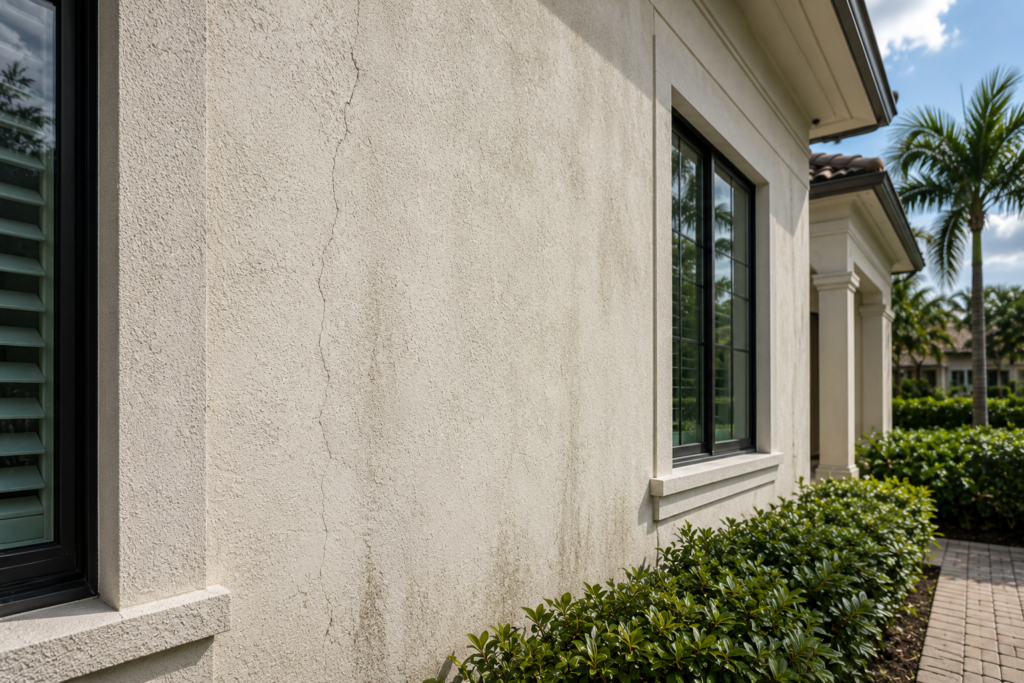
Stucco has long been one of the most popular exterior finishes in Florida and other humid climates. It’s durable, fire-resistant, low maintenance, and well-suited to homes that experience frequent rain, intense sun, and year-round humidity.
Yet few exterior materials create more homeowner confusion.
After a stretch of rainy weather, you may notice green stains spreading across one wall, hairline cracks that suddenly seem more noticeable, white chalky deposits appearing near the foundation, or sections of stucco that never seem to fully dry. It’s natural to assume Florida’s humidity is damaging your home’s exterior.
In most cases, though, that’s not what’s happening.
Humidity rarely damages properly installed stucco by itself. Instead, it changes how moisture behaves. It slows evaporation, extends drying times, increases the amount of time surfaces remain damp, and creates conditions that allow algae, mildew, staining, and moisture-related problems to become much more noticeable.
Perhaps most importantly, humidity often exposes problems that already exist.
A wall with failed flashing, deteriorated sealant, or a small crack may perform adequately in a dry climate because moisture evaporates quickly. In a humid climate, that same wall may stay damp for days after every rainstorm, giving water more time to migrate into the wall assembly and making minor defects much easier to see.
Understanding this difference is one of the keys to caring for a home in a humid climate.
In this guide, we’ll explain how humidity affects stucco, why some walls stay damp longer than others, what causes common problems like cracks and staining, and how to recognize when visible changes are simply part of normal weathering—or signs that moisture may be entering where it shouldn’t.
What Is Stucco?
Before understanding how humidity affects stucco, it helps to understand how stucco is designed to work.
Traditional stucco is a cement-based exterior finish made primarily from Portland cement, sand, lime, and water. It is applied over a supporting wall system in multiple layers to create a durable exterior cladding.
Many homeowners think of stucco as a waterproof shell, but that’s not entirely accurate.
Traditional stucco is water shedding, not waterproof.
During a rainstorm, the surface naturally becomes wet. Small amounts of moisture can also be absorbed into the outer layer of the stucco. Under normal conditions, that moisture later dries through evaporation once weather conditions improve.
In other words, stucco is designed with the expectation that it will get wet.
Its long-term performance depends on two important principles of building science:
- Limiting how much liquid water enters the wall system.
- Allowing any incidental moisture to dry efficiently.
Modern homes may also use EIFS (Exterior Insulation and Finish Systems), sometimes called synthetic stucco. While EIFS performs differently and has its own moisture-management requirements, this article focuses primarily on traditional cement-based stucco, which remains common throughout Florida and many other humid regions.
Like every exterior cladding, stucco is only one part of the wall assembly. Flashing, sealants, water-resistive barriers, drainage details, and proper installation all work together to keep moisture from reaching the home’s framing.
Humidity doesn’t change how stucco is built—but it significantly changes how efficiently that entire system dries.
Does Humidity Damage Stucco?
The Short Answer
Usually, no.
Humidity alone rarely damages properly installed traditional stucco.
Instead, humidity affects the moisture cycle of your home’s exterior.
Building scientists often think of moisture in terms of two separate processes:
- Wetting — how often water reaches a material.
- Drying — how quickly that material can return to normal moisture levels.
Florida doesn’t necessarily experience more wetting than every other part of the country. What makes humid climates different is that they experience much slower drying.
That distinction matters.
After a summer thunderstorm, a stucco wall in Arizona may dry within hours because the surrounding air can accept large amounts of additional moisture.
That same wall in coastal Florida may remain damp well into the next day because the surrounding air is already holding a significant amount of water vapor. When the air is nearly saturated, evaporation slows dramatically.
Humidity therefore influences stucco by extending the amount of time moisture remains on or within the exterior finish.
Over months and years, those longer wet periods create ideal conditions for:
- Algae growth
- Mildew
- Surface mold
- Organic staining
- Efflorescence
- Premature weathering of exterior coatings
- Moisture intrusion becoming more apparent
Humidity doesn’t usually create these problems—but it often allows them to develop more easily or become more visible.
How Humidity Changes the Moisture Cycle of Stucco
One of the biggest misconceptions homeowners have is believing humidity somehow “attacks” stucco.
In reality, humidity changes how long moisture stays on the wall.
Every exterior surface goes through repeated wetting and drying cycles.
A typical Florida summer day might look like this:
- Morning dew forms before sunrise.
- The wall begins drying after sunrise.
- Afternoon thunderstorms soak the exterior again.
- Evening humidity slows evaporation.
- Overnight temperatures fall, allowing dew to form once more.
Some walls never become completely dry before the next source of moisture arrives.
Over time, these repeated wetting cycles create a very different environment than homes experience in drier climates.
Instead of spending most of their time dry, portions of the home’s exterior may remain slightly damp for much of the summer.
This doesn’t automatically damage stucco.
However, it creates ideal conditions for organisms like algae and mildew while also giving liquid water more time to exploit any weaknesses in the wall system.
Why Evaporation Matters
The speed at which stucco dries depends largely on evaporation.
Evaporation occurs when water molecules leave the surface and enter the surrounding air.
The drier the air, the easier this process becomes.
The more humid the air, the slower evaporation occurs.
This is why homeowners often notice that:
- Sidewalks stay wet longer during the summer.
- Pool decks remain damp in the morning.
- Outdoor furniture dries slowly after rain.
- Stucco walls remain darker for hours after a storm
The stucco itself hasn’t changed.
The surrounding atmosphere has.
When relative humidity remains high, there is less capacity for additional moisture to leave the wall.
As a result, the entire drying process slows.
From a building-science perspective, this is one of the primary reasons humid climates require careful attention to drainage, flashing, sealants, and routine maintenance.
Materials that stay wet longer have less margin for error if water finds its way into places it shouldn’t.
Why One Side of Your House May Look Worse Than the Other
One of the most common questions homeowners ask is:
“Why is only one side of my house turning green?”
Humidity is only part of the answer.
The real difference usually comes down to how humidity interacts with sunlight, airflow, and moisture exposure.
A north-facing wall may receive very little direct sunlight throughout the year. Without solar heating, moisture evaporates more slowly after rain and morning dew.
Dense landscaping can further reduce airflow, trapping humid air against the stucco.
Large trees block sunlight while also depositing organic debris that feeds algae and mildew.
Homes near lakes, retention ponds, canals, or the coast often experience even higher overnight humidity than neighboring properties.
Even something as simple as a sprinkler head that regularly wets the same section of wall can create a microclimate where that area rarely dries completely.
The result is a wall that develops green staining, darker patches, or mildew months—or even years—before the rest of the house.
In many cases, the stucco itself is perfectly healthy.
It’s simply spending much more time wet than the other elevations of the home.
How Humidity Affects Stucco
Why Some Stucco Walls Stay Damp for Days
One of the biggest differences between living in a humid climate and a dry climate isn’t how often your home gets wet—it’s how long it stays wet afterward.
A properly built stucco wall is expected to get wet during rain. That alone isn’t a problem.
The challenge begins when the wall doesn’t have enough time to dry before the next source of moisture arrives.
In much of Florida, a typical summer weather pattern includes overnight dew, morning humidity, afternoon thunderstorms, and warm, humid evenings. Before the stucco has fully dried from one moisture event, another often occurs.
This creates repeated wetting and drying cycles that heavily influence how the exterior ages over time.
Building scientists generally agree that materials which remain wet for longer periods are more susceptible to biological growth, cosmetic staining, and moisture-related deterioration if water finds its way into the wall assembly.
Humidity doesn’t necessarily increase how much water reaches the stucco—but it often increases how long that water stays there.
Factors That Slow Drying
Every home dries differently depending on its surroundings.
Several environmental conditions can dramatically slow the drying process.
Morning Dew
Many homeowners assume their stucco only becomes wet when it rains.
In reality, exterior walls frequently become damp overnight as temperatures fall and moisture from the air condenses onto cooler surfaces.
During periods of high humidity, your stucco may begin nearly every morning with a thin layer of moisture—even if no rain has fallen for days.
Frequent Rainfall
Florida’s summer thunderstorms rarely allow exterior walls to complete a full drying cycle.
A wall may begin drying after yesterday’s storm only to become saturated again during another afternoon downpour.
Over weeks and months, this repeated moisture exposure creates ideal conditions for staining and biological growth.
High Relative Humidity
Relative humidity describes how much water vapor is already present in the air compared to how much it can hold at a given temperature.
When relative humidity remains high, evaporation slows because the surrounding air has less capacity to absorb additional moisture.
Think about trying to dry a towel indoors versus hanging it outside in the desert.
The towel itself hasn’t changed.
The environment has.
Stucco behaves the same way.
Shade
Sunlight is one of the most effective natural drying mechanisms.
Walls shaded by neighboring homes, mature trees, covered lanais, or privacy fences often remain damp significantly longer than sunlit walls.
This is one reason algae and mildew commonly develop on north-facing elevations while south-facing walls remain relatively clean.
Limited Airflow
Moving air helps carry moisture away from exterior surfaces.
Dense shrubs, decorative fencing, neighboring structures, and narrow side yards can all reduce airflow around the home.
Without adequate air movement, humid air lingers against the wall, slowing evaporation even further.
Why Longer Drying Times Matter
Humidity isn’t usually harmful because moisture touches the stucco.
It’s harmful because moisture stays there.
Extended dampness creates conditions that favor:
- Algae growth
- Mildew
- Surface mold
- Organic staining
- Dirt accumulation
- Efflorescence
- Gradual deterioration of exterior coatings
Perhaps even more importantly, slower drying gives liquid water additional time to migrate into tiny cracks, failed sealants, or construction defects that might otherwise dry quickly.
Over many years, that difference can become significant.
Stains and Discoloration
One of the earliest ways humidity affects stucco is through changes in appearance.
Many homeowners notice green patches, dark streaks, white deposits, or uneven coloring long before they discover any actual moisture problem.
Fortunately, staining doesn’t automatically mean the stucco is failing.
Instead, stains often provide clues about how moisture is behaving on the wall.
Organic Staining
Green, black, and brown discoloration is extremely common in humid climates.
Most organic staining results from:
- Algae
- Mildew
- Surface mold
- Airborne organic debris
These organisms exist naturally in the environment.
Humidity doesn’t create them.
Instead, humidity creates the damp conditions they need to grow.
Think of algae spores like grass seed.
The spores may already be present almost everywhere outdoors, but they don’t begin growing until moisture remains available long enough.
That’s exactly what happens on many stucco homes.
Walls that stay damp for extended periods become ideal environments for biological growth.
Where Organic Growth Usually Appears
Humidity-related staining often develops first on:
- North-facing walls
- Areas beneath mature trees
- Sections exposed to irrigation overspray
- Walls behind dense landscaping
- Coastal homes
- Homes near lakes or retention ponds
- Areas beneath roof overhangs with limited sunlight
These locations generally remain damp longer than surrounding portions of the home.
Why Humidity Makes Algae Worse
Many homeowners ask why they clean algae only to have it return a few months later.
The answer usually isn’t the algae itself.
It’s the moisture.
If the wall continues experiencing long periods of dampness, algae simply recolonizes the surface.
Cleaning removes the symptom.
Reducing prolonged moisture exposure addresses the cause.
Sometimes that may involve:
- Redirecting sprinkler heads
- Trimming vegetation
- Improving airflow
- Cleaning clogged gutters
- Increasing sunlight exposure where practical
Water Staining
Not every dark streak is biological growth.
Rainwater naturally carries dirt, pollen, roofing particles, dust, and other debris as it moves down the exterior of the home.
As the water evaporates, those materials remain behind.
Common examples include:
- Dark streaks beneath windows
- Brown runoff beneath roof edges
- Vertical dirt trails
- Staining below roof penetrations
- Splash-back near the base of walls
Humidity often makes these stains more noticeable because slower drying allows water to remain on the surface longer before evaporating.
Efflorescence
White, chalky deposits are another common sight on stucco homes.
This condition is known as efflorescence.
Efflorescence occurs when water dissolves naturally occurring salts within cement-based materials and carries them toward the surface.
As the moisture evaporates, the salts remain behind as a white powdery residue.
Humidity doesn’t create the salts.
Nor does it directly create efflorescence.
Instead, humidity influences how moisture moves and dries, increasing the amount of time dissolved salts remain active within the stucco before reaching the surface.
Small areas of efflorescence are often considered cosmetic.
However, recurring or widespread deposits may indicate that excess moisture is repeatedly moving through the wall system.
The white residue itself usually isn’t the concern.
The recurring moisture that transports it may be.
Cracks in Stucco
Cracks are one of the most misunderstood stucco issues because homeowners often assume humidity caused them.
In reality, humidity is usually not the reason cracks develop.
Instead, humidity changes what happens after the crack already exists.
That’s an important distinction.
Traditional stucco is a rigid cement-based material.
Like concrete, it naturally develops small amounts of movement throughout its life.
Minor cracking may occur because of:
- Cement shrinkage during curing
- Normal settlement
- Seasonal movement
- Thermal expansion and contraction
- Minor structural movement
Many hairline cracks are considered a normal part of stucco’s aging process.
The concern isn’t necessarily the crack itself.
The concern is whether that crack allows moisture to enter the wall assembly.
How Humidity Changes Existing Cracks
Florida homeowners often notice cracks more during the rainy season.
That’s because moisture temporarily darkens the crack, making it easier to see.
Humidity also slows drying inside the crack itself.
If liquid water repeatedly enters that opening during storms, humid conditions give it more time to migrate deeper into the wall before evaporation occurs.
Over months or years, this repeated moisture exposure may contribute to:
- Larger cracks
- Deteriorating sealants
- Efflorescence
- Biological growth
- Moisture intrusion behind the stucco
Humidity didn’t create the crack.
But it can make the consequences of that crack more significant if repairs are delayed.
When Cracks Become More Than Cosmetic
Many hairline cracks never become a problem.
Others deserve closer attention.
Rather than focusing only on crack width, consider the overall pattern.
You should pay closer attention if a crack:
- Continues growing over time
- Repeatedly reappears after repair
- Allows visible water intrusion
- Appears alongside bulging stucco
- Develops with soft spots in the wall
- Is accompanied by interior staining or elevated indoor moisture
One isolated cosmetic crack is very different from multiple symptoms occurring together.
Understanding that broader picture helps distinguish normal aging from conditions that may require professional evaluation.
When Moisture Gets Behind Stucco
The biggest misconception about stucco in humid climates is that humidity itself causes major damage.
In reality, humidity is rarely the root problem. Trapped liquid water is.
Understanding this distinction is one of the most important concepts in building science.
Traditional stucco is designed to become wet during normal weather. Rain strikes the surface, some moisture is absorbed into the outer layer, and the wall gradually dries afterward.
Problems begin when water bypasses the exterior surface and enters the wall assembly instead.
At that point, humidity changes from being a relatively harmless environmental condition to a factor that can significantly slow drying.
The longer moisture remains trapped inside the wall, the more opportunity it has to damage surrounding materials.
How Water Gets Behind Stucco
Most significant moisture problems don’t begin in the middle of an intact stucco wall.
Instead, water typically enters at transitions where different building materials meet.
Some of the most common entry points include:
- Failed caulking around windows and doors
- Improper flashing
- Roof-to-wall intersections
- Missing kick-out flashing
- Plumbing penetrations
- Utility penetrations
- Roof leaks
- Widening cracks
- Improper drainage details
- Defects in the wall assembly
During wind-driven rain, water can be forced into surprisingly small openings.
Once inside the wall, humid outdoor conditions often slow the drying process, especially if airflow is limited or moisture becomes trapped behind relatively impermeable materials.
Why Humid Climates Make Hidden Moisture More Serious
Imagine two identical homes with the same small flashing defect.
One is located in Arizona.
The other is located in coastal Florida.
Both homes experience a rainstorm.
In Arizona, hot, dry air allows incidental moisture to evaporate relatively quickly.
In Florida, high outdoor humidity slows evaporation. The wall may remain damp for much longer after the rain ends, giving water additional time to soak into surrounding materials.
The defect itself hasn’t changed.
The drying potential has.
This is why building scientists often emphasize that successful wall systems must not only resist water intrusion—they must also be able to dry.
In humid climates, drying is naturally slower, making proper drainage and moisture management even more important.
What Can Happen When Moisture Stays Trapped?
Most moisture damage develops gradually rather than all at once.
Repeated wetting followed by incomplete drying can slowly affect multiple parts of the wall assembly.
Delamination
Delamination occurs when the stucco begins separating from the substrate beneath it.
You may notice:
- Hollow-sounding areas when gently tapped
- Sections that feel loose
- Bulging surfaces
- Pieces that eventually separate from the wall
Repeated moisture exposure can weaken the bond between stucco layers and the materials supporting them.
Corrosion of Metal Components
Traditional stucco systems often include galvanized metal lath, corner beads, fasteners, and other metal accessories.
If moisture repeatedly reaches these components, corrosion can eventually develop.
As rust forms, metal expands.
That expansion places pressure on the surrounding stucco, sometimes contributing to:
- Cracking
- Surface spalling
- Rust-colored staining
- Delamination
While humidity doesn’t directly rust metal, prolonged damp conditions allow corrosion to progress more readily once protective coatings have been compromised.
Rot in Wood Framing
Many modern homes use wood framing behind the exterior cladding.
Wood performs well when it can dry.
However, wood that remains wet for extended periods becomes vulnerable to fungal decay.
This process typically occurs slowly and out of sight.
Homeowners may not discover rot until exterior repairs expose the wall assembly or interior moisture damage begins appearing.
Mold Inside the Wall
One of the most common misconceptions is that mold grows inside the stucco itself.
Traditional cement-based stucco is inorganic and does not provide a food source for mold.
However, mold can readily grow on nearby organic materials if moisture remains trapped inside the wall.
Examples include:
- Wood framing
- Paper-faced drywall
- Insulation facings
- Wood sheathing
In humid climates, hidden moisture may persist longer before drying, increasing the opportunity for mold growth if water intrusion continues.
Humidity Doesn’t Create Most Moisture Problems—It Often Reveals Them
Many homeowners first notice problems during Florida’s rainy season.
Suddenly they see:
- New staining
- Darker cracks
- Damp walls
- White deposits
- Algae
- Interior moisture
It can feel as though humidity has suddenly damaged the house.
More often, humidity has simply made an existing weakness easier to see.
A small flashing defect that went unnoticed during dry weather may become obvious after weeks of afternoon thunderstorms.
An aging sealant joint may begin allowing enough water inside that it can no longer dry between rain events.
Humidity didn’t create the defect.
It reduced the wall’s ability to recover from it.
Common Stucco Problems Homeowners Mistake for Humidity
Because humidity is something homeowners experience every day, it’s easy to blame it whenever the exterior begins changing.
In reality, many recurring stucco problems have completely different causes.
| Homeowner Notices | Often Blamed on Humidity | More Likely Cause |
| Green walls | Humidity | Algae growing because surfaces stay damp |
| White powder | Humidity | Efflorescence caused by moisture movement |
| Cracks | Humidity | Shrinkage, settlement, or thermal movement |
| Interior water stains | Humidity | Roof leaks, flashing failures, or window leaks |
| Soft or bulging stucco | Humidity | Moisture intrusion behind the wall |
| Chipping or loose stucco | Humidity | Aging, impact damage, installation defects, or prolonged moisture exposure |
| Damp wall after rain | Humidity | Sometimes normal drying, but also irrigation, poor drainage, or hidden leaks |
Humidity is often part of the story, but it’s rarely the entire story.
Looking at the complete moisture picture usually leads to a much more accurate diagnosis.
How to Protect Stucco in Humid Climates
You can’t change the climate, but you can reduce the amount of time moisture affects your home’s exterior.
The goal isn’t to keep stucco perfectly dry.
The goal is to help it shed water efficiently and dry as completely as possible between wetting events.
Inspect the Exterior Every Year
Walk around your home annually looking for:
- New cracks
- Failed caulking
- Bulging areas
- Recurring stains
- Loose stucco
- Areas that remain damp significantly longer than surrounding walls
Early detection often prevents larger repairs later.
Repair Cracks Before They Become Water Entry Points
Many hairline cracks are cosmetic.
However, larger or changing cracks should be repaired before repeated rain events allow water to migrate deeper into the wall assembly.
Maintain Caulking Around Windows and Doors
Sealants gradually deteriorate from sunlight, movement, and weather.
Inspect them regularly for:
- Shrinkage
- Separation
- Cracking
- Missing sections
Failed sealants are one of the most common pathways for water intrusion.
Keep Irrigation Off Exterior Walls
Sprinklers should water landscaping—not your stucco.
Repeated irrigation overspray keeps walls wet far longer than normal rainfall and is one of the most common causes of recurring algae and mildew.
Improve Airflow Around the Home
Trim shrubs and vegetation that remain in constant contact with exterior walls.
Improved airflow helps moisture evaporate more efficiently after rain and morning dew.
Clean Biological Growth Carefully
Algae and mildew should be removed using cleaning methods appropriate for painted or finished stucco.
Avoid excessive pressure washing, which can damage protective coatings or force water into existing cracks and joints.
Maintain Gutters and Roof Drainage
Overflowing gutters, clogged downspouts, and concentrated roof runoff repeatedly expose portions of the wall to unnecessary moisture.
Keeping roof drainage systems functioning properly helps reduce localized wetting.
Address Water Intrusion Promptly
Humidity slows drying.
That’s exactly why water entry points should never be ignored.
Correcting roof leaks, flashing defects, failed sealants, and drainage problems early is one of the most effective ways to protect stucco in humid climates.
Frequently Asked Questions
Does humidity damage stucco?
Usually, no. High humidity alone rarely damages properly installed traditional stucco. Instead, it slows evaporation, allowing exterior walls to remain damp longer after rain, morning dew, or irrigation. These extended drying times encourage algae, mildew, staining, and can worsen existing moisture problems if water enters behind the stucco.
Why does my stucco stay wet long after it rains?
In humid climates, stucco often dries much more slowly because the surrounding air is already holding a large amount of moisture. Shade, dense landscaping, limited airflow, morning dew, irrigation overspray, and frequent afternoon thunderstorms can all extend drying times. If one area consistently stays wet much longer than the rest of the house, inspect for irrigation issues, clogged gutters, roof runoff, or hidden water intrusion.
Why is one side of my house turning green?
Green discoloration is usually algae growing on surfaces that remain damp for extended periods. North-facing walls, shaded areas, dense landscaping, and walls exposed to irrigation overspray often stay wet longer than sunny elevations, allowing algae to grow more easily. Humidity supports this process by slowing evaporation rather than creating the algae itself.
Are hairline cracks in stucco normal?
Yes. Small hairline cracks are common as cement-based stucco cures, experiences minor settlement, and expands and contracts with temperature changes. While many remain cosmetic, they should still be monitored because larger or widening cracks can eventually allow water to enter the wall system.
Can humidity make stucco cracks worse?
Humidity usually doesn’t create cracks, but it can make existing cracks more problematic. Slower drying allows moisture to remain inside cracks longer after rain, increasing the opportunity for water to migrate deeper into the wall if repairs are delayed.
What causes white powder on stucco?
White powder is usually efflorescence, a harmless deposit of natural salts left behind when moisture moves through cement-based materials and evaporates. While the white residue itself is generally cosmetic, recurring efflorescence may indicate that excess moisture is repeatedly moving through the wall.
Can mold grow on stucco?
Traditional cement-based stucco does not provide a food source for mold. However, mold and algae can grow on dirt and organic material that collects on the surface. More importantly, if water becomes trapped behind the stucco, mold can develop on wood framing, drywall, insulation, or other organic materials inside the wall assembly.
Why is my stucco chipping or flaking?
Stucco may chip because of impact damage, normal aging, poor installation, improper curing, or long-term moisture exposure. Humidity typically doesn’t cause chipping by itself, but it can accelerate deterioration once the protective surface has already been compromised.
Should stucco be sealed in humid climates?
Not necessarily. Traditional stucco is designed to shed water while allowing moisture vapor to escape. Applying the wrong waterproof coating can trap moisture inside the wall system and potentially make problems worse. If you’re considering sealing or repainting stucco, choose products specifically designed for cement-based stucco and address any moisture intrusion before applying new coatings.
When should I have stucco inspected?
Consider having stucco evaluated if you notice widening cracks, bulging walls, soft spots, hollow-sounding areas, recurring dampness in the same location, widespread efflorescence, interior water stains, or areas that never seem to dry. These symptoms may indicate moisture is entering behind the stucco rather than simply remaining on the surface.
The Bottom Line
Humidity is one of the defining characteristics of life in Florida and other humid climates, but it usually isn’t what damages stucco.
Instead, humidity changes how moisture behaves.
It slows evaporation after rain, morning dew, and irrigation. It extends wetting and drying cycles, encourages algae and mildew, makes stains more noticeable, and reduces how quickly exterior walls recover after getting wet.
When a stucco wall is properly installed and water stays where it belongs, humidity alone is rarely a cause for concern.
The bigger risk is allowing liquid water to enter behind the stucco through cracks, deteriorated sealants, improper flashing, roof leaks, or other construction defects. In humid climates, those hidden moisture problems often dry more slowly, giving deterioration more time to progress before it becomes visible.
Understanding the difference between humidity, surface moisture, and true water intrusion helps homeowners make better maintenance decisions and recognize when routine weathering is normal—and when it’s time to investigate further.
With regular inspections, prompt repairs, and good moisture management, stucco can provide decades of reliable performance, even in some of the most humid climates in the country.