
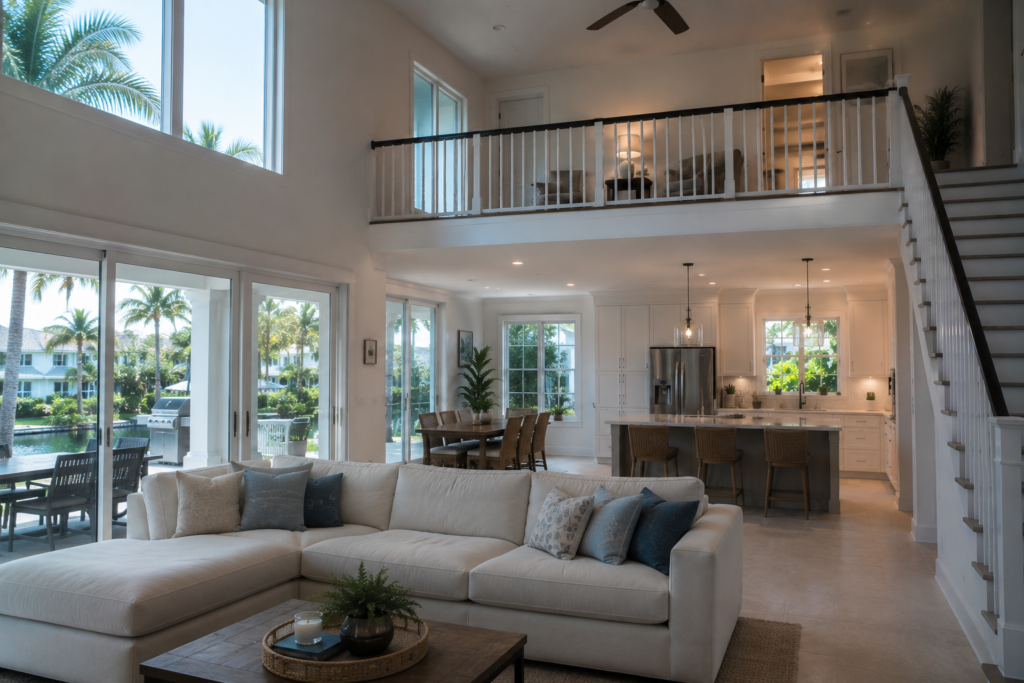
Many homeowners notice that the upstairs can feel completely different from the downstairs during humid weather. Some upper floors feel warmer and harder to cool, while others develop a heavier, stuffier feeling that lingers even when the air conditioner seems to be running constantly.
What makes this frustrating is that the problem often does not feel straightforward. The thermostat may appear normal. Cool air may still be coming from the vents. The downstairs may feel relatively comfortable. Yet the upper portion of the house continues feeling different for reasons that are not always obvious.
While warm air naturally rises, that alone does not fully explain why upper floors can behave so differently from the rest of the home.
In many houses, the upstairs is responding differently to heat, airflow, moisture, and the structure itself — often all at the same time.
The Upstairs Exists in a Completely Different Environment Than the Downstairs
The upstairs is exposed to different conditions than the lower part of the house.
Upper floors typically sit closer to:
- roofing systems
- attic heat
- upper wall cavities
- solar radiation
- heated ceiling surfaces
At the same time, upper floors are often farther from:
- the air handler
- major return pathways
- cooler foundation temperatures
- thermally stable lower structural materials
That difference matters more than many homeowners realize.
The upstairs is usually dealing with:
- greater heat exposure
- slower heat removal
- weaker airflow
- stronger radiant heat
- more trapped humidity
all at the same time.
Meanwhile, the downstairs often benefits from:
- denser cool air settling lower
- more stable temperatures near the foundation
- reduced roof exposure
- less radiant heat from above
This is one reason two floors in the same home can feel like completely different environments even when the thermostat reading does not look dramatically different.
Warm Air Rises — But Heat Also Builds and Stays Trapped Upstairs
Most people have heard that warm air rises. That is true, but it is only part of the explanation.
What many homeowners are actually experiencing is heat accumulation inside the structure itself.
Roofing systems absorb solar radiation for hours. That heat moves into:
- roof decking
- attic framing
- insulation
- ceiling assemblies
- upper wall cavities
Over time, surrounding materials begin storing thermal energy.
This is important because building materials do not instantly cool once outdoor temperatures begin dropping. Instead, they slowly release stored heat back into surrounding spaces.
This process is often called thermal lag.
It is one reason the upstairs may still feel warm or stuffy long after outdoor conditions improve. The structure itself is still releasing heat into the upper floor.
This also helps explain why:
- upstairs rooms often feel worse later in the day
- upper levels cool more slowly
- some homes feel warmer upstairs even overnight
- certain rooms seem to hold heat for hours
The issue is often not simply hot air. It is stored structural heat continuing to radiate into the living space.
Roofing Systems Affect Upstairs Comfort More Than Many Homeowners Realize
The roof is one of the largest heat-collecting surfaces on the house.
During humid weather, roofing materials absorb large amounts of solar energy throughout the day. That energy eventually transfers downward into surrounding assemblies.
Roof color, roofing material, roof orientation, ventilation, and shading all affect how much heat reaches the upper floor.
Several roofing conditions can make upstairs discomfort worse:
- dark roof surfaces
- intense western sun exposure
- minimal tree shading
- poorly ventilated attic spaces
- rooflines directly over living areas
- older roofing systems retaining more heat
This is why two homes in the same neighborhood can feel completely different upstairs even with similar HVAC systems.
One lesser-known issue is radiant heat transfer.
Even if the upstairs air temperature does not seem extreme, warm ceilings and upper walls can still radiate heat into the room. The body senses this radiant heat from surrounding surfaces, not just the air temperature itself.
This is one reason a room can feel uncomfortable even when the thermostat says it should feel fine.
Attics Often Become Heat Reservoirs
Attics play a major role in upstairs comfort.
During humid weather, attic temperatures can rise substantially above outdoor temperatures because the attic traps:
- heated air
- radiant energy
- stored thermal energy within framing and decking
Many homeowners assume attic ventilation completely removes this heat. In reality, attics often continue holding and releasing heat throughout the day.
The upstairs essentially sits beneath one of the hottest parts of the structure.
That heat slowly radiates downward into:
- ceilings
- framing
- insulation
- ductwork
- upper wall assemblies
This becomes especially noticeable when:
- attic insulation is insufficient
- attic air leaks exist
- recessed lighting allows heat transfer
- HVAC ducts run through hot attic spaces
- attic hatches are poorly sealed
- humid attic air infiltrates living areas
In many homes, attic conditions become one of the largest reasons the upstairs behaves differently than the downstairs.
Humidity Changes How Heat Behaves Inside the Home
Humidity affects more than comfort alone.
Moisture changes how heat is stored, transferred, and removed inside the structure.
Air conditioning systems remove:
- sensible heat (temperature)
- latent heat (moisture)
In humid weather, the HVAC system must manage both simultaneously.
This is one reason the upstairs can feel uncomfortable even when the thermostat reading appears relatively normal.
The upper floor often experiences:
- greater heat gain
- slower moisture removal
- weaker airflow
- warmer surrounding surfaces
at the same time.
Humidity also changes how efficiently materials dry and release heat. Moist materials can hold thermal energy differently than dry materials, especially after prolonged periods of humid weather.
This contributes to the:
- heavy
- sticky
- stale
- stagnant
feeling many homeowners notice upstairs.
The problem is usually not temperature alone. It is the interaction between:
- humidity
- radiant heat
- stored structural heat
- airflow limitations
- slower cooling
all working together simultaneously.
Airflow Often Weakens Upstairs
Many upstairs comfort problems are partially airflow problems.
Upper rooms are frequently:
- farther from the air handler
- located at the end of duct runs
- more difficult to balance evenly
- exposed to greater heat load
As airflow weakens, cooled and dehumidified air may not circulate evenly throughout the upper level.
Several issues commonly worsen upstairs airflow:
- leaking attic ducts
- undersized returns
- crushed flex duct
- closed interior doors
- blocked returns
- poor balancing between floors
- insufficient return pathways
One important detail many homeowners do not realize is that supply air alone does not solve comfort problems.
Air also needs to return effectively to the HVAC system.
If cooled air enters a room but cannot circulate back properly, the space may begin trapping:
- heat
- humidity
- stagnant air
This is one reason some upstairs rooms feel stuffy even when cool air is actively coming from the vents.
Stack Effect Slowly Pulls Heat and Humidity Upward
Homes naturally move air vertically.
As warm air rises, it creates pressure differences inside the structure. This process is called stack effect.
In humid weather, stack effect can gradually pull:
- warm air
- humid air
- attic air
- indoor moisture
upward through:
- stairwells
- framing gaps
- wall cavities
- ceiling penetrations
- attic bypasses
Small air leaks become much more important here than many homeowners realize.
Tiny openings around:
- recessed lights
- wiring penetrations
- attic hatches
- plumbing chases
- framing gaps
can slowly allow heat and humidity to move throughout the structure.
This movement is often invisible, but over time it contributes to upstairs heat buildup and humidity imbalance.
Insulation Influences Surface Temperatures and Thermal Stability
Many people think insulation only affects energy efficiency. In reality, insulation also affects:
- heat transfer speed
- surface temperatures
- comfort stability
- thermal consistency
- moisture behavior inside assemblies
Upper floors are exposed to stronger heat loads than lower portions of the home because they sit closer to attic and roofing conditions.
If insulation is:
- thin
- compressed
- uneven
- missing
- poorly installed
- moisture affected
heat moves into the living space more easily.
This affects not only the air temperature, but also the temperature of:
- ceilings
- upper walls
- nearby surfaces
A room may technically reach the thermostat setting while still feeling uncomfortable because surrounding surfaces are radiating warmth into the space.
Humidity can amplify this problem because moisture movement through assemblies affects how materials absorb and release thermal energy over time.
Foundations Help Explain Why Downstairs Often Feels More Stable
The downstairs often feels more stable because it sits closer to the foundation and ground.
Concrete slabs, crawl spaces, and lower structural materials usually change temperature more slowly than upper portions of the home exposed to roof heat and attic conditions.
This thermal stability helps explain why:
- downstairs rooms often remain cooler longer
- lower levels feel less reactive
- upper floors fluctuate more dramatically
Foundation moisture can also influence indoor humidity throughout the home.
In some homes:
- damp crawl spaces
- slab moisture intrusion
- poor drainage
- vapor movement through foundations
increase the home’s overall moisture load, which can further complicate upstairs comfort.
This does not mean foundations directly cause upstairs heat problems. It means lower and upper levels are operating under very different environmental conditions simultaneously.
Certain Upstairs Rooms Often Feel Worse Than Others
Not every upstairs room behaves the same way.
A room beneath a roof slope may feel dramatically different than an interior loft. A west-facing office may absorb more radiant heat than a shaded hallway. A room over a garage may behave differently than a room over conditioned space.
Upper-floor comfort is heavily influenced by:
- room orientation
- roofline proximity
- window exposure
- airflow strength
- attic adjacency
- insulation quality
- return airflow access
This is why one room may feel dramatically worse than another even within the same upper floor.
The Less Obvious Science: Mean Radiant Temperature
One scientific concept many homeowners never hear about is mean radiant temperature.
Comfort is not determined only by air temperature.
The body also responds to the temperature of surrounding surfaces.
Warm ceilings, walls, windows, and nearby materials radiate heat toward occupants. Even when the thermostat reading appears acceptable, those surrounding surfaces can still make the room feel uncomfortable.
This helps explain why:
- upper floors can feel warmer than the thermostat suggests
- some rooms feel oppressive despite “normal” temperatures
- ceiling temperature matters
- radiant heat feels different than air temperature alone
In humid weather, this effect becomes even more noticeable because the body is already cooling less efficiently.
According to Building Science Experts
Building Science Corporation explains the relationship clearly:
“Heat flow, air flow, and moisture flow are highly interrelated and must be considered together.”
That is ultimately why upstairs comfort problems rarely have one simple cause.
The issue is usually created by:
- roofing heat
- attic conditions
- airflow limitations
- humidity accumulation
- insulation performance
- duct behavior
- radiant heat transfer
- pressure differences
all interacting together inside the same structure.
Common Reasons the Upstairs Feels Different
| What Homeowners Notice | What Is Often Happening | What May Help |
| Upstairs feels warmer | Roofing and attic heat are accumulating above the living space | Improve attic insulation, airflow, and ventilation |
| Upstairs feels humid | Moisture removal is lagging behind cooling demand | Improve circulation and humidity control |
| One room feels dramatically hotter | Solar exposure or airflow imbalance differs in that room | Check airflow and sun exposure |
| Air feels stale or stuffy | Return airflow may be weak | Improve return pathways and circulation |
| Upstairs cools slowly | Surrounding materials are still releasing stored heat | Reduce attic heat transfer |
| Thermostat says normal but room feels warm | Mean radiant temperature is still elevated | Address hot surrounding surfaces and airflow |
Practical Solutions That Actually Help
Improving upstairs comfort usually requires addressing multiple smaller issues together rather than searching for one single cause.
Improve Airflow Between Floors
Good airflow helps distribute cooled and dehumidified air more evenly throughout the home.
Helpful steps may include:
- keeping vents unobstructed
- checking upstairs return airflow
- using ceiling fans for circulation
- improving airflow between rooms
- reducing blocked returns
Reduce Attic Heat Transfer
Attic conditions strongly affect upstairs comfort.
Helpful improvements may include:
- upgrading insulation
- sealing attic air leaks
- improving attic ventilation
- insulating attic ductwork
- reducing radiant heat beneath roofing systems
Evaluate HVAC Performance
If upper floors consistently struggle, the HVAC system may need evaluation.
Potential issues include:
- duct leakage
- airflow imbalance
- undersized returns
- poor humidity removal
- insufficient run times
- improperly balanced airflow
Improve Humidity Control
Humidity management is critical for comfort.
Helpful strategies may include:
- monitoring indoor humidity levels
- reducing indoor moisture buildup
- improving circulation
- using dehumidification when necessary
- ensuring bathroom and kitchen exhaust systems function properly
If the upstairs consistently feels different, the TempPro Temp Air 2-Sensor can help you compare conditions between floors instead of relying on how each space feels.
When to Call a Professional
Some difference between floors is normal. Severe or persistent differences may justify professional evaluation.
It may be worth investigating further if you notice:
- major temperature differences between floors
- persistently high humidity upstairs
- weak airflow from vents
- musty smells upstairs
- condensation around vents or windows
- rooms that never seem comfortable
- unusually high cooling costs
- visible attic moisture or insulation problems
The correct professional depends on the pattern:
- HVAC contractors evaluate airflow and duct systems
- insulation professionals evaluate thermal transfer and air sealing
- roofing professionals assess roofing and attic behavior
- crawl space or foundation specialists investigate lower moisture issues
Frequently Asked Questions
Is it normal for the upstairs to feel warmer than the downstairs?
Some difference between floors is common because upper levels sit closer to roof heat and naturally collect rising warm air. Severe differences often involve airflow imbalance, attic heat transfer, humidity retention, or insulation issues.
Why does the upstairs feel humid even when the AC is running?
The HVAC system may be lowering temperature faster than it removes moisture upstairs. Weak airflow, attic heat, duct issues, or short cycling can all contribute.
Why does one upstairs room feel dramatically worse?
Room orientation, window exposure, airflow strength, roofline proximity, and insulation quality can all influence how individual rooms behave.
Can insulation really affect upstairs comfort that much?
Yes. Insulation affects how quickly heat moves into the living space and how warm surrounding surfaces become.
Does the roof really affect upstairs temperatures?
Absolutely. Roofing systems continuously absorb solar heat, which eventually transfers into attic spaces and surrounding assemblies near the upper floor.
Should lowering the thermostat solve the problem?
Not always. Many upstairs comfort problems involve airflow, humidity, attic heat transfer, or radiant heat rather than thermostat settings alone.
The Bottom Line
The upstairs often feels dramatically different from the downstairs during humid weather because the upper portion of the home is exposed to a completely different combination of heat, airflow, moisture, and structural conditions.
Roofing systems absorb and release heat for hours, attics store thermal energy, airflow weakens farther from HVAC equipment, and humidity changes how heat lingers inside the structure itself. At the same time, lower levels often remain more thermally stable because they sit farther from roofing heat and closer to the foundation.
The result is often a home where the upstairs and downstairs no longer behave like the same environment — even when the thermostat appears normal.