
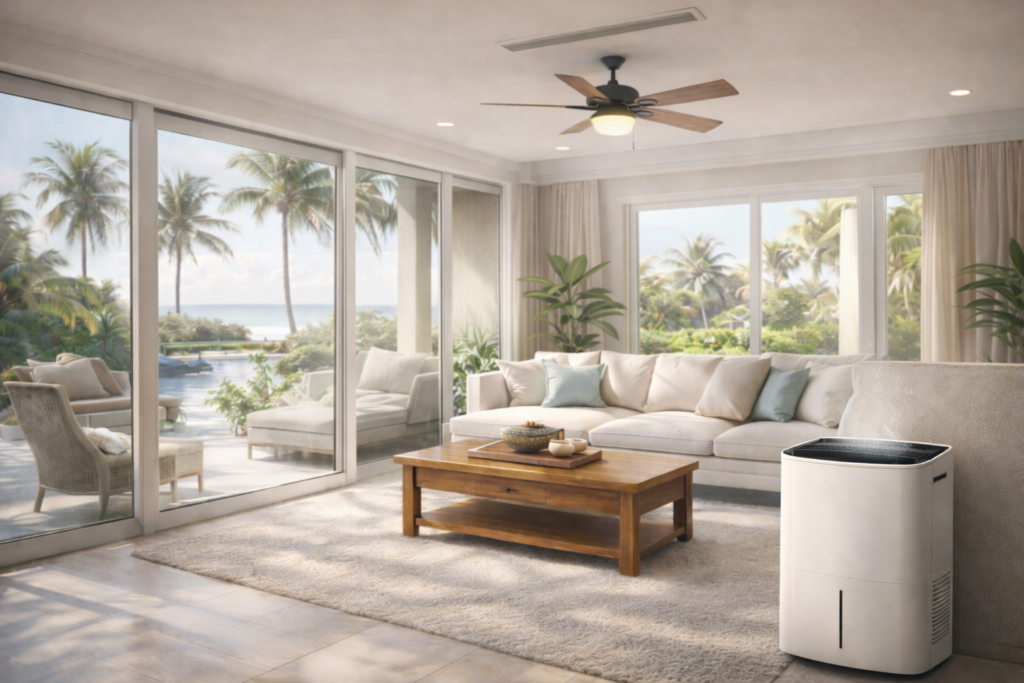
A home can reach its set temperature and still feel noticeably warmer than expected. The air does not feel neutral or balanced—it feels slightly resistant, heavier, and slower to cool the body.
This is not a thermostat error, and it is not always a cooling failure.
It is the result of elevated indoor moisture altering how heat is exchanged between the body and the surrounding air.
When humidity rises, the body’s primary cooling mechanism—evaporation—becomes less effective. As a result, the same measured air temperature produces a different physiological response. The environment feels warmer, even though the temperature has not changed.
Why This Occurs More Frequently in Humid Climates
In humid regions, indoor environments rarely begin from a dry baseline. Moisture is continuously introduced through both external and internal sources, and removal is often incomplete.
Moisture load inside the home typically includes:
• infiltration of humid outdoor air through leakage pathways
• upper floors that retain heat and humidity longer because of attic exposure, weaker airflow, and slow moisture removal
• latent moisture generated from bathing and laundry
• kitchens, cooking, and food storage spaces that regularly generate and retain moisture
• cooling systems that reduce sensible heat faster than latent moisture
Over time, this creates a condition where indoor air maintains an elevated moisture content relative to what the cooling system is removing. This imbalance does not need to be extreme. Even moderate elevations in indoor humidity can significantly affect perceived comfort.
Why Humidity Changes Thermal Perception
Indoor comfort is governed by heat transfer, not temperature alone.
The human body dissipates heat through:
• convection (air movement)
• radiation (exchange with surrounding surfaces)
• evaporation (moisture leaving the skin)
Of these, evaporation becomes the dominant mechanism in warm indoor conditions.
When relative humidity increases:
• the vapor pressure gradient between skin and air decreases
• evaporation slows
• heat remains in the body longer
This produces a measurable shift in perceived temperature, even when air temperature remains constant. This is the reason a home can feel hotter than the thermostat reading: the thermal environment is no longer supporting efficient heat loss.
Why the Thermostat Does Not Capture This
Standard residential thermostats measure dry-bulb temperature. They do not evaluate latent heat or moisture content.
This creates a disconnect between:
• system performance (temperature reached)
• occupant experience (comfort achieved)
From the system’s perspective, the cooling demand has been satisfied. From the occupant’s perspective, it has not.
This is why homeowners often interpret the issue incorrectly as:
• insufficient cooling capacity
• equipment inefficiency
• thermostat inaccuracy
In reality, the system is achieving temperature control but not necessarily moisture balance.
Humidity and Perceived Temperature Relationship
The relationship between humidity and perceived warmth is not linear, but it is predictable.
| Relative Humidity | Thermal Effect Indoors | Perceived Result |
| 40-50% | Balanced heat exchange | Neutral comfort |
| 50-60% | Reduced evaporative cooling | Slight warmth |
| 60-65% | Noticeable reduction in heat loss | Feels warmer than set temperature |
| 65%+ | Significant evaporation limitation | Persistent warmth, heavy air |
This is not a change in temperature. It is a change in how the body interacts with the environment.
Why Lowering the Thermostat Does Not Resolve the Issue
Lowering the thermostat addresses sensible temperature but does not directly address latent moisture.
When humidity remains elevated:
- air temperature decreases
- moisture content remains relatively unchanged
- evaporative cooling remains impaired
This often results in a condition where:
- surfaces feel cooler
- air still feels thermally uncomfortable
In some cases, overcooling can introduce secondary issues, including condensation risk and uneven temperature distribution, without improving comfort.
System Behavior That Contributes to the Problem
This condition is often tied to how the cooling system operates within the home.
Common contributors include:
- Short cycling
Systems that reach temperature quickly do not run long enough to remove latent moisture. - Oversized equipment
Larger systems reduce runtime, limiting dehumidification. - Airflow imbalance
Uneven distribution allows moisture to accumulate in certain zones. - Infiltration-driven humidity load
Outdoor moisture entering the home exceeds removal capacity.
These are performance characteristics, not necessarily failures.
Professional Perspective
“Thermal comfort is a function of both temperature and humidity. Elevated humidity reduces the body’s ability to reject heat through evaporation, which can significantly increase perceived temperature even when air temperature remains constant.”— American Society of Heating, Refrigerating and Air-Conditioning Engineers (ASHRAE)
This distinction between temperature and thermal perception is central to understanding indoor comfort in humid climates.
When This Is Within Normal Range vs. When It Indicates Imbalance
A mild difference between measured temperature and perceived comfort is expected in humid environments.
However, persistent conditions may indicate imbalance.
More typical conditions:
- slight warmth during high outdoor humidity periods
- temporary discomfort following moisture-generating activities
Less typical conditions:
- consistent feeling of warmth despite stable temperature
- prolonged heavy or stagnant indoor air
- lack of improvement with extended system operation
These patterns suggest that moisture removal is not keeping pace with moisture load.
What Homeowners Can Adjust
Improving comfort requires addressing moisture behavior, not only temperature control.
Relevant adjustments include:
- increasing effective system runtime to allow latent moisture removal
- reducing indoor moisture sources during peak conditions
- improving airflow continuity between spaces
- monitoring relative humidity rather than relying on temperature alone
These changes support alignment between temperature and perceived comfort.
Frequently Asked Questions
Why does my house feel hotter than the thermostat says even when the AC is running?
Because humidity is reducing your body’s ability to release heat. The temperature is correct, but the thermal environment feels warmer.
Does humidity actually raise the temperature indoors?
No. The measured temperature remains the same. Humidity affects how that temperature is experienced.
What humidity level starts to affect comfort indoors?
Comfort typically begins to decline above ~50–60% relative humidity, depending on conditions.
Why does lowering the thermostat not fix the problem?
Because temperature reduction does not remove moisture. Without addressing humidity, comfort remains limited.
The Bottom Line
A home that feels warmer than the thermostat reading is not necessarily warmer in temperature.It is operating in a different thermal condition, where elevated moisture reduces the body’s ability to release heat. Until humidity and temperature are aligned, the home can continue to feel warmer than it actually is—regardless of the thermostat setting.