
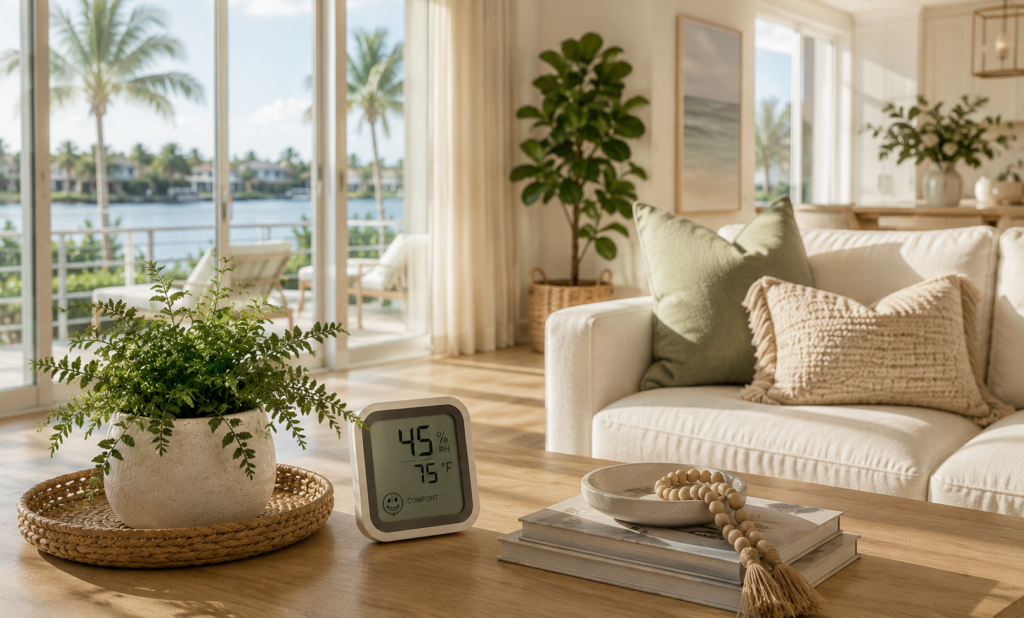
Indoor humidity affects far more than comfort. It changes how a home dries, how air feels, how materials behave, how long surfaces stay damp, and how easily musty conditions develop over time. In humid climates, moisture in the air often becomes one of the biggest hidden forces affecting daily life inside a home.
Many homeowners first notice humidity indirectly. The house may feel “off” even though the thermostat looks normal. Bathrooms stay damp longer than expected. Closets smell stale. Bedding feels slightly clammy at night. Air conditioning runs, but the home still feels heavy or stuffy.
Most advice online simplifies indoor humidity down to a single number, usually suggesting homes stay somewhere around 30% to 50% relative humidity. While that range is a useful starting point, real homes are more complicated than that — especially in humid climates where outdoor moisture levels remain high for much of the year.
The better question is not simply “What humidity should my house be?” It is also:
- How long is humidity staying elevated?
- Which rooms are affected?
- How well is the home drying after normal moisture exposure?
- Is the air conditioner removing enough moisture?
- Is humidity stable or constantly swinging?
Once homeowners begin looking at humidity this way, many confusing comfort and moisture issues start making much more sense.
What Indoor Humidity Actually Means
Indoor humidity usually refers to relative humidity. Relative humidity measures how much moisture is in the air compared to how much moisture the air could hold at that same temperature.
This is important because warm air can hold far more moisture than cool air. A room at 75°F and 55% humidity contains more actual moisture than a cooler room at the same relative humidity.
That means humidity is not just about the number on a hygrometer. Temperature changes how moisture behaves inside a home and how that moisture feels to people living there.
This is one reason two homes with the exact same humidity reading can feel completely different. Airflow, surface temperatures, insulation, room usage, ventilation, and cooling performance all influence how humidity behaves indoors.
Humidity also does not distribute evenly throughout a house. Bathrooms, closets, storage rooms, large gun safes, garages, bedrooms, and laundry areas often hold moisture differently than open living spaces. A home may technically average 50% humidity while several smaller spaces remain significantly more humid.
What Is Considered An Ideal Indoor Humidity Level?
For most homes, a practical indoor humidity target is usually around 40% to 50% relative humidity. That range generally balances comfort, moisture control, and normal material behavior well.
In humid climates, many homes realistically fluctuate somewhat higher at times, especially during summer or mild humid weather. Short-term humidity increases are normal after showers, cooking, storms, or doors opening frequently.
The larger concern is not brief spikes. It is prolonged elevated humidity.
Most indoor moisture guidance recommends trying to keep indoor humidity below 60% whenever possible. Once humidity regularly stays near or above that level, homes become more likely to develop persistent dampness, musty odors, condensation, and moisture-related material problems over time.
In real-world humid climates, consistency matters more than perfection. A house that stays relatively stable around 48% to 55% humidity often behaves much better than a home constantly swinging between very dry and very humid conditions.
| Indoor Relative Humidity | What It Usually Means | Typical Home Impact |
| Below 30% | Dry indoor air | Can feel harsh or dry in some homes |
| 30% – 40% | Dry to comfortable | Often common in cooler climates |
| 40% – 50% | Comfortable range for many homes | Strong balance for comfort and moisture control |
| 50% – 55% | Slightly elevated but often manageable | Common in humid climates |
| 55% – 60% | Higher moisture load | Dampness and musty conditions become more likely |
| Above 60% | Persistently elevated humidity | Greater risk for ongoing humidity-related issues |
| Above 65% | Excess indoor moisture | Often requires corrective action |
Why Humidity Feels Different In Humid Climates
Humidity behaves differently in humid climates because outdoor air already carries a large amount of moisture before it ever enters the house.
Every time doors open, outdoor air leaks indoors, ventilation systems exchange air, or bathroom exhaust fans pull replacement air into the home, moisture enters with it.
The air conditioner is responsible for handling both temperature and moisture. Many homeowners focus only on cooling, but dehumidification is equally important in humid environments.
This is why some homes feel damp even while cool. The AC may successfully lower the temperature without removing enough moisture from the air.
Humid climates also make moisture behavior more noticeable throughout the house. Bathrooms dry slower. Closets smell mustier. Carpets feel heavier. Bedding feels less crisp overnight. Towels remain damp longer. Rooms with poor airflow become noticeably stuffier.
In dry climates, these differences are often smaller. In humid climates, they become much more obvious because the surrounding outdoor environment constantly adds moisture pressure to the home.
Why Temperature Changes How Humidity Feels
Many homeowners assume cooler air automatically means drier air, but temperature and humidity are not the same thing.
A home can feel cool while still holding a large amount of moisture in the air. This is one reason some homes feel clammy even when the thermostat is set low.
Lowering the thermostat reduces air temperature, but it does not always remove enough moisture to improve comfort. In some situations, lowering the temperature too aggressively can actually make cool surfaces more likely to collect condensation while the underlying humidity problem remains.
For example, a room at 78°F and 45% humidity will often feel more comfortable than a room at 72°F and 60% humidity, even though the second room is cooler. The second room contains more moisture in the air, which can make fabrics, skin, bedding, and indoor air feel heavier and slower to dry.
This is why homeowners sometimes describe humid homes as feeling “cold and damp” at the same time.
A related concept called dew point helps explain this. Relative humidity changes as temperature changes, but dew point reflects how much actual moisture is present in the air. Higher dew points generally feel muggier and place more moisture stress on indoor environments.
Homeowners do not need to calculate dew point regularly, but understanding the concept helps explain why some homes continue feeling humid even when indoor temperatures appear comfortable.
Why 60% Humidity Matters
The 60% range is important because many moisture-related issues become more likely once indoor humidity stays elevated for long periods.
This does not mean mold suddenly appears at exactly 60%. Moisture behavior is more gradual than that. But once homes consistently remain near or above this range, materials and surfaces tend to stay damp longer and dry less efficiently.
The EPA states:
“If possible, keep indoor humidity below 60 percent (ideally between 30 and 50 percent) relative humidity.”
That recommendation matters because prolonged elevated humidity changes how a house behaves overall. Moisture lingers longer on surfaces and inside materials, especially in bathrooms, closets, storage spaces, carpets, fabrics, and low-airflow rooms.
Persistently elevated humidity may contribute to:
- Musty, damp, stale, or unusual odors
- Damp-feeling rooms
- Slow-drying bathrooms
- Condensation on cooler surfaces
- Heavier-feeling indoor air
- Moisture-sensitive material wear
- Dust mite activity
- Increased strain on cooling systems
Over time, elevated humidity can also affect cardboard storage, paper products, leather items, wood materials, fabrics, and electronics, particularly in closed spaces with limited airflow.
Why Humidity Problems Are Often Worse In Newer Homes
Many homeowners assume newer homes should automatically have fewer humidity problems, but newer construction can sometimes create more complicated indoor moisture behavior.
Modern homes are usually built much tighter than older homes. Better insulation, improved windows, tighter building envelopes, and energy-efficiency standards reduce uncontrolled air leakage. While this improves energy performance, it can also allow indoor moisture to remain trapped more easily if ventilation and dehumidification are not balanced correctly.
Newer homes may also contain oversized air conditioning systems. Larger systems cool homes quickly, but shorter cooling cycles can reduce moisture removal because the system satisfies the thermostat before enough humidity is removed from the air.
This can create a frustrating situation where the house reaches the desired temperature but still feels slightly damp or stuffy.
Some newer homes also contain significant construction moisture during the first year or two after completion. Concrete, framing lumber, paint, drywall compounds, flooring materials, and other building products release moisture slowly over time.
This is one reason newer homes can still develop musty odors, slow-drying bathrooms, damp closets, or humidity complaints even when the home appears modern and well built.
Why Some Rooms Feel More Humid Than Others
Humidity rarely behaves evenly throughout an entire home.
Bathrooms naturally accumulate moisture from showers and sinks. Laundry rooms produce moisture from washing and drying. Kitchens release moisture during cooking. Bedrooms often trap humidity overnight because doors remain closed for long periods.
Closets and storage spaces behave differently because they usually have limited airflow. Air movement helps moisture evaporate and dry surfaces. When airflow remains limited, fabrics, shoes, cardboard, walls, and stored belongings can hold moisture longer.
Garage-adjacent rooms often behave differently as well. Garages in humid climates frequently hold heat and moisture, which can influence nearby interior rooms.
Rooms near exterior walls, attics, poorly insulated spaces, or ductwork may also experience different humidity patterns than interior living spaces.
This is why a single hygrometer reading from one hallway or living room often does not tell the whole story.
Why Humidity Often Rises At Night
Many homeowners notice their homes feel more humid overnight or early in the morning. This is extremely common in humid climates.
Outdoor humidity often rises during nighttime hours as temperatures cool. At the same time, many homes require less cooling overnight, so the air conditioner runs less frequently.
That creates a situation where moisture removal decreases while outdoor humidity remains high.
Bedrooms can become especially uncomfortable overnight because:
- Doors remain closed
- Airflow becomes more limited
- People exhale moisture while sleeping
- Bedding and fabrics retain warmth and moisture
- Cooling cycles may shorten overnight
This is one reason homes sometimes feel stuffier in the morning even though temperatures were lower overnight.
Why Air Conditioning Alone Does Not Always Control Humidity
Air conditioners remove humidity by pulling warm indoor air across a cold evaporator coil. Moisture condenses on the coil and drains away.
For this process to work effectively, the system needs sufficient runtime and proper airflow.
If an AC system cools the house too quickly, it may shut off before removing enough moisture. This is especially common with oversized systems.
Humidity control can also suffer when:
- HVAC airflow is incorrect
- Drain lines are restricted
- Filters are dirty
- Duct leakage is present
- Outdoor air infiltration is excessive
- Thermostat settings reduce runtime too much
- The HVAC fan is left set to “on” instead of “auto”
Many homeowners assume constant fan circulation improves humidity control, but in humid climates, leaving the fan continuously running can sometimes reintroduce moisture from the evaporator coil back into the air between cooling cycles.
This can make indoor humidity worse even while air movement increases.
Common Humidity Myths Homeowners Believe
“If The AC Is Running, Humidity Must Be Controlled”
Not necessarily. Air conditioners can lower temperature without adequately removing moisture, especially if systems are oversized or short cycling.
“Cooler Air Means Drier Air”
A room can feel cool while still holding a large moisture load.
“Humidity Is Only A Summer Problem”
Humidity issues often continue year-round in humid climates, especially in bathrooms, closets, garages, storage areas, and closed-up homes.
“One Hygrometer Reading Tells The Whole Story”
Humidity often varies dramatically between rooms.
“Bathroom Fans Solve Humidity Problems”
Bathroom fans help remove shower moisture, but they do not automatically solve whole-home humidity conditions.
How To Measure Indoor Humidity More Accurately
The easiest way to monitor indoor humidity is with digital hygrometers. These are inexpensive and useful, but readings naturally vary slightly between devices.
The pattern matters more than achieving perfect precision.
It is often helpful to check humidity in:
- Main living areas
- Bedrooms
- Bathrooms
- Closets
- Laundry rooms
- Garage-adjacent rooms
- Closed-up spaces
Look for trends over time rather than isolated readings.
Pay attention to:
- Whether humidity stays elevated for hours
- Whether certain rooms consistently read higher
- Whether humidity rises overnight
- Whether bathrooms dry slowly
- Whether musty odors increase during humid weather
- Whether the home feels damp despite cooling
These patterns usually provide more useful information than one single humidity number.
What Homeowners Can Do To Improve Indoor Humidity Control
Humidity control works best when multiple smaller factors are improved together rather than relying on a single fix.
Helpful steps often include:
- Running bathroom exhaust fans during and after showers
- Using kitchen exhaust during cooking
- Keeping HVAC filters clean
- Using the HVAC fan “auto” setting instead of constant fan operation
- Improving airflow in closets and closed rooms
- Avoiding storing damp fabrics indoors
- Ensuring dryers vent outdoors properly
- Monitoring humidity during mild humid weather
- Checking for hidden leaks or drainage problems
- Using dehumidifiers when humidity stays persistently elevated
In humid climates, the goal is not perfectly dry air. The goal is helping the home recover and dry normally after everyday moisture exposure.
When A Dehumidifier Makes Sense
A dehumidifier may help when humidity remains elevated even though the air conditioner appears to function normally.
This is especially common in:
- Humid coastal climates
- Oversized HVAC systems
- Mild humid weather
- Closed-up homes
- Tighter newer homes
- Homes with persistent musty odors
- Rooms with recurring dampness
Portable dehumidifiers may help individual rooms, while whole-home dehumidifiers may help larger or persistently humid homes.
A dehumidifier is not a substitute for fixing leaks or major HVAC problems, but it can significantly improve indoor moisture control when used appropriately.
Frequently Asked Questions
Is 60% Humidity Too High Indoors?
Short-term spikes are common after showers, storms, or cooking. The larger concern is humidity remaining above 60% for extended periods.
Is 55% Indoor Humidity Okay?
In humid climates, 55% may be manageable if the home feels comfortable and surfaces dry normally. Persistent humidity much above that range becomes more concerning over time.
Why Does My House Feel Humid Even When It’s Cool?
Cooling and dehumidification are not identical. Your AC may be lowering temperature without removing enough moisture.
What Humidity Level Is Best For Florida Homes?
Many Florida homes perform best around 45%–55% relative humidity, while still aiming to remain below 60% whenever possible.
Should I Lower My Thermostat To Reduce Humidity?
Sometimes longer AC runtime can improve dehumidification, but lowering temperature excessively does not always solve humidity problems and may increase condensation on cooler surfaces.
Why Does My Bedroom Feel More Humid At Night?
Closed doors, reduced airflow, overnight humidity increases, shorter AC runtime, and moisture from breathing and bedding can all contribute.
Does Opening Windows Help With Humidity?
In humid climates, opening windows often introduces additional moisture indoors rather than improving humidity conditions.
Is A Whole-Home Dehumidifier Worth It?
For some humid-climate homes, especially tighter newer homes or homes with oversized HVAC systems, whole-home dehumidifiers can substantially improve comfort and moisture control.
The Bottom Line
For most homes, an indoor humidity range around 40%–50% is generally ideal, while humid-climate homes often function realistically closer to the mid-40s through mid-50s. Short-term fluctuations are normal. Persistent humidity above 60% is more likely to create long-term moisture and comfort problems.
Indoor humidity affects far more than whether a room feels warm or cool. It influences how quickly a home dries, how surfaces behave, how materials age, how air feels overnight, and how well an air conditioning system manages indoor moisture.
The most useful approach is not chasing one perfect number every hour of the day. It is understanding how humidity behaves throughout the home, watching for patterns over time, and helping the house dry consistently after normal daily moisture exposure.