
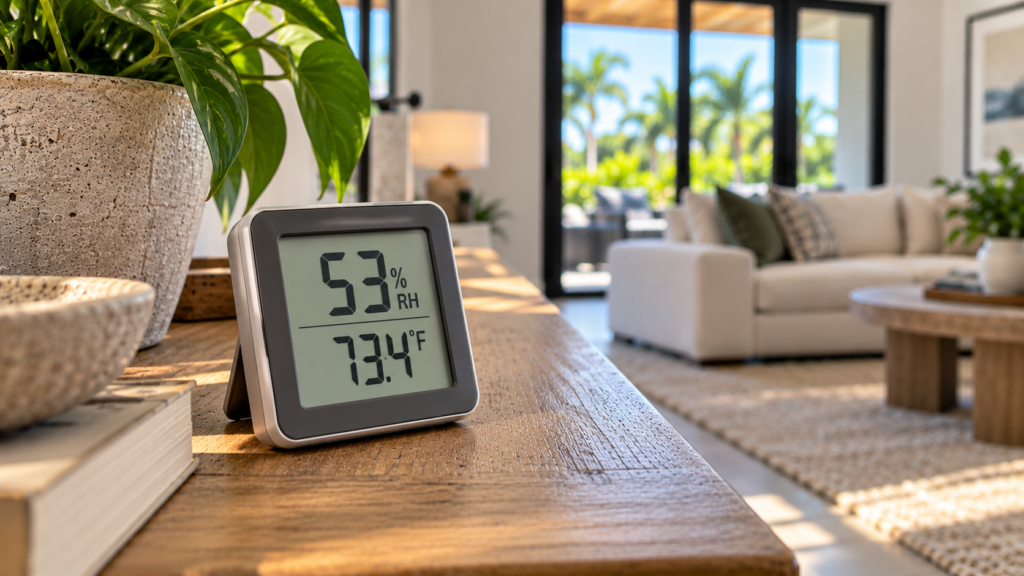
Indoor humidity plays an important role in home comfort, moisture control, and indoor air quality. However, determining whether your home’s humidity is too high or too low requires more than checking the thermostat or relying on how the air feels.
A hygrometer provides a direct measurement of relative humidity, allowing homeowners to monitor indoor conditions and identify patterns that may contribute to condensation, dampness, or discomfort.
Accurate measurements depend on where the device is placed, how long it has been allowed to stabilize, and when readings are collected. A single measurement may provide a useful snapshot, but monitoring humidity over time offers a more complete picture of the conditions inside your home.
This article contains affiliate links. If you make a purchase through one of these links, The Humid House may earn a small commission at no additional cost to you.
What Is a Hygrometer?
A hygrometer is an instrument used to measure the amount of moisture in the air. Most household hygrometers display relative humidity (RH) as a percentage, often alongside the indoor temperature.
Relative humidity describes how much water vapor is present in the air compared with the maximum amount the air could hold at that temperature, expressed as a percentage.
For example, a reading of 55% RH means the air contains approximately 55% of the water vapor required for saturation at its current temperature.
Because warmer air has a greater capacity to hold water vapor, relative humidity changes as temperature changes—even when the actual amount of moisture in the air remains the same.
This distinction is important when comparing humidity measurements between rooms or interpreting changes throughout the day.
Digital vs. Analog Hygrometers
Homeowners typically encounter two types of hygrometers:
Digital hygrometers use electronic sensors to measure relative humidity. Most display both humidity and temperature, and some models include data logging, wireless connectivity, or alerts when readings exceed a selected threshold.
Analog hygrometers use mechanical components that respond to changes in humidity. Although they can provide useful measurements, their accuracy and adjustment requirements vary by design.
For routine household monitoring, a digital thermo-hygrometer is generally the more convenient option.
When selecting a device, look for a clearly stated humidity accuracy specification, preferably ±3% RH or better within the expected measurement range. A device rated at ±3 percentage points may display 53% when the actual humidity is approximately 50%, assuming the device is operating within its specified conditions.
Accuracy specifications should always be interpreted according to the manufacturer’s documentation.
How to Measure Indoor Humidity: Step by Step
Measuring indoor humidity is straightforward, but following a consistent procedure helps eliminate many common sources of error.
Step 1: Choose a Suitable Hygrometer
Start with a digital hygrometer that measures both relative humidity and temperature.
For basic humidity monitoring, the TempPro TP50 Digital Hygrometer is a straightforward option that displays both temperature and relative humidity, along with minimum and maximum reading.
A useful household device should have:
- A stated relative humidity accuracy specification
- A readable temperature and humidity display
- A measurement range appropriate for indoor conditions
- Clear manufacturer instructions
- A calibration or adjustment feature, if available
For homeowners investigating recurring moisture problems, a device that records minimum and maximum readings or logs measurements over time can be particularly valuable.
Smart connectivity is optional. Reliable measurements and consistent placement are more important than additional features.
Step 2: Select the Correct Location
Place the hygrometer in a location representative of the room’s normal occupied conditions.
For general indoor monitoring, position the device approximately 3–5 feet above the floor, such as on an interior shelf, table, or suitable wall-mounted location.
Avoid placing it directly against an exterior wall or in an area where unusual temperatures or airflow may affect the measurement.
Keep the hygrometer away from:
- Direct sunlight
- Air-conditioning supply vents
- Heating registers
- Open windows and exterior doors
- Bathrooms immediately after showering
- Kitchens during cooking
- Humidifiers and dehumidifier outlets
- Appliances that generate heat or moisture
These locations can create localized conditions that do not accurately represent the rest of the room.
For example, a hygrometer positioned directly beneath an air-conditioning vent may measure cooler supply air rather than the room’s average conditions.
Similarly, a device exposed to direct sunlight may warm above the surrounding air temperature, affecting its relative humidity measurement.
The goal is to measure the room’s typical indoor environment—not an unusually warm, cool, wet, or dry location.
Step 3: Allow the Hygrometer to Stabilize
After positioning the device, allow it to adjust to the surrounding temperature and humidity before recording a measurement.
Electronic sensors require time to respond to environmental changes. The appropriate stabilization period depends on the device, airflow, and the difference between its previous and current conditions.
Follow the manufacturer’s recommendations whenever available.
For an initial household measurement, allowing approximately 20–30 minutes in a stable location is a reasonable practical starting point, but some instruments and environmental transitions may require longer.
If the displayed humidity continues changing significantly, allow additional time.
Avoid holding the device in your hand during measurement. Body heat and moisture from breathing can influence readings, particularly with small sensors.
Step 4: Record the Humidity and Temperature
Once the reading has stabilized, record both the relative humidity and the room temperature.
For example:
- Room: Living room
- Time: 9:00 a.m.
- Temperature: 74°F
- Relative humidity: 54%
- Conditions: Air conditioner operating normally
Recording temperature alongside humidity is important because relative humidity depends on temperature.
Two rooms can have different RH readings even when they contain similar amounts of water vapor.
A humidity reading without temperature provides useful information, but both measurements together offer better context for understanding indoor moisture conditions.
Step 5: Repeat Measurements Throughout the Day
Indoor humidity is not constant.
Levels can change as the air-conditioning system cycles, outdoor conditions shift, occupants shower or cook, and moisture is introduced or removed from the home.
For an initial assessment, record readings at approximately the same times each day, such as:
- Morning, before major household activities
- Afternoon, during typical cooling or heating operation
- Evening, after normal daily activities
Repeat this process for at least three days. Monitoring for a full week can reveal additional patterns, particularly when weather conditions or household activities vary.
These time frames are practical monitoring recommendations rather than formal testing requirements.
If your hygrometer automatically records readings, review the changes throughout the day rather than relying exclusively on its current display.
If you’re trying to figure out when your home’s humidity increases, a monitor that records readings over time can be particularly useful. The Govee H5075 connects to your phone through Bluetooth, allowing you to review humidity trends without having to check and record the display throughout the day.
Step 6: Compare Multiple Rooms
A single hygrometer reading does not necessarily represent humidity throughout an entire house.
Bedrooms, bathrooms, laundry rooms, and rooms with different airflow conditions may experience different temperature and humidity patterns.
For a more complete assessment, measure several areas of the home.
Particular attention may be useful in:
- Bedrooms that feel damp or uncomfortable
- Bathrooms with recurring condensation
- Rooms with limited airflow
- Areas near known moisture problems
- Closets or enclosed spaces with musty odors
When using one portable hygrometer, allow it to stabilize after each move.
If using multiple devices, compare them side by side before distributing them throughout the house. This helps identify differences between the instruments themselves.
Remember that small humidity differences between rooms are normal. A persistent, substantial difference deserves further investigation, particularly when accompanied by condensation, odors, or visible moisture.
What Is a Good Indoor Humidity Level?
The U.S. Environmental Protection Agency recommends maintaining indoor relative humidity between 30% and 50% when possible and keeping it below 60% to help control moisture and mold growth.
These recommendations provide useful reference points, but an individual reading should be evaluated in context.
| Relative Humidity | General Interpretation |
| Below 30% | Low humidity; may contribute to dryness and discomfort |
| 30-50% | EPA’s ideal recommended range |
| 51-59% | Above the ideal range; monitor for persistent moisture and condensation |
| 60% or higher | Above EPA’s recommended upper limit; investigate sustained elevated humidity |
A reading of 55% does not automatically indicate a moisture problem, just as a reading of 45% does not guarantee that a home is free of mold or hidden moisture.
The duration of elevated humidity, surrounding temperatures, surface conditions, and presence of moisture sources all matter.
In hot, humid climates, maintaining the ideal range can be challenging, especially when air-conditioning equipment does not remove sufficient moisture.
For Florida homeowners, persistent readings in the upper 50s or above 60% may warrant a closer look at air-conditioning performance, ventilation, and potential sources of moisture.
The Florida Department of Health similarly recommends keeping indoor humidity below 60%, noting that levels below 50% are preferable for controlling mold growth and dust mites.
Where Should You Place Hygrometers Throughout Your Home?
The best location depends on whether you want to monitor overall indoor conditions or investigate a specific concern.
For routine monitoring, begin with a centrally located living area and a frequently occupied bedroom.
For targeted investigations, additional measurements may be useful.
| Location | What the Reading Can Help Evaluate |
| Living room | General conditions in a primary occupied space |
| Bedroom | Overnight and early-morning humidity patterns |
| Bathroom | Moisture buildup and recovery after showering |
| Laundry room | Humidity changes associated with laundry activities |
| Closet | Conditions in enclosed spaces with limited airflow |
| Problem area | Differences associated with condensation, dampness, or odors |
If you suspect humidity varies between rooms, having more than one hygrometer can make comparisons easier. the TempPro TP50 three-pack is a practical option for monitoring areas like living rooms, bedrooms, and closets at the same time.
For bathrooms, compare the humidity before showering, shortly afterward, and during the subsequent drying period. A temporary increase is expected. Humidity that remains elevated for extended periods may suggest inadequate moisture removal.
Avoid exposing instruments to direct water spray or conditions outside their manufacturer’s operating specifications.
In closets, keep the device away from damp clothing and other immediate moisture sources unless you are specifically evaluating that location.
Important: A hygrometer measures moisture in the surrounding air. It cannot directly measure moisture inside drywall, flooring, insulation, or other building materials.
A room can have acceptable relative humidity while still containing a plumbing leak, water intrusion, or concealed moisture problem.
How Accurate Are Digital Hygrometers?
The accuracy of a household hygrometer depends on its sensor, manufacturing specifications, calibration, age, and environmental conditions.
Many consumer digital hygrometers advertise accuracy of approximately ±2% to ±5% RH, although some models have wider tolerances.
For example, consider a device rated at ±3 percentage points:
If the display reads 55% RH, the actual humidity could be approximately 52–58% under the conditions covered by that accuracy specification.
This does not mean every reading will differ by three points. It means the instrument’s specified measurement uncertainty must be considered when interpreting results.
Other factors can affect accuracy, including:
Temperature differences: Relative humidity measurements are temperature-dependent. Sensors that have not adjusted to their surroundings may temporarily display misleading results.
Sensor drift: Some humidity sensors gradually become less accurate as they age or experience environmental exposure.
Condensation: Liquid water contacting a sensor can temporarily interfere with measurements and may damage some instruments.
Airflow and placement: A sensor close to a vent, window, or moisture source may accurately measure that local condition while failing to represent the room as a whole.
Manufacturing variation: Two hygrometers from the same manufacturer may display slightly different readings.
According to the National Institute of Standards and Technology (NIST), humidity instruments can be calibrated against controlled environments with known moisture conditions. Household devices are generally not calibrated to laboratory-level tolerances, making realistic accuracy expectations important.
How to Check Whether Your Hygrometer Is Accurate
If your hygrometer consistently produces unexpected readings, there are several ways to assess its performance.
Compare Two Hygrometers Side by Side
Place two hygrometers next to each other in a stable indoor environment, away from sunlight, vents, and moisture sources.
Allow both devices to stabilize, then compare their measurements.
For example:
- Hygrometer A: 48% RH
- Hygrometer B: 50% RH
A difference of two percentage points may fall within the manufacturers’ stated accuracy limits.
If one instrument consistently reads 45% and another reads 57%, further investigation is appropriate.
However, agreement between two devices does not prove that either is perfectly accurate. Both could share a similar measurement bias.
For greater confidence, compare your device with a calibrated reference instrument.
Use a Manufacturer-Approved Calibration Method
Some hygrometers include a calibration adjustment or correction setting.
If your device supports calibration, follow its manufacturer’s instructions and use the specified reference method.
A common method for checking humidity sensors is exposure to a controlled environment created by a saturated salt solution.
Under appropriate conditions, saturated sodium chloride produces an equilibrium relative humidity near 75% at typical room temperatures.
However, the accuracy of this method depends on temperature stability, correct preparation, adequate equilibration time, and the suitability of the sensor.
A household salt test is best understood as an approximate accuracy check—not a substitute for professional calibration.
Do not expose a hygrometer to liquid water, salt contamination, or sealed high-humidity conditions unless its manufacturer permits that method. Some devices are not designed for user calibration.
For routine homeowner measurements, purchasing a reliable hygrometer with documented accuracy is often more practical than attempting to calibrate an inexpensive, nonadjustable device.
Why Does My Hygrometer Show Different Readings in Different Rooms?
Different humidity readings do not necessarily indicate a problem with your equipment.
Several factors can explain the variation.
Temperature Differences
Because relative humidity changes with temperature, a cooler room can display a higher RH reading than a warmer room even when their actual water-vapor content is similar.
For example, air at 75°F and 50% RH may rise to approximately 60% RH if cooled to 68°F without removing moisture.
This is why temperature should always be recorded alongside humidity.
Uneven Air Conditioning
Rooms that receive different amounts of conditioned air may experience different temperature and humidity patterns.
Closed doors, restricted return-air pathways, duct leakage, and equipment operation can influence these conditions.
Humidity differences alone cannot establish whether a duct problem exists, but repeated patterns may help identify where further investigation is needed.
Local Moisture Sources
Showering, cooking, drying laundry indoors, and other household activities release water vapor.
A bathroom may reach substantially higher humidity than a nearby hallway immediately after a shower.
The key is determining whether that increase is temporary or persists long after the activity ends.
Limited Air Circulation
Closets, closed bedrooms, and other enclosed spaces may have different conditions from open living areas.
Poor circulation can also contribute to cooler, moisture-prone surfaces, particularly around exterior walls or behind furniture.
Why Does Indoor Humidity Change When the Air Conditioner Runs?
Air conditioning affects both indoor temperature and moisture content.
During normal cooling operation, humid indoor air passes over the system’s cold evaporator coil. When the coil temperature is below the air’s dew point, water vapor condenses on the coil and is removed through the condensate drainage system.
However, relative humidity does not always decrease immediately when the air conditioner starts.
Cooling the air lowers its moisture-holding capacity, which can temporarily increase relative humidity unless enough water vapor is removed.
As the system continues operating and removes moisture, indoor humidity may decline.
The outcome depends on factors such as:
- Cooling system runtime
- Evaporator coil conditions
- Indoor airflow
- Moisture entering the home
- Thermostat and fan settings
- Equipment sizing and configuration
A system that cools the home quickly but operates in short cycles may provide insufficient moisture removal under certain conditions. These problems may also contribute to higher humidity overnight.
Similarly, continuous blower operation can affect indoor humidity in some systems by re-evaporating moisture remaining on a wet cooling coil.
These possibilities should be evaluated in the context of repeated measurements rather than diagnosed from one reading.
If humidity routinely remains above 60% despite normal air-conditioning operation, review basic equipment settings and maintenance needs. Persistent problems may warrant evaluation by a qualified HVAC professional.
Common Mistakes When Measuring Indoor Humidity
Even a reasonably accurate hygrometer can produce misleading information when used incorrectly.
Measuring Too Close to an Air Vent
Supply air differs in temperature and humidity from the surrounding room. A reading directly in the airflow may not represent occupied conditions.
Better approach: Position the hygrometer away from supply and return grilles in a location representative of the room.
Relying on a Single Measurement
One reading cannot reveal daily humidity patterns or distinguish temporary moisture increases from persistent conditions.
Better approach: Measure at consistent intervals over several days or use a device that records humidity continuously.
Moving the Device Without Allowing Stabilization
A hygrometer moved from a cool room into a warmer room may need time to adjust.
Better approach: Follow the instrument’s stabilization instructions and record measurements only after the display has settled.
Comparing Readings Without Temperature
A humidity difference between two rooms may partly reflect their temperature difference.
Better approach: Record temperature and RH together.
Assuming the Thermostat Is Always Correct
Some thermostats include built-in humidity sensors, but their accuracy and placement can differ from those of a separate hygrometer.
A thermostat mounted near a heat source, in an unusual airflow pattern, or on a wall with different thermal conditions may not represent the entire home.
Better approach: Compare thermostat readings with a separate, appropriately placed hygrometer.
Treating Normal Humidity as Proof There Is No Moisture Problem
Normal room humidity does not rule out condensation on cold surfaces, plumbing leaks, or moisture trapped inside building assemblies.
Better approach: Consider humidity readings alongside visible evidence, building conditions, and moisture history.
How Often Should You Check Indoor Humidity?
The appropriate monitoring frequency depends on your home’s conditions and whether you are investigating an existing problem.
For general home maintenance: Checking humidity periodically, especially during seasonal weather changes, is usually sufficient.
For homes with recurring humidity concerns: Continuous monitoring or multiple daily readings can help identify patterns.
After correcting a moisture problem: Record measurements before and after the change under comparable conditions whenever possible.
During unusually humid weather: Additional monitoring may help determine whether indoor conditions remain adequately controlled.
A practical initial monitoring period is three to seven days, although longer tracking may be useful when problems occur intermittently.
When evaluating a proposed correction, compare readings under similar indoor temperatures, weather patterns, occupancy, and HVAC operating conditions. Otherwise, the results may be difficult to interpret.
What Should You Do If Your Indoor Humidity Is Too High?
If repeated measurements indicate elevated humidity, start by identifying potential moisture sources and determining whether the condition affects one room or the entire house.
For homes with sustained elevated humidity:
- Verify the measurements. Confirm proper hygrometer placement and accuracy before drawing conclusions.
- Look for obvious moisture sources. Check for plumbing leaks, water intrusion, condensation, and damp materials.
- Use exhaust ventilation appropriately. Run bathroom and kitchen exhaust fans that discharge outdoors when producing moisture.
- Evaluate air-conditioning operation. Confirm that the system is functioning normally, filters are maintained, and the condensate drain is operating correctly.
- Consider dehumidification. A properly selected dehumidifier may help when existing cooling and ventilation systems cannot adequately control indoor moisture.
- Investigate persistent problems. Continued elevated humidity may require assessment of HVAC performance, air leakage, ventilation, or building moisture conditions.
If humidity remains elevated despite addressing obvious moisture sources, a dehumidifier may be worth considering. The Midea Cube 20-Pint Dehumidifier is one option for smaller spaces that need additional moisture removal.
In humid climates, opening windows is not automatically an effective way to lower indoor humidity. Outdoor air can introduce additional moisture even when its relative humidity percentage appears similar to or lower than the indoor reading.
Comparing indoor and outdoor dew points or humidity ratios provides a better indication of the actual moisture difference between the two air masses.
If water is actively entering the home or building materials are wet, address the water source promptly rather than relying on a dehumidifier alone.
Frequently Asked Questions
How long should I leave a hygrometer in a room before reading it?
Follow the manufacturer’s instructions. For a typical household digital hygrometer, allowing approximately 20–30 minutes in a stable location may provide a useful starting point. Longer stabilization may be necessary after significant temperature or humidity changes.
Is 60% indoor humidity too high?
The EPA recommends maintaining indoor humidity below 60%, ideally between 30% and 50%. A brief reading of 60% is not proof of a moisture problem, but consistently elevated readings warrant investigation, particularly when condensation or dampness is present.
Is 55% humidity acceptable inside a house?
A reading of 55% is above the EPA’s ideal 30–50% range but below its recommended 60% upper limit. Evaluate how consistently the reading occurs and whether there are signs of moisture accumulation.
Can I measure humidity with my phone?
Most smartphones do not contain a built-in ambient humidity sensor designed for measuring room conditions. Weather apps generally report outdoor conditions from weather stations or forecasting services.
A smartphone connected to a compatible external hygrometer can display actual measurements from that sensor.
Why do two hygrometers show different humidity readings?
Differences can result from sensor accuracy, calibration, temperature, response time, or placement. Allow both devices to stabilize side by side before comparing them.
Should I put a hygrometer in every room?
Not necessarily. A central living area and a bedroom are reasonable starting locations. Additional devices are helpful when investigating room-specific problems or monitoring areas with recurring moisture concerns.
Can a hygrometer detect mold?
No. A hygrometer measures relative humidity in the air, not mold growth or moisture content inside building materials.
Elevated humidity may indicate conditions that support mold growth, but mold can also develop around isolated leaks or cold surfaces even when room humidity appears acceptable.
Does a hygrometer measure the same thing as a moisture meter?
No. A hygrometer measures humidity in the air. A building-material moisture meter evaluates moisture-related properties of materials such as wood or drywall, depending on the instrument and measurement method.
The two instruments serve different purposes and may provide complementary information during a moisture investigation.
The Bottom Line
Measuring indoor humidity accurately is one of the simplest ways to better understand your home’s moisture conditions.
A properly placed digital hygrometer can help identify persistent elevated humidity, differences between rooms, and patterns associated with air-conditioning operation or daily activities.
However, the value of a humidity measurement depends on how it is collected and interpreted.
Use a suitable instrument, allow readings to stabilize, record temperature alongside relative humidity, and monitor conditions over time.
Most importantly, remember that humidity measurements are a starting point for understanding moisture conditions—not a complete assessment of the home.