
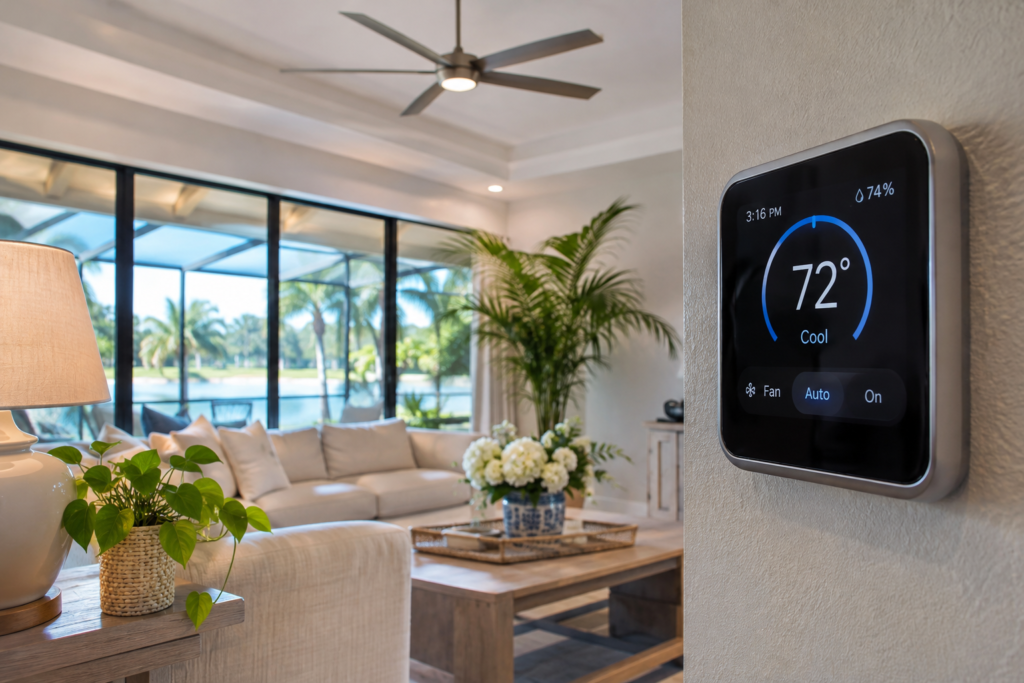
Your thermostat may have two fan settings, ON and AUTO, but choosing between them can affect more than how often air moves through your home. It can also influence how effectively your air conditioner removes moisture from the indoor air.
For homeowners in humid climates, this distinction is particularly important. A home can reach its desired temperature while still feeling damp, sticky, or uncomfortable. In some cases, continuous fan operation may contribute to that problem.
Understanding what each setting does, how air conditioners remove humidity, and when continuous airflow may be appropriate can help you make a more informed decision about your home’s cooling system.
This article contains affiliate links. If you make a purchase through one of these links, The Humid House may earn a small commission at no additional cost to you.
Should Your AC Fan Be ON or AUTO?
For most homes with a conventional central air conditioning system, AUTO is the better fan setting for humidity control.
When your thermostat fan is set to AUTO, the indoor blower generally runs during cooling cycles and stops shortly after the cooling cycle ends. This allows moisture collected on the cooling coil to drain away rather than being carried back into the home’s air.
When the fan is set to ON, the blower continues circulating air even when the air conditioner is no longer actively cooling. Depending on the system, this airflow can cause some of the water remaining on the cooling coil to evaporate back into the indoor air.
That means your air conditioner may cool your home successfully while removing less moisture overall.
However, AUTO is not the correct setting for every HVAC configuration. Some systems have specialized ventilation, humidity-control, or variable-speed features that require different fan operation.
For typical residential systems without those requirements, AUTO is generally the preferred starting point when humidity control is the priority.
What Is the Difference Between AC Fan ON and AUTO?
Your thermostat’s fan setting controls when the indoor blower operates. It does not directly determine when the air conditioner produces cooling.
Fan Setting: AUTO
With AUTO selected, the blower generally runs when the system is actively heating or cooling, along with any programmed fan delays or other system-controlled operation.
During cooling, the blower moves warm indoor air across the cold evaporator coil. The conditioned air then travels through the ductwork and returns to your living spaces.
Once the cooling cycle finishes, the blower typically stops after any programmed delay.
This gives accumulated condensation an opportunity to drain from the cooling coil into the condensate collection system.
Fan Setting: ON
With ON selected, the indoor blower runs continuously, including periods when the air conditioner is not actively cooling.
This provides ongoing air circulation through the home’s ductwork. However, the blower is not continuously cooling or dehumidifying the air simply because it is running.
If water remains on the cooling coil after a cooling cycle, continued airflow can allow some of that moisture to evaporate back into the home.
AC Fan ON vs. AUTO: Quick Comparison
| Feature | AUTO | ON |
| Blower operation | Primarily during heating or cooling cycles | Continuous |
| Air circulation | Intermittent | Continuous |
| Humidity control | Generally better during cooling | May reduce net moisture removal |
| Fan electricity use | Usually lower | Usually higher |
| Air filtration | Primarily when blower runs | Continuous when properly configured |
| Room temperature mixing | Periodic |
Actual performance depends on the equipment, thermostat programming, ductwork, and ventilation design.
How Your Air Conditioner Removes Humidity
An air conditioner does more than lower indoor temperature. During normal cooling operation, it can also remove water vapor from the air.
As warm, humid indoor air passes over the cold evaporator coil, the air cools. If the coil surface is below the air’s dew point, some of the water vapor condenses into liquid water.
The collected water flows into a drain pan and exits through the condensate drain.
This is one of the main ways a conventional air conditioning system reduces indoor humidity.
The process has two important parts:
- Cooling the air: The system lowers the temperature of indoor air.
- Removing moisture: Water vapor condenses onto the coil and drains out of the system.
These processes are related, but they are not interchangeable.
An air conditioner can lower the temperature effectively without removing enough moisture to maintain comfortable humidity levels.
The amount of moisture removed depends on several factors, including cooling cycle duration, coil temperature, airflow, equipment design, and the amount of moisture entering the home.
Why Leaving the AC Fan ON Can Increase Indoor Humidity
The most important difference between ON and AUTO occurs after the cooling cycle ends.
During active cooling, moisture condenses onto the evaporator coil. Some of that water drains away, while a portion may remain on the coil surfaces.
When cooling stops but the fan continues running, indoor air keeps passing across the wet coil.
As the coil warms, some of the remaining water can evaporate into that moving air and return to the living space.
This is known as off-cycle moisture re-evaporation.
The effect has been documented in building-science research, including investigations of how continuous blower operation affects the net dehumidification performance of air conditioning equipment.
The result is not necessarily a dramatic or immediate humidity increase. Instead, the system may remove less moisture over time than it would with the blower cycling off.
This distinction matters in humid climates, where indoor moisture can remain a concern even after the desired temperature has been reached.
The effect can be especially noticeable when cooling cycles are relatively short or when the home has substantial indoor or outdoor moisture loads.
Does Running the Fan Continuously Create Humidity?
No. The blower itself does not manufacture water vapor.
The issue is that continuous airflow can return moisture already collected on the cooling coil to the indoor air.
In other words, the system may remove moisture during cooling and then return some of it after cooling stops.
Continuous operation can also influence humidity indirectly if the ductwork passes through unconditioned spaces or if the HVAC system is connected to outdoor-air ventilation.
The extent of these effects depends on the specific installation.
Can the AC Fan Be ON While the Air Conditioner Is Cooling?
Yes.
The fan setting and cooling setting are separate controls on many thermostats.
If your thermostat is set to COOL and the fan is set to ON, the air conditioner can still cool normally whenever the thermostat calls for cooling.
The difference is what happens between those cooling cycles.
With ON selected, the blower continues running after the cooling equipment stops.
With AUTO selected, the blower generally stops when the cooling cycle finishes, subject to the equipment’s normal controls.
Changing the fan setting does not necessarily change the thermostat’s temperature setpoint.
Is AUTO Always the Best Setting?
Not necessarily.
Although AUTO generally supports better moisture removal in conventional cooling systems, some homes have equipment designed to operate differently.
Examples include:
- Variable-speed systems: Some adjust blower speed automatically to support comfort, air circulation, or humidity management.
- Dedicated ventilation systems: Certain configurations depend on coordinated blower operation to distribute outdoor ventilation air properly.
- Advanced humidity-control systems: Equipment may use specific fan speeds, operating schedules, or dehumidification modes.
- Specialized filtration arrangements: Some systems are configured to circulate air periodically or continuously for filtration purposes.
These systems should be operated according to the manufacturer’s instructions and the HVAC design.
A thermostat’s AUTO setting does not necessarily override every programmed fan operation. Some systems intentionally run the blower after cooling stops or periodically circulate air without active cooling.
If your system has features such as Circulate, Dehumidify, or a programmable fan schedule, review the thermostat and equipment instructions before changing those settings.
The important distinction is between continuous blower operation on a conventional system and fan operation intentionally controlled as part of an integrated HVAC design.
Does Keeping the AC Fan ON Use More Electricity?
Generally, yes.
When the fan is set to ON, the blower operates for more hours than it typically would in AUTO mode.
That additional runtime consumes electricity.
The actual cost depends on the blower motor, operating speed, electricity rate, and how many additional hours it runs.
Older blower motors may use substantially more electricity than modern high-efficiency variable-speed motors under comparable operating conditions.
However, even an efficient blower consumes energy when operating.
Continuous fan operation should not be assumed to save electricity simply because it circulates air without running the cooling compressor.
In homes where continuous operation increases moisture re-evaporation, additional dehumidification may also be needed to maintain the desired indoor humidity.
How to Tell Whether Your AC Is Controlling Humidity Properly
Your thermostat’s temperature reading cannot tell you whether your home has an appropriate humidity level.
To evaluate indoor moisture conditions, use a hygrometer like the TempPro TP50, which measures relative humidity (RH).
Relative humidity is the percentage of water vapor in the air compared with the maximum amount the air could hold at the same temperature.
The U.S. Environmental Protection Agency recommends keeping indoor RH below 60%, ideally between 30% and 50% when practical.
In warm, humid climates, consistently maintaining the lower end of that range may be difficult without additional dehumidification.
What to Check
1. Confirm your thermostat settings.
Look at both the system mode and fan setting.
A conventional cooling system will often display COOL for the operating mode and AUTO or ON for the fan.
If the fan is set to ON, the blower may be circulating air continuously even when cooling is not active.
2. Measure humidity with a hygrometer.
Place the hygrometer in a representative living area, away from direct sunlight, supply vents, windows, and moisture-producing appliances.
Allow it to stabilize according to the manufacturer’s instructions.
For more reliable information, record temperature and RH at consistent times over at least three separate days.
A single reading cannot establish whether an ongoing humidity problem exists.
3. Observe normal cooling operation.
Notice whether the air conditioner reaches the thermostat setpoint and whether the blower continues running after cooling stops.
Some brief fan operation after a cooling cycle is normal for certain systems.
Continuous airflow during extended periods without cooling may indicate that the fan is set to ON or that additional circulation features are enabled.
4. Look for recurring moisture indicators.
Pay attention to conditions such as:
- Indoor RH readings that remain elevated.
- A damp or sticky feeling despite comfortable temperatures.
- Repeated condensation on indoor surfaces.
- Musty odors that persist or return.
- Unusually short cooling cycles.
These observations do not establish that the fan setting is responsible. They help identify whether further evaluation is warranted.
If your system uses specialized ventilation or humidity controls, consult the equipment instructions or an HVAC professional before changing its operating configuration.
For more guidance, read How to Measure Indoor Humidity Accurately With a Hygrometer.
What if Your House Is Still Humid With the Fan Set to AUTO?
Switching to AUTO may improve moisture removal when continuous fan operation has been reducing the system’s dehumidification performance.
However, AUTO is not a complete solution for every indoor humidity problem.
If indoor RH remains elevated, other conditions may be contributing.
The Air Conditioner Runs for Very Short Cycles
An oversized air conditioner can cool a home quickly and shut off before it has removed sufficient moisture.
This is particularly relevant in well-insulated homes with relatively low cooling demand but substantial moisture loads.
Repeated short cooling cycles may warrant evaluation of equipment sizing, operating controls, and dehumidification performance.
The AC Is Not Removing Moisture Effectively
Restricted airflow, improper refrigerant charge, equipment problems, or unsuitable system settings can affect cooling and moisture removal.
Homeowners can check accessible air filters and confirm that supply and return vents are unobstructed. The Humid House recommends Filtrete Air Filters when preexisting filters need replacement.
Refrigerant systems, internal equipment adjustments, and diagnostic measurements should be handled by qualified HVAC professionals.
The Condensate Drain Is Not Working Properly
Water removed by the cooling coil must drain through the condensate system.
A clogged drain, overflowing pan, or damaged drain connection can cause water accumulation or damage.
Check accessible areas for visible water, and respond promptly to leaks or overflowing condensate pans.
Do not open electrical compartments or bypass equipment safety controls.
Moisture Is Entering the House Faster Than the AC Can Remove It
Outdoor air leakage, excessive ventilation moisture loads, plumbing leaks, and everyday activities such as showering or cooking can increase indoor moisture.
In humid climates, outdoor air may introduce substantial water vapor even when the outdoor temperature is not especially high.
Bathroom exhaust fans, properly vented appliances, building-envelope maintenance, and appropriate dehumidification all contribute to moisture management.
Your Home Needs Additional Dehumidification
Some homes need dedicated moisture removal even when the air conditioner is operating properly.
This may occur during mild but humid weather, when the air conditioner does not run long enough to remove the moisture entering or being generated inside the home.
A properly selected and installed dehumidifier can help manage humidity independently of the home’s cooling demand. The Humid House recommends the Midea Cube Dehumidifier because of it’s energy efficiency, moisture-removal capacity, and practical features for everyday home use.
The correct approach depends on measured conditions and the home’s HVAC configuration, not simply on how humid the air feels.
When Should You Call an HVAC Professional?
Consider arranging a professional evaluation if:
- Indoor RH repeatedly remains at or above 60% despite normal cooling operation.
- The home reaches its temperature setpoint but consistently feels damp.
- The system frequently starts and stops after short cooling periods.
- There is visible water around the air handler, condensate pan, or drain line.
- The cooling system cannot maintain the desired temperature.
- Condensation or musty odors persist without an identified source.
An HVAC professional can evaluate cooling-cycle behavior, airflow, condensate drainage, equipment configuration, and moisture-removal performance.
Explain both the temperature and humidity conditions you have observed.
For example, reporting that your home maintains 73°F but regularly measures 65% RH provides more useful information than simply saying the house feels humid.
Ask whether the system is operating as designed and whether any recommended changes are appropriate for its ventilation and humidity-control requirements.
Persistent wet materials, water damage, or suspected hidden moisture may require additional evaluation beyond the HVAC system.
Frequently Asked Questions
Should I leave my AC fan on AUTO all the time?
For most conventional central air conditioning systems, AUTO is the preferred setting when humidity control and reduced blower runtime are priorities.
However, equipment with integrated ventilation, advanced fan scheduling, or specialized humidity controls may require different operation.
Why is my house humid even though the AC is running?
Possible contributors include short cooling cycles, inadequate dehumidification, excessive moisture entering the home, ventilation conditions, or HVAC performance problems.
The thermostat fan setting is one factor worth checking, but it should not automatically be assumed to be the cause.
Is AUTO better than ON in Florida?
For typical residential cooling systems in Florida, AUTO is generally preferable for humidity control because it reduces the opportunity for moisture on the cooling coil to re-evaporate between cooling cycles.
Specialized equipment and ventilation arrangements may operate differently.
What is the difference between AUTO and CIRCULATE on a thermostat?
AUTO generally operates the blower during heating or cooling cycles.
CIRCULATE, available on some thermostats, periodically runs the blower even without a heating or cooling demand.
The exact schedule varies by manufacturer. Periodic circulation may reduce blower runtime compared with ON, but it can still affect off-cycle moisture evaporation.
Check your thermostat instructions to understand how the feature works with your system.
The Bottom Line
For most homes with conventional central air conditioning, AUTO is generally the better choice for controlling indoor humidity.
It allows the blower to stop after cooling, reducing the opportunity for moisture remaining on the evaporator coil to return to the indoor air.
Continuous fan operation can improve air circulation, but it is not the same as continuous cooling or dehumidification.
If your home remains humid with AUTO selected, focus on measuring RH, observing cooling behavior, and identifying the conditions contributing to excess moisture.
The goal is not simply to keep air moving or maintain a comfortable temperature. It is to ensure your home’s systems are controlling moisture effectively while operating as intended.
Sources and Further Reading
- Building Science Corporation — How to Look at a House Like a Building Scientist, Part 3: Temperature, Humidity, and HVAC Systems. Explains off-cycle moisture re-evaporation and blower operation.
https://buildingscience.com/documents/published-articles/pa-1903-how-look-house-building-scientist-part-3-temperature-humidity - Florida Solar Energy Center — Understanding the Dehumidification Performance of Air-Conditioning Equipment at Part-Load Conditions. Technical research on cooling-coil moisture evaporation and net dehumidification.
https://publications.energyresearch.ucf.edu/wp-content/uploads/2018/06/FSEC-CR-1537-05.pdf - Building Science Corporation — Humidity Control Investigation. Documents reduced dehumidification performance associated with continuous fan operation and other HVAC factors.
https://buildingsciencecorp.com/index.php/project/humidity-control-investigation/ - U.S. Environmental Protection Agency — A Brief Guide to Mold, Moisture and Your Home. Guidance on indoor RH, condensation, moisture prevention, and condensate maintenance.
https://www.epa.gov/mold/brief-guide-mold-moisture-and-your-home - Florida Department of Health — Mold. Guidance on moisture management and maintaining indoor RH below 60%.
https://www.floridahealth.gov/community-environmental-public-health/environmental-public-health/air-quality/mold/