
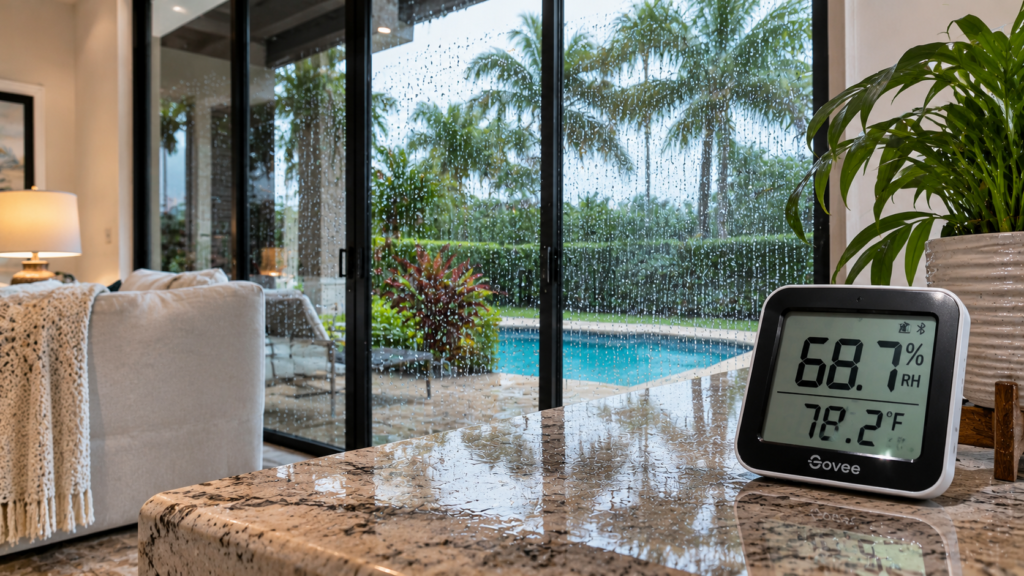
After several days of heavy rain, you may notice that your home feels unusually damp, indoor humidity readings are climbing, or a musty odor has become more noticeable. These changes can occur even when the air conditioner is running normally and there are no visible signs of water intrusion.
In humid climates, prolonged rainy weather can affect the balance between moisture entering a home and the amount being removed. Outdoor air often contains substantial water vapor, while cooler, cloudy conditions may reduce the amount of time an air conditioner operates. As a result, indoor relative humidity can increase by several percentage points or more.
Higher humidity can also make existing musty odors more noticeable and create conditions where moisture remains in building materials longer than intended. Understanding why these changes occur, how to distinguish temporary humidity fluctuations from potential moisture problems, and which steps improve moisture control can help homeowners respond appropriately during and after rainy weather.
This article contains affiliate links. If you make a purchase through one of these links, The Humid House may earn a small commission at no additional cost to you.
Why Does Indoor Humidity Increase When It Rains?
Rainy weather can influence indoor humidity without any rainwater actually entering the house. The increase generally involves a combination of outdoor moisture, air movement, temperature changes, and the home’s ability to remove water vapor.
Humid Outdoor Air Enters the Home
During rainy periods, outdoor air is frequently near saturation, meaning its relative humidity is high. However, the amount of moisture it introduces indoors depends on its actual water vapor content, not relative humidity alone.
In warm, humid climates, outdoor air can carry substantial moisture even when temperatures are relatively mild. As this air enters through doors, windows, building-envelope gaps, or mechanical ventilation, it adds to the home’s indoor moisture load.
Air leakage is particularly relevant because it allows outdoor conditions to influence the indoor environment without an obvious opening or visible water intrusion.
The greater the difference between outdoor and indoor moisture content, the more additional dehumidification may be needed to maintain stable indoor conditions.
Rainy Weather Can Reduce Air Conditioning Runtime
Air conditioning systems remove moisture as they cool indoor air. When warm, humid air passes over a sufficiently cold evaporator coil, water vapor condenses into liquid water and drains through the condensate system.
However, the amount of moisture removed depends partly on how long the equipment operates.
Cloud cover, rainfall, and lower outdoor temperatures can reduce the home’s cooling demand. The thermostat may reach its temperature setpoint quickly, causing the air conditioner to run less frequently even though outdoor moisture remains high.
This creates an important distinction between temperature control and humidity control.
A home can maintain a comfortable indoor temperature while its relative humidity continues to increase.
The effect can be especially noticeable in homes where cooling demand is low but moisture loads remain significant. Oversized air conditioners, short cooling cycles, and limited dehumidification capabilities can make this imbalance more pronounced.
Indoor Moisture Sources Continue Contributing
Rainy weather doesn’t eliminate the moisture generated by everyday household activities.
Showering, cooking, laundering clothes, and other normal activities continually release water vapor into the indoor environment. Damp belongings brought inside after rain can introduce additional moisture.
When air conditioning operates less frequently, that moisture may accumulate faster than it is removed.
The result is not necessarily a malfunctioning HVAC system. In some cases, the home simply has more moisture to manage than its cooling equipment can remove under those particular weather conditions.
How Much Can Indoor Humidity Rise During Rainy Weather?
There is no fixed amount by which indoor humidity increases when it rains. Some homes maintain stable readings, while others experience noticeable fluctuations depending on construction, ventilation, HVAC operation, and outdoor conditions.
For example, a home that normally maintains 48% relative humidity may rise to 56% during prolonged wet weather. Another home might increase from 54% to 62%, exceeding the recommended upper limit for indoor humidity.
These examples represent increases of eight percentage points, but they are not predictions of what every home will experience.
The distinction between relative humidity and actual water vapor content is also important.
Relative humidity describes how close the air is to saturation at its current temperature. When air temperature decreases, its relative humidity can increase even without additional water vapor entering the space.
This means a rising hygrometer reading does not always indicate that the total amount of moisture in the air has increased.
However, when indoor temperatures remain relatively stable and RH readings continue climbing, it may indicate that moisture is entering or being generated faster than the home’s systems are removing it.
For more reliable comparisons, measure humidity in the same location, record indoor temperature alongside RH, and observe readings over several days rather than drawing conclusions from one measurement.
Why Does a House Smell Musty After Rain?
Musty odors frequently become more noticeable during periods of elevated humidity. Although the smell may seem to appear suddenly, the underlying source may have existed before the rainy weather began.
Materials such as drywall, wood, carpeting, upholstery, and stored fabrics interact with moisture in the surrounding air. As relative humidity rises, many porous materials absorb additional water vapor and may take longer to dry.
In areas with existing dampness or microbial activity, these conditions can contribute to more noticeable odors.
This is one reason a home may smell relatively normal during dry weather but develop a musty odor after several days of rain.
However, high humidity alone does not establish that mold is present, and a musty smell cannot identify its source.
Why Some Rooms Smell Mustier Than Others
Closets, storage areas, rooms with limited airflow, and spaces near cool exterior surfaces may experience different moisture conditions from the main living area.
A closet located along an exterior wall, for example, may have cooler surfaces and less air circulation than an adjacent room. Under elevated indoor humidity, its contents and surfaces may be more susceptible to moisture accumulation.
Similarly, an existing damp area behind furniture or beneath flooring may become more noticeable when surrounding conditions are humid.
An odor concentrated in one location should be evaluated differently from a general increase in indoor humidity throughout the house.
If a musty smell repeatedly appears in the same area after rain, persists after humidity levels improve, or becomes progressively stronger, investigate the possibility of localized moisture or water intrusion.
What Is a Normal Indoor Humidity Level After Rain?
The U.S. Environmental Protection Agency recommends maintaining indoor relative humidity below 60%, ideally between 30% and 50% when possible.
These recommendations provide useful reference points for evaluating indoor moisture, but individual readings should be interpreted alongside temperature, duration, and visible conditions.
A digital hygrometer, such as the TempPro TP50, provides a simple way to monitor indoor relative humidity and recognize changes during extended rainy periods. It’s temperature and humidity readings also make it easier to compare indoor conditions over time.
| Indoor Relative Humidity | General Interpretation |
| Below 30% | Low humidity; may contribute to dryness and discomfort |
| 30-50% | EPA’s ideal recommended range |
| 51-59% | Above the ideal range; monitor persistent moisture and condensation |
| 60% or higher | Above the recommended upper limit; investigate sustained elevated readings |
A temporary increase into the mid-50% range during rainy weather does not necessarily indicate a serious moisture problem.
However, repeated readings near or above 60%, particularly when accompanied by persistent odors or condensation, suggest that additional moisture control or investigation may be appropriate.
It is equally important to recognize that normal room humidity does not rule out concealed water damage. A localized leak can wet building materials without significantly changing humidity throughout the home.
Signs of Excess Moisture to Watch for After Heavy Rain
Rainy weather can cause temporary changes in indoor humidity, but it can also reveal building-envelope or drainage problems that remain less noticeable during dry conditions.
Certain patterns help distinguish a general increase in airborne moisture from possible localized water intrusion.
| Observation | Possible Explanation | What to Check |
| Humidity increases throughout the home | Outdoor-air moisture, reduced AC runtime, indoor moisture generation | Hygrometer readings, indoor temperature, cooling cycles |
| Musty smell develops in one room | Damp materials, localized condensation, possible water intrusion | Closets, exterior walls, flooring, nearby windows |
| Condensation appears on vents or windows | Humid air contacting surfaces below its dew point | Surface temperature, indoor RH, airflow |
| New ceiling or wall stains appear after rain | Possible roof, flashing, or exterior water intrusion | Changes in stain size, location, visible dampness |
| Baseboards or flooring begin swelling | Moisture exposure affecting building materials | Adjacent walls, floor edges, plumbing, exterior openings |
| Humidity remains elevated after weather improves | Inadequate moisture removal or continuing moisture source | HVAC operation, ventilation, leaks, dehumidification |
These observations do not independently diagnose the problem. More than one moisture mechanism may be present at the same time.
For example, a home may experience generally elevated indoor humidity while also having a small window leak that becomes visible only during wind-driven rain.
The appropriate response depends on determining whether moisture is primarily accumulating in the air, condensing on cool surfaces, or entering the structure as liquid water.
How to Lower Indoor Humidity During Rainy Weather
When indoor humidity rises during extended periods of rain, the most effective approach is to limit unnecessary moisture loads while ensuring the home’s air conditioning, ventilation, and dehumidification systems are operating appropriately.
1. Limit Humid Outdoor Air Entering the Home
Opening windows may seem like a natural way to freshen musty indoor air, but it can make humidity worse when outdoor air contains more water vapor than indoor air.
During warm, humid, rainy conditions, keep unnecessary windows and exterior doors closed.
Check accessible weatherstripping around exterior doors and windows for deterioration or gaps that may allow uncontrolled air leakage.
Required mechanical ventilation should continue operating as designed. In humid climates, ventilation systems need to be coordinated with appropriate moisture control rather than simply turned off.
2. Check Your Thermostat Fan Setting
For most conventional residential central air conditioning systems, the AUTO fan setting is generally preferable to continuous ON operation when humidity control is the priority.
When the blower continues running after active cooling stops, moisture remaining on the evaporator coil can sometimes evaporate back into the indoor air.
AUTO typically allows the blower to stop after the cooling cycle, reducing that opportunity for moisture re-evaporation.
However, specialized variable-speed equipment and integrated ventilation systems may use different fan-control strategies.
For a more detailed explanation, see AC Fan ON vs. AUTO: Which Is Better for Humidity?
3. Consider Supplemental Dehumidification
During mild but humid weather, air conditioning may not operate long enough to remove the amount of moisture entering the home.
A dehumidifier addresses this limitation by removing moisture independently of cooling demand.
Portable units may be useful for individual rooms, while recurring whole-house humidity problems may require a properly designed whole-home dehumidification system.
The Humid House recommends this Midea Dehumidifier as an option for spaces that need supplemental moisture removal.
Equipment should be selected according to the space, expected moisture load, and drainage requirements.
Dehumidifiers can improve airborne humidity, but they do not repair roof leaks, plumbing leaks, or other sources of liquid water intrusion.
4. Reduce Additional Indoor Moisture
Everyday activities can contribute significantly to indoor humidity, particularly when the home’s cooling system is operating less frequently.
Several routine practices can reduce unnecessary moisture:
- Run properly vented bathroom exhaust fans during and after showers.
- Use appropriate kitchen ventilation when cooking.
- Avoid drying wet laundry indoors when practical.
- Promptly dry wet towels, clothing, and other rain-soaked belongings.
- Check that bathroom and laundry exhaust systems are functioning and venting properly.
These measures reduce additional moisture entering the indoor air, although they cannot compensate for an unresolved building leak or serious HVAC deficiency.
5. Check Areas Where Moisture May Accumulate
Closets, enclosed storage spaces, and areas behind furniture deserve attention when musty odors develop during rainy weather.
Check for damp belongings, condensation, staining, or changes in surrounding building materials.
Where practical, avoid tightly packing moisture-sensitive items against surfaces that repeatedly become damp.
Improving circulation around dry materials may help reduce localized moisture accumulation. However, ventilation or airflow alone should not be used to conceal an unidentified moisture problem.
6. Inspect for Rainwater Intrusion
After heavy rainfall, examine accessible areas around windows, exterior doors, ceilings, baseboards, and flooring for signs of water entry.
Outside, check whether gutters and downspouts are directing rainwater away from the building and whether water is collecting near exterior walls or the foundation.
New staining, damp drywall, swollen trim, or recurring localized odors may require further investigation.
The EPA recommends drying wet areas and materials within 24–48 hours whenever possible to help prevent mold growth.
If water intrusion is present, correcting its source takes priority over simply reducing indoor humidity.
How Long Should Indoor Humidity Stay Elevated After Rain?
There is no single recovery time that applies to every home.
Humidity may begin declining once outdoor moisture conditions improve and the air conditioner resumes longer cooling cycles. In other homes, recovery may depend on supplemental dehumidification or correcting an ongoing moisture source.
The amount of moisture stored in furnishings, building materials, and other porous surfaces can also influence how indoor conditions change over time.
Rather than relying on a specific number of hours, evaluate the overall pattern.
Does humidity return toward its usual range? Are musty odors disappearing? Does the same room repeatedly remain damp after every storm?
Repeated humidity measurements over several days can help distinguish a temporary weather-related increase from a recurring moisture-control problem.
When Should You Call a Professional?
A brief humidity increase during rainy weather does not automatically require professional evaluation. However, persistent or worsening conditions deserve more attention.
Consider further investigation when:
- Indoor RH repeatedly remains at or above 60% despite normal HVAC operation.
- The air conditioner maintains the temperature setpoint but consistently struggles to control humidity.
- Musty odors persist after humidity levels return to normal.
- Water stains, damp materials, or visible damage appear following rainfall.
- Condensation repeatedly develops on the same surfaces.
- Humidity remains unusually elevated after outdoor conditions improve.
An HVAC professional can evaluate equipment operation, cooling-cycle duration, condensate drainage, airflow, and dehumidification performance.
Suspected rainwater intrusion, hidden moisture, or damaged building materials may require evaluation by an appropriately qualified building or moisture professional.
The objective is to identify the underlying moisture mechanism rather than treating every symptom as a separate problem.
The Bottom Line
Rainy weather can cause measurable increases in indoor relative humidity, particularly when humid outdoor air enters the home while reduced air conditioning runtime limits moisture removal. Rising humidity can also make existing musty odors more noticeable, even when there is no active water intrusion.
Although temporary fluctuations aren’t necessarily cause for concern, consistently elevated humidity, recurring musty odors, or signs of dampness deserve closer attention. Monitoring indoor humidity, effective moisture control, and investigating persistent changes can help homeowners distinguish normal weather-related fluctuations from moisture problems that require action.