
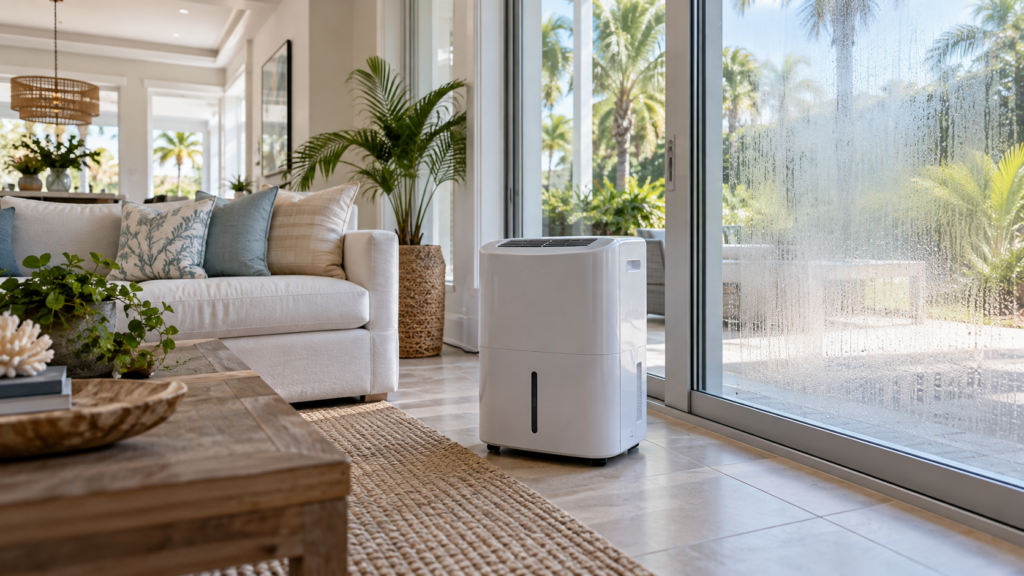
You bought a dehumidifier to get your home’s moisture under control. It’s running, the fan is blowing, and maybe you’re even emptying the water tank regularly. But every time you check the humidity reading, it’s still sitting at 60%, 65%, or higher.
If your dehumidifier is running but the humidity isn’t going down, the problem isn’t necessarily the appliance itself.
Sometimes the issue is as simple as an incorrect setting or a clogged filter. Other times, the dehumidifier is working exactly as designed but cannot keep up with the moisture entering your home.
Understanding the difference is important. Replacing a perfectly good dehumidifier won’t solve a problem caused by outdoor air infiltration, hidden moisture, or an improperly sized unit.
This article contains affiliate links. If you make a purchase through one of these links, The Humid House may earn a small commission at no additional cost to you.
Why Is My Dehumidifier Running but Not Lowering Humidity?
A dehumidifier removes moisture by drawing humid air across cold coils, where some of the water vapor condenses into liquid. That water collects in a tank or exits through a drain hose, while the air is reheated and released back into the room.
For indoor humidity to decrease, the dehumidifier must remove moisture faster than new moisture enters the space.
When that isn’t happening, there are generally three possibilities:
- The dehumidifier isn’t removing moisture effectively. Dirty filters, blocked airflow, low temperatures, incorrect settings, or mechanical problems may be limiting its performance.
- The unit is removing moisture, but the moisture load is too high. Outdoor air, wet building materials, leaks, and everyday activities may be adding moisture as quickly as the dehumidifier removes it.
- The humidity reading doesn’t accurately represent the room. An inaccurate sensor, poor measurement location, or temperature differences may make it appear that humidity isn’t improving.
Before assuming your dehumidifier has failed, it’s worth checking each possibility.
Common Causes and Solutions
Use this table to narrow down the problem before moving into more detailed troubleshooting.
| Possible Cause | What You May Notice | Recommended Solution |
| Incorrect humidity setting | Unit runs intermittently, but humidity remains above your goal | Set the humidistat to approximately 45-50% RH |
| Dirty air filter | Weak airflow or reduced water collection | Clean the filter according to the manufacturer’s instructions |
| Blocked airflow | Unit sits close to furniture or walls | Clear intake and exhaust openings; follow the required clearances |
| Undersized dehumidifier | Collects water continuously but struggles to lower RH | Check moisture load and capacity; consider a larger unit |
| Open doors or air leaks | Humidity increases during humid weather | Close windows and exterior doors; address air leaks |
| Cold room or frozen coils | Frost appears, or the fan runs without much water collection | Allow defrosting and verify the unit’s operating temperature range |
| Excess moisture entering the space | Tank fills, but humidity barely changes | Investigate leaks, damp materials, drainage, and ventilation |
| Drainage or bucket problem | Full-bucket warning, unexpected shutoffs, or water backup | Check bucket placement, drain hose, and pump if equipped |
| Inaccurate humidity reading | Unit and separate hygrometer show different readings | Check sensor placement and compare readings over time |
| Compressor or refrigeration problem | Fan runs, but little or no water is collected despite humid conditions | Follow manufacturer troubleshooting; arrange service if necessary |
1. Your Dehumidifier’s Humidity Setting Is Too High
One of the easiest problems to overlook is the humidity setting itself.
Most modern dehumidifiers have a built-in humidistat that tells the appliance when to remove moisture.
For example, if your room is at 60% relative humidity but the dehumidifier is set to 60%, it may stop actively removing moisture because it considers the target satisfied.
Some models continue running their fans even when the compressor is off. That can make the appliance sound as though it is dehumidifying when it is actually circulating air.
How to fix it
Check the humidity setting on your dehumidifier’s control panel.
For most homes, 45–50% relative humidity is a reasonable starting target.
The U.S. Environmental Protection Agency (EPA) recommends keeping indoor relative humidity between 30% and 50% when possible, and below 60% to help discourage mold growth.
For more detailed explanation of indoor humidity readings and how temperature affects them, see our guide to relative humidity.
If your room is currently at 65%, try setting the unit to 50%.
Make sure you’re selecting the desired humidity level rather than simply changing the fan speed.
If your model has a continuous operation setting, that can be useful temporarily when evaluating performance in a very damp room. However, continuous operation isn’t necessarily needed once the desired humidity level is achieved.
Important: Setting the dehumidifier to 35% does not automatically make it remove water faster than setting it to 50%. On many models, it simply tells the appliance to continue operating until a lower target is reached.
2. The Air Filter Is Dirty or Airflow Is Restricted
A dehumidifier needs adequate airflow to remove moisture effectively.
When dust and debris build up on the air filter, less air can pass through the appliance.
The result may be reduced moisture removal, longer operating times, and potentially frost buildup on the coils.
Blocked vents can cause similar problems.
How to fix it
Start by turning off and unplugging the dehumidifier.
Remove the accessible air filter according to your owner’s manual. If the manufacturer allows washing, clean it as directed and let it dry completely before reinstalling.
Check the air intake and exhaust openings for dust, pet hair, or anything obstructing airflow.
Next, look at where the dehumidifier is positioned.
A unit tucked tightly into a corner, pressed against furniture, or surrounded by storage boxes may struggle to circulate air properly.
Move it to a location with unobstructed airflow and follow the manufacturer’s recommended clearances.
Not every model needs the same amount of space around it. Some are designed with top-mounted discharge vents, while others require additional clearance along the sides or back.
The Humid House Tip: If you’re using a dehumidifier in a garage, workshop, or dusty basement, inspect the filter more frequently. Dust-heavy environments can affect airflow surprisingly quickly.
For additional guidance on moisture control in unconditioned spaces, see our guide to garage humidity.
3. Your Dehumidifier Is Too Small for the Space
A dehumidifier can run continuously and collect water without being powerful enough to control the humidity in a room.
This is especially common in large basements, open floor plans, and homes with substantial moisture problems.
Dehumidifier capacity is measured in pints of water removed per 24 hours, not simply the square footage advertised on a product listing.
A 20-pint unit may be adequate for a moderately damp enclosed room but struggle in a larger space with ongoing moisture entering from outside.
The size of the room matters, but so does the amount of moisture the dehumidifier needs to remove.
How to tell if your dehumidifier is undersized
An undersized unit may:
- Run for long periods without reaching the selected humidity level.
- Collect substantial amounts of water every day.
- Lower humidity slightly before leveling off.
- Struggle more during rainy weather or periods of high outdoor humidity.
However, these symptoms can also occur when the home has an unresolved moisture source.
That distinction matters. A larger appliance may help, but it shouldn’t be the first solution to a leak or water intrusion problem.
What size dehumidifier do you need?
ENERGY STAR provides the following general capacity recommendations for portable dehumidifiers.
| Moisture Conditions | Space Under 2,000 Sq. Ft. | Space Over 2,000 Sq. Ft. |
| Slightly to moderately damp (50-75% RH) | 20-30 pints/day | 30+ pints/day |
| Very damp (75-90% RH) | 25-40 pints/day | 40+ pints/day |
| Wet conditions (90-100% RH) | 30-50 pints/day | 50+ pints/day |
Source: ENERGY STAR portable dehumidifier buying guidance. These are general minimum-capacity recommendations, not guarantees of performance. Actual requirements depend on temperature, moisture sources, air leakage, and other conditions.
If your appliance is consistently removing water but cannot reach your target humidity, compare its rated capacity against your space and moisture conditions.
If you’re shopping for a replacement, pay attention to the current DOE-rated pint capacity. Older dehumidifier ratings may not be directly comparable with newer models because testing procedures have changed.
And remember, a larger dehumidifier cannot permanently correct uncontrolled water intrusion.
4. Too Much Moisture Is Entering Your Home
This is one of the most important possibilities to investigate, particularly in humid climates.
A dehumidifier doesn’t create a moisture barrier around your house. It removes moisture from the air that reaches it.
If humid outdoor air continually enters the home through gaps, open windows, poorly sealed doors, or duct leakage, the dehumidifier must constantly handle that additional moisture.
This can make it seem as though the appliance isn’t doing anything, even when it is removing water.
Consider a Florida home during a humid summer afternoon.
The dehumidifier may be collecting water consistently, but humid outdoor air entering through the building envelope may replenish much of the moisture being removed.
How to fix it
Start by checking the most obvious sources of outdoor air infiltration:
- Windows and exterior doors that don’t seal properly.
- Damaged or missing weatherstripping.
- Gaps around plumbing or utility penetrations.
- Leaky ductwork, particularly in attics or other unconditioned spaces.
- Frequently opened exterior doors.
Close exterior doors and windows while operating the dehumidifier.
If you’re using a portable appliance, temporarily reducing the area it serves can help determine whether it performs better in a smaller, more enclosed space.
For persistent problems, improving air sealing and correcting HVAC duct leakage may reduce the moisture load significantly.
In homes with attic ductwork, humid attic air entering the living space can also contribute to elevated indoor humidity through duct leaks and other air pathways.
ENERGY STAR specifically notes that proper home and duct sealing can improve dehumidification performance and reduce energy consumption.
Why humidity is especially difficult to control in hot, humid climates
In places with long, humid summers, moisture can enter the home throughout much of the day.
Your air conditioner also plays an important role in removing humidity, but its moisture removal depends on factors such as runtime, equipment sizing, airflow, and operating conditions.
A home can reach its thermostat’s temperature setting while still having elevated relative humidity.
This is one reason persistent indoor humidity should be evaluated as a whole-home moisture problem rather than automatically blaming the portable dehumidifier.
5. There Is an Ongoing Moisture Problem
Sometimes the dehumidifier is doing exactly what it’s supposed to do.
It’s simply fighting a moisture source that hasn’t been addressed.
Water can enter a home through roof leaks, plumbing problems, foundation seepage, or poor exterior drainage.
Moisture can also remain trapped in carpeting, drywall, subfloors, and other building materials long after an initial water event.
As those materials dry, they release moisture back into the surrounding air.
That additional moisture can keep a dehumidifier working for extended periods.
Signs to look for
Inspect the area for:
- Water stains on ceilings or walls.
- Damp carpeting or flooring.
- Musty odors that persist after dehumidification.
- Condensation on windows or cold surfaces.
- Wet basement walls or foundation seepage.
- Plumbing leaks beneath sinks or around appliances.
- Recent flooding or water damage.
A musty odor alone doesn’t prove there’s hidden mold, but it is a reason to investigate possible moisture problems.
Our Mold and Moisture: A Homeowner’s Guide explains how persistent moisture can contribute to mold growth, where to investigate, and when professional assistance may be necessary.
How to fix it
Identify and correct the water source first.
That may involve repairing plumbing, improving exterior drainage, fixing roof leaks, or addressing water entering through the foundation.
Once the source is corrected, dehumidification can help dry the affected area.
However, drying the air is not the same as drying every material inside the building.
Wet drywall, insulation, and flooring may require additional drying methods or professional restoration.
The EPA recommends drying wet materials promptly, generally within 24–48 hours when possible, to reduce the likelihood of mold growth.
A dehumidifier should support moisture control, not substitute for repairing the source of unwanted water.
6. The Room Is Too Cold for Effective Dehumidification
Temperature has a major influence on how well a dehumidifier works.
Most common portable dehumidifiers use refrigeration technology to cool incoming air below its dew point, causing water vapor to condense.
When room temperatures drop, the air generally contains less moisture at a given relative humidity, and water removal can become less effective.
Cold conditions can also cause frost to develop on the appliance’s coils.
According to ENERGY STAR, temperatures below approximately 65°F can create frosting problems for some models.
A number of newer dehumidifiers are designed to operate at lower temperatures, but their effectiveness and minimum operating temperature vary.
How to fix it
Check the actual room temperature rather than relying on the thermostat in another part of the house.
If the appliance is operating in a cool basement, garage, or other unconditioned space, review the manufacturer’s minimum operating temperature.
If frost has accumulated, turn off the unit and allow it to defrost according to the manufacturer’s instructions.
Never chip ice off the coils or use a sharp object to remove it.
Some units have automatic defrost cycles that temporarily stop the compressor while the fan continues running.
During these cycles, the dehumidifier may make noise without collecting much water.
If the coils repeatedly freeze under conditions that should be within the unit’s normal operating range, the problem may involve restricted airflow or a mechanical issue.
For spaces that regularly stay cool, consider a dehumidifier specifically rated for those conditions.
7. The Bucket, Drain Hose, or Pump Isn’t Working Properly
Not all dehumidifier problems involve moisture removal.
Sometimes the appliance is unable to collect or drain the water it removes.
Most portable units have a safety switch that stops dehumidification when the collection bucket becomes full or isn’t seated properly.
Depending on the model, the fan or indicator lights may continue operating.
What to check
First, inspect the collection bucket.
Make sure it is empty, properly positioned, and fully seated.
If the unit uses continuous drainage, inspect the drain hose for kinks, clogs, or improper positioning.
Gravity-drain systems typically need a continuous downhill path from the outlet to the drain. A hose that rises above the connection may prevent water from flowing properly.
For dehumidifiers with built-in condensate pumps, check the pump’s operating instructions and any error indicators.
Do not assume that an empty bucket means the unit isn’t removing moisture. If continuous drainage is connected and functioning, the water may be going directly into the drain.
Frigidaire’s troubleshooting guidance identifies blocked hoses, incorrect hose positioning, and water backup as common causes of drainage problems.
Always turn off and unplug the appliance before inspecting or cleaning removable drainage components, and follow the manufacturer’s instructions.
8. Your Humidity Reading May Be Misleading
If the dehumidifier seems to be collecting water normally but the displayed humidity never changes, the measurement itself deserves attention.
Relative humidity depends on both the amount of water vapor in the air and the air temperature.
That means relative humidity can change even when no additional moisture has entered the space.
For example, when air cools without losing moisture, its relative humidity generally rises.
This can sometimes explain why humidity appears higher overnight or when the room temperature changes.
Check the humidity with a separate hygrometer
A standalone digital hygrometer is a useful troubleshooting tool.
A ThermoPro TP50 Digital Hygrometer provides an independent temperature and humidity reading, making it easier to compare room conditions with the dehumidifiers built-in sensor.
Place it in the same room as the dehumidifier, away from direct sunlight, vents, windows, and the appliance’s discharge airflow.
Allow the reading to stabilize.
Then compare its measurements with the dehumidifier’s display.
It’s normal for two consumer humidity sensors to differ somewhat because of accuracy tolerances, placement, and air temperature.
However, a substantial, consistent difference may indicate a sensor problem or a misleading measurement location.
For a more useful comparison, track readings at approximately the same location and temperature over several hours.
The Humid House Tip: Don’t judge a dehumidifier’s performance only by the amount of water in the bucket. Monitor how indoor humidity changes over time, ideally with an independent hygrometer.
9. The Dehumidifier Hasn’t Had Enough Time
A very damp room may not return to a normal humidity range immediately.
When a space has been exposed to high humidity for an extended period, moisture can accumulate in furnishings, wood, and other absorbent materials.
As the dehumidifier removes water vapor from the air, some of that stored moisture can move back into the room.
This can slow the initial reduction in relative humidity.
How long should a dehumidifier take to lower humidity?
There isn’t one reliable number that applies to every home.
Performance depends on:
- The starting humidity level.
- Room size and air circulation.
- Dehumidifier capacity.
- Indoor temperature.
- Outdoor moisture conditions.
- The amount of moisture stored in building materials and furnishings.
Frigidaire recommends allowing up to 24 hours for a dehumidifier to lower humidity in a damp space.
That doesn’t mean every dehumidifier needs 24 hours to show improvement, or that a room should always reach its target within that period.
It means you should evaluate performance over a reasonable operating period rather than relying on the first few minutes.
If humidity remains high after extended operation, investigate the unit’s water collection, operating conditions, and possible moisture sources.
10. The Compressor or Refrigeration System May Be Failing
If you’ve ruled out the obvious causes and the dehumidifier still isn’t removing water effectively, a mechanical problem becomes more likely.
A typical compressor-based dehumidifier contains a fan, compressor, refrigeration coils, controls, and drainage components.
The fan can continue circulating air even when the refrigeration system isn’t actively removing moisture.
This creates a frustrating situation: the appliance sounds like it’s working, but the humidity barely changes.
Signs that may indicate a mechanical problem
- The fan runs, but little or no water is collected despite high humidity.
- The compressor doesn’t appear to start when dehumidification is needed.
- The appliance repeatedly shuts down or displays fault codes.
- Ice repeatedly forms during otherwise suitable operating conditions.
- Moisture removal has declined noticeably despite clean filters and unobstructed airflow.
These signs are not enough to confirm a failed compressor. Automatic defrost operation, incorrect settings, and sensor behavior can produce similar symptoms.
What to do next
Start with the troubleshooting instructions in your owner’s manual.
If the manufacturer recommends a reset, follow the specified procedure.
Check the warranty before paying for repairs.
If the problem persists, contact the manufacturer or a qualified appliance service professional.
Do not open the sealed refrigeration system or attempt refrigerant repairs yourself. These repairs require appropriate equipment and training.
For some portable dehumidifiers, replacement may be more practical than major mechanical repair, especially when parts or manufacturer service are unavailable.
How to Tell Whether the Problem Is the Dehumidifier or Your Home
This is one of the most useful distinctions you can make before spending money.
Try the following controlled test using a portable dehumidifier.
A simple at-home dehumidifier performance test
Step 1: Choose an enclosed room.
Select a room that falls within the dehumidifier’s intended capacity and normal operating temperature range.
Avoid a room with an active leak or other obvious water source.
Step 2: Measure the starting humidity.
Use a separate hygrometer to record the room’s relative humidity and temperature.
Step 3: Prepare the appliance.
Clean the filter if needed, check airflow, empty and correctly reinstall the bucket, and make sure there are no warning lights.
If using continuous drainage, confirm that the water can drain properly.
Step 4: Close exterior windows and doors.
Minimize additional moisture entering the space during the test.
Step 5: Set the dehumidifier to approximately 45–50% RH.
If the starting humidity is already below the selected target, a lack of water collection isn’t evidence of malfunction.
Step 6: Monitor the room over several hours.
Check the humidity, temperature, and water collection periodically.
Avoid placing the hygrometer directly in the appliance’s airflow.
How to interpret your results
Humidity decreases and water is collected: The appliance is removing moisture. If it struggles elsewhere, investigate the size of the original space and potential moisture sources.
Water is collected, but humidity barely changes: The unit is functioning at least partially, but the room may have a substantial moisture load or the appliance may be underperforming.
Little water is collected despite persistently high humidity: Recheck settings, temperature, airflow, and drainage. If those are normal, the unit may require service.
Humidity drops but rises again after the unit stops: Moisture may be entering the space or being released from damp materials. Temperature changes can also affect the relative humidity reading.
This isn’t a standardized capacity test, and it cannot determine the precise amount of water a dehumidifier should remove. It’s simply a practical way to narrow down the likely causes.
What If Your Dehumidifier Collects Water but Humidity Stays at 60%?
This situation deserves special attention because it’s often misunderstood.
If your dehumidifier is filling its tank while the room remains at 60% RH, that does not automatically mean the unit is defective.
Water collection proves that at least some moisture is being removed.
What it doesn’t tell you is whether the appliance is removing enough moisture to overcome the home’s moisture load.
For example, a dehumidifier removing several pints of water per day may still struggle if humid outdoor air continues entering through building leaks.
Likewise, an appliance drying a previously damp room may spend considerable time removing moisture released from furnishings and building materials.
Start by checking the actual operating conditions and measuring the room’s humidity independently.
Then investigate whether moisture is continually entering the space.
If the room is properly enclosed, no significant moisture source is present, and the appliance remains unable to reach the target, its capacity or performance may be inadequate.
A consistently high reading deserves investigation even when the bucket fills regularly.
When Should You Replace Your Dehumidifier?
Before purchasing a replacement, make sure you aren’t dealing with a problem that a new unit would encounter too.
Consider replacement when:
- The appliance repeatedly fails to remove moisture despite correct settings and operating conditions.
- The refrigeration system requires an uneconomical repair.
- The unit is substantially undersized for your space.
- The manufacturer cannot provide the necessary parts or service.
- The appliance has become unreliable or presents an electrical safety concern.
If the dehumidifier works properly but your home experiences consistently elevated humidity, first consider whether the underlying problem is excessive moisture infiltration, water intrusion, or insufficient overall dehumidification capacity.
When shopping for a replacement, prioritize appropriate pint capacity, operating temperature range, efficient operation, and practical drainage options.
For homeowners replacing an undersized portable unit, the Midea Cube Dehumidifier is one option to consider, with multiple capacities available for different room sizes and moisture conditions.
An ENERGY STAR certified model can also help reduce electricity consumption compared with a similarly sized conventional unit.
In homes with persistent whole-house humidity issues, a professionally sized and installed whole-home dehumidifier may be worth evaluating.
However, no dehumidification system should be expected to compensate indefinitely for water leaks or serious building-envelope problems.
How to Keep Your Home’s Humidity Under Control
Once you’ve corrected the immediate problem, preventing excess moisture is usually easier than repeatedly fighting it.
A few habits can make a meaningful difference.
Keep indoor humidity in a reasonable range. Aim for approximately 30–50% RH when practical, adjusting for climate, condensation risk, and comfort.
Use ventilation where moisture is generated. Run properly vented bathroom exhaust fans during showers and kitchen exhaust ventilation when cooking.
Avoid bringing unnecessary outdoor humidity inside. Opening windows can help under dry outdoor conditions, but may increase indoor moisture during hot, humid weather.
Maintain your HVAC system. Keep drainage components clear and have persistent air-conditioning or ductwork problems evaluated.
Address leaks quickly. Plumbing leaks, roof damage, foundation moisture, and poor drainage should be corrected rather than managed solely with a dehumidifier.
Monitor humidity consistently. An independent hygrometer can help you recognize developing problems before dampness becomes obvious.
The most effective approach combines moisture-source control, appropriate ventilation, air conditioning, and dehumidification when necessary.
Frequently Asked Questions
Why is my dehumidifier running constantly but the humidity stays high?
Continuous operation can indicate that the appliance hasn’t reached its selected humidity target. Common reasons include an undersized unit, excessive moisture entering the space, restricted airflow, or an unresolved moisture source. Some dehumidifiers also run their fans when the compressor is off, so continuous fan noise doesn’t always mean continuous moisture removal.
Why is my dehumidifier running but not collecting water?
Check the humidity setting, collection bucket, drain arrangement, filter, and room temperature. If the room is already below the selected target, water collection may be minimal or stop altogether. If the room remains humid and the appliance never collects water, a mechanical problem is possible.
Is 60% humidity too high for a house?
A persistent 60% relative humidity reading is higher than ideal for most homes. The EPA recommends keeping indoor humidity below 60%, preferably between 30% and 50%. Persistent readings around or above 60% warrant attention, particularly when accompanied by condensation, dampness, or musty odors.
Should I run my dehumidifier continuously?
Continuous operation can be useful temporarily in a very damp room, but it usually isn’t necessary once the desired humidity level is reached. For normal operation, use the humidistat to maintain a suitable target. If the appliance runs continuously without improving the humidity, investigate the cause rather than assuming more runtime is the solution.
Can a dehumidifier work properly but still not lower humidity?
Yes. A dehumidifier may remove substantial moisture while new moisture enters at a similar rate. This can happen in humid climates, leaky buildings, damp basements, or spaces containing wet materials. In that situation, reducing the moisture source or increasing appropriate dehumidification capacity may be necessary.
Will a bigger dehumidifier solve high humidity?
A larger unit may help if the existing appliance is undersized. However, it won’t correct plumbing leaks, foundation seepage, or uncontrolled moisture entry. Identifying the source of the problem is an important step before upgrading equipment.
The Bottom Line
When a dehumidifier is running but humidity isn’t going down, don’t assume the appliance has failed.
Start with the simple checks: humidity settings, filter condition, airflow, temperature, drainage, and an independent humidity reading.
If the appliance is collecting water but the room remains humid, look beyond the dehumidifier. Moisture entering through air leaks, damp building materials, or ongoing water problems may be overwhelming its capacity.
And if the appliance isn’t removing water under suitable operating conditions, manufacturer troubleshooting or professional service may be the next step.
The goal isn’t simply to keep a dehumidifier running. It’s to understand where the moisture is coming from and bring your home’s humidity under lasting control.