
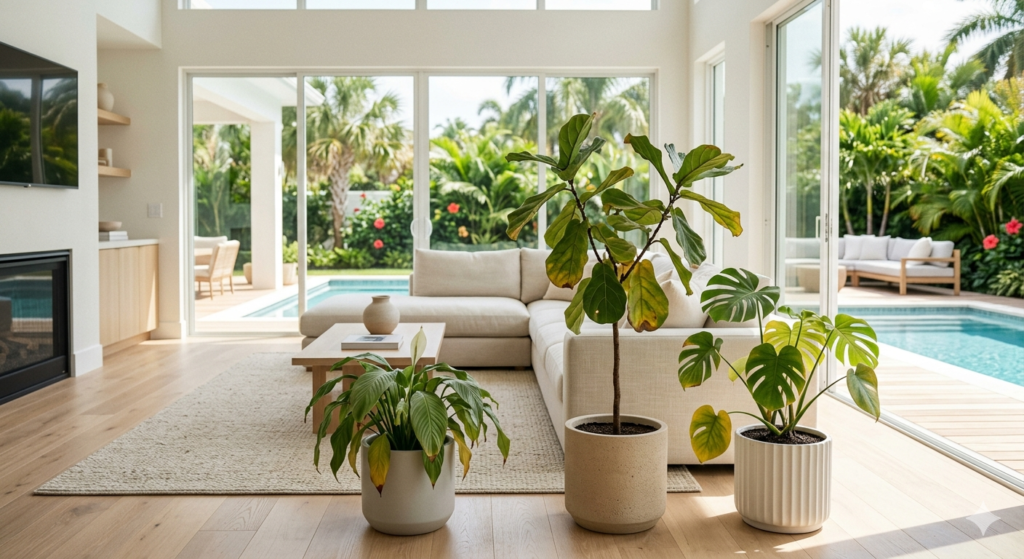
You bring home healthy indoor plants, follow typical care instructions, water them carefully, and still watch them decline within weeks. Leaves yellow, growth stalls, soil feels constantly damp, and in some cases, mold or small flying insects begin to appear.
This situation is especially common in humid climates, where the problem isn’t usually neglect or incorrect watering frequency. Instead, it’s a mismatch between how plants are typically cared for and how moisture actually behaves indoors in high humidity environments.
What feels like “doing everything right” often leads to conditions that plants can’t tolerate long-term.
This article contains affiliate links. If you make a purchase through one of these links, The Humid House may earn a small commission at no additional cost to you.
Why it happens in humid homes
Indoor plant care advice is usually based on environments where moisture evaporates at a steady, predictable rate. In humid homes, that assumption breaks down.
Evaporation slows down significantly
When indoor humidity is high, water doesn’t leave the soil efficiently. The surrounding air is already saturated, so moisture lingers much longer than expected.
This creates a situation where:
- Soil stays wet for extended periods
- Roots sit in moisture instead of cycling through wet and dry phases
- Oxygen availability in the root zone drops
Roots begin to suffocate
Healthy plant roots need both water and oxygen. In consistently damp soil, oxygen levels decrease, and roots struggle to function properly.
Over time, this can lead to:
- Root stress or early-stage rot
- Reduced nutrient uptake
- Yellowing leaves despite “correct” watering
Microbial and fungal activity increases
Warm, damp soil creates an ideal environment for microbial growth.
This is why you may start noticing:
- White fuzzy growth on soil surface
- Musty smells
- Fungus gnats or small flying insects
These aren’t always the root problem—they’re often a sign that moisture is not cycling properly.
“Overwatering” becomes misleading
In humid homes, overwatering is less about how often you water and more about how long the soil stays wet afterward.
You can water the exact “right” amount and still create overwatered conditions simply because the environment doesn’t allow the soil to dry.
Why this is more common in humid climates
Humidity affects the entire indoor moisture system, not just your plants.
In homes with consistently high indoor humidity:
- Air already holds a large amount of moisture
- Surfaces dry more slowly
- Soil retains water longer than expected
- Airflow may not be enough to compensate
This creates a subtle but persistent imbalance where moisture accumulates faster than it can dissipate.
Common signs your environment—not your watering—is the issue
| What You’re Seeing | What It Often Means in Humid Homes |
| Soil stays damp for days or weeks | Evaporation is too slow |
| Yellowing leaves despite careful watering | Root stress from low oxygen |
| Fungus gnats or tiny flies | Excess moisture in soil |
| White or fuzzy growth on soil | Fungal activity from damp conditions |
| Musty smell near plant pots | Moisture is lingering too long |
What homeowners can do
The goal isn’t to stop watering—it’s to help moisture move through the system properly.
Let soil dry more than you think
In humid environments, plants often need longer drying periods than typical care guides suggest.
Instead of watering on a schedule:
- Check deeper soil dryness (not just the surface)
- Allow a more complete dry-down between waterings
Improve airflow around plants
Air movement helps moisture evaporate more efficiently.
Simple changes can help:
- Avoid tightly grouping plants
- Keep them out of stagnant corners
- Use ceiling fans or gentle air circulation nearby
Use better-draining soil mixes
Standard potting soil can retain too much moisture in humid environments.
A better approach:
- Add perlite, bark, or coarse material
- Choose mixes such as Sol Soils Houseplant Chunky Mix designed for faster drainage
Be cautious with decorative pots
Pots without drainage holes trap moisture.
Even when used as outer containers, they can:
- Slow evaporation
- Keep the root zone wetter than expected
Watch humidity, not just watering
If your home consistently feels damp, heavy, or slow to dry, your plants are experiencing that same environment. This is where broader home conditions matter more than plant-specific care routines.
When to consider a bigger moisture issue
If you’re noticing plant decline alongside other signs, it may not be isolated:
- Persistent musty smells in the home
- Condensation on windows or surfaces
- Bathrooms or showers staying damp
- Fabrics or towels feeling slow to dry
- Small flying insects appearing indoors
These patterns suggest your home may be holding excess humidity overall, not just around your plants.
Prevention going forward
Plants tend to do best when moisture moves in a cycle:
- Water enters the soil
- Roots absorb what they need
- Excess moisture gradually evaporates
In humid homes, that cycle slows down. The solution isn’t more care—it’s adjusting expectations to match how moisture actually behaves indoors.
Professional perspective
As indoor environmental conditions shift, plant care guidance often needs to shift with them.
“In high-humidity environments, the limiting factor for plant health is often oxygen availability in the root zone, not water supply. When soils remain saturated for extended periods, root function declines even if watering practices appear appropriate. Adjusting for airflow and drainage becomes more important than reducing watering alone.”
This reflects a broader principle: plants respond to the environment they’re in, not the instructions they came with.
Frequently asked questions
Why are my plants dying even though I’m not overwatering?
In humid homes, soil can stay wet much longer than expected. Even normal watering can lead to conditions similar to overwatering because moisture doesn’t evaporate efficiently.
Why does my plant soil never seem to dry out?
High indoor humidity slows evaporation. If the surrounding air is already full of moisture, water has nowhere to go, so it lingers in the soil.
Are fungus gnats a sign I’m watering too much?
They’re more accurately a sign that soil is staying damp too long. In humid environments, that can happen even with careful watering habits.
Should I water less in a humid climate?
Not necessarily less often—but you should allow more drying time between waterings and focus on drainage and airflow.
Why did my plants do fine before I moved?
They were likely in an environment where soil dried at a normal rate. Moving to a humid climate changes how moisture behaves, even if your care routine stays the same.
Bottom line
When indoor plants decline in humid homes, the issue is rarely just watering technique. It’s the way moisture behaves in the environment. Soil that stays wet too long, reduced airflow, and consistently high humidity can create conditions that plants struggle to tolerate, even with careful care. Understanding that different environmental stressors affect plants differently, is what turns a frustrating cycle into something predictable—and fixable.