
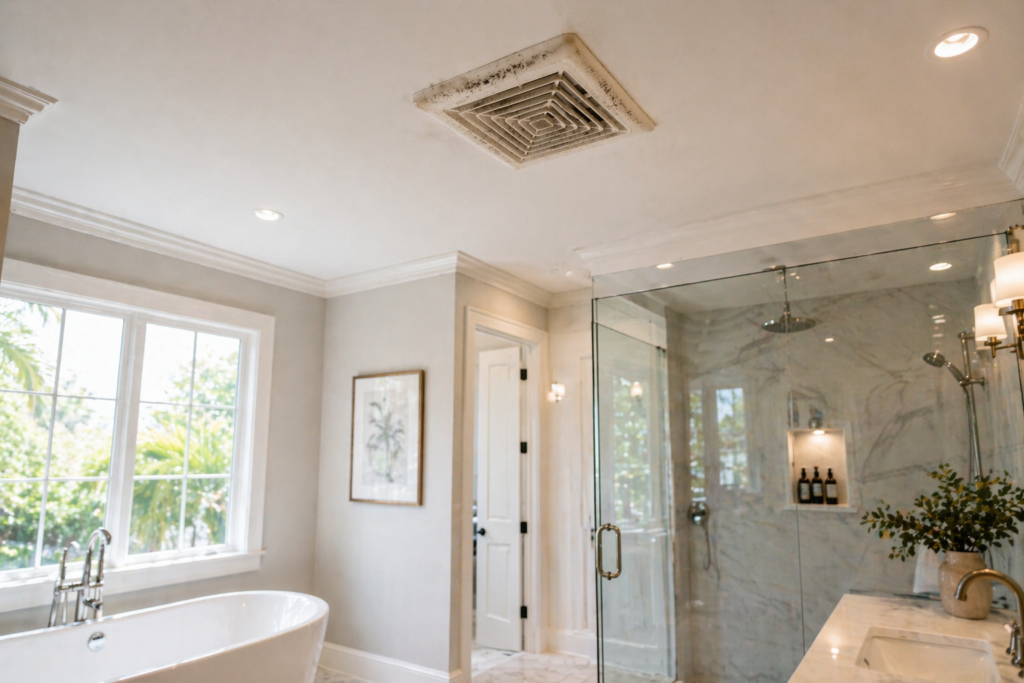
Mold growing on bathroom fans, ceiling fans, or near vents is not usually a cleaning issue—it’s a moisture behavior issue. These surfaces don’t create mold independently. Instead, they reveal how humidity, airflow, and condensation interact inside the home. In humid climates, fans often become one of the earliest and most visible indicators that moisture is not being fully removed from the indoor environment.
Homeowners often assume that fans “dry the air.” In reality, most fans only move air. When humidity remains elevated, that moving air can actually spread and redistribute moisture rather than eliminate it.
What’s Happening When Mold Appears on Fans
Mold on fans typically appears as:
- Light gray or black speckling on fan covers
- Dust buildup that darkens over time
- Spotting near exhaust grilles or vent openings
This happens because fans naturally accumulate dust, lint, and airborne particles, which act as a base layer. When humid air passes over these surfaces, moisture binds to that layer, creating a stable environment for mold growth.
The fan is not the source—it is the collection point.
What’s often missed is that mold spores are already present in indoor air at low levels. Growth only becomes visible when conditions allow those spores to settle, stay damp, and multiply over time. Fans provide a consistent surface where that process can repeat.
Why Fans Become Mold Collection Points
Fans sit directly in the path of moving air, which exposes them to both moisture and particles. Over time, this creates consistent conditions for growth.
Key Mechanism at Play
| Factor | What It Does | Why It Matters |
| Dust buildup | Holds organic particles | Provides surface for mold attachment |
| Humid air | Carries moisture | Allows spores to activate and grow |
| Air movement | Circulates moisture | Spreads humidity instead of removing it |
| Temperature differences | Can create condensation | Adds localized moisture on surfaces |
The critical misunderstanding is this:
Air movement does not equal moisture removal.
Why This Matters Physically
Air can hold a certain amount of water vapor depending on its temperature. When that air is already near its moisture limit, moving it around does not reduce that moisture—it simply redistributes it.
In some cases, especially near cooler surfaces, that moisture can partially condense, creating micro-damp conditions that aren’t obvious but are enough for mold to grow.
Why This Is More Common in Humid Homes
In humid climates, the air already contains a high moisture load before it even enters the home. Once inside:
- Surfaces dry more slowly
- Moisture lingers after normal activities like showering
- Cooling systems may reduce temperature without fully removing humidity
The Key Misconception
Cooler air often feels drier, but that is not always true.
Air conditioning lowers temperature quickly, which can make the environment feel more comfortable. However, if the system is not running long enough or is oversized, it may not remove sufficient moisture from the air.
This creates a condition where:
air feels cool, but still contains enough moisture to support mold growth.
Fans operating in that environment continue moving that moisture across surfaces.
Where Mold on Fans Typically Appears
While the underlying mechanism is the same, it shows up slightly differently depending on the fan type.
Bathroom Exhaust Fans
Bathroom fans are the most common location.
- Moist air is pulled toward the fan
- Not all moisture is fully exhausted outside
- Short run times allow humidity to remain
- Duct length, bends, or termination points can reduce effectiveness
This is closely related to patterns seen in shower mold, where moisture persists even after use.
Ceiling Fans
Ceiling fans circulate indoor air but do not remove moisture.
- Humid air continuously passes over blades
- Dust accumulates over time
- Moisture binds to that dust layer
In some cases, ceiling fans can actually delay drying by keeping humid air in motion instead of allowing it to settle and be removed through proper ventilation or dehumidification.
This often appears in homes that feel humid even with the AC running, where moisture is being redistributed rather than removed.
HVAC Vents (Secondary Pattern)
While not technically fans, vents can show similar signs.
- Cool air meets humid air
- Small condensation zones can form at the grille
- Dust captures that moisture
This effect is usually subtle but consistent, especially in humid environments.
Why Mold Keeps Coming Back Even After Cleaning
Cleaning removes:
- Visible mold
- Surface buildup
But it does not change:
- Indoor humidity levels
- Airflow patterns
- Moisture retention behavior
Why Recurrence Happens
If a surface repeatedly reaches even slightly damp conditions, mold can re-establish itself quickly. This does not require visible moisture—just consistent elevated humidity at the surface level.
A similar pattern occurs when mold comes back even with bathroom ventilation, where airflow exists but moisture removal is incomplete.
What Mold on Fans Says About Your Home
Mold on fans is not isolated—it reflects broader conditions.
It usually indicates:
- Moisture is lingering longer than expected
- Air is being moved, but not fully dried
- Humidity levels are consistently elevated
In many cases, the fan is simply revealing a system-level issue.
A More Precise Way to Think About It
Instead of:
- “This fan is getting moldy”
A more accurate interpretation is:
- “This location is consistently exposed to air that is not drying fast enough.”
Professional Perspective on Moisture and Airflow
To understand this more clearly, it helps to look at how building science defines airflow and moisture behavior.
“Ventilation and air movement alone do not guarantee moisture removal. Effective moisture control depends on both air exchange and the reduction of absolute humidity within the space. Without that, moisture can remain and redistribute across surfaces.”
— Building Science Corporation, indoor air and moisture research
In practical terms, this means:
- Moving humid air around a room does not reduce its moisture content
- Moisture must either be removed (exhausted or dehumidified) or allowed to fully dissipate
What Homeowners Can Do
The goal is not just cleaning—it’s changing how moisture behaves in the space.
Focus on Moisture Removal, Not Just Air Movement
| Action | What It Helps With | Limitation |
| Running bathroom fans 20–30 minutes after showers | Extends moisture removal window | Only effective if vented properly outside |
| Cleaning fan surfaces regularly | Removes buildup that holds moisture | Does not address root cause |
| Checking that exhaust vents exit outdoors | Prevents moisture from recirculating | May require inspection |
| Using dehumidification where needed | Reduces overall moisture load | Requires consistent use |
Practical Guidance That Actually Helps:
- Run bathroom fans longer than you think necessary, especially in humid climates
- Avoid turning fans off immediately after moisture-producing activities
- Be aware that airflow alone is not drying—time and moisture removal matter
- Watch for patterns (recurring spots, same locations), not just isolated buildup
When It’s More Than a Normal Pattern
Some buildup over time can happen in humid environments.
However, it may indicate a larger issue if:
- Mold returns quickly after cleaning
- Growth becomes thicker or spreads
- Multiple areas of the home show similar patterns
This suggests that overall indoor humidity may be consistently elevated, not just localized moisture.
Prevention That Actually Works Long-Term
Long-term prevention comes from changing conditions, not just surfaces.
What tends to help:
- Allowing moisture to fully leave the space
- Reducing repeated exposure to humid air
- Keeping surfaces from holding moisture
What typically does not solve the issue alone:
- Brief fan use
- Surface cleaning only
- Relying on airflow without moisture control
Frequently Asked Questions
Is mold on a bathroom fan normal?
Some light buildup can occur over time, especially in humid climates. However, repeated or fast-returning mold usually indicates that moisture is not being fully removed from the space.
Does running a fan prevent mold?
Not always. Fans move air, but they do not remove moisture unless that air is effectively exhausted or dehumidified. In some cases, fans can redistribute humid air.
Why does mold come back after I clean the fan?
Cleaning removes the surface growth, but the underlying humidity conditions remain the same. If moisture continues to linger, mold can return.
Is this a sign of high humidity in my home?
Often, yes. Mold forming on fans is commonly associated with elevated indoor humidity or inefficient moisture removal.
Should I be concerned about mold on ceiling fans?
Light buildup is not uncommon, but it can indicate that humid air is circulating through the home without being fully dried or removed.
The Bottom Line
Mold on fans is not just a surface issue—it’s a signal. It shows that moisture is being moved, circulated, and allowed to linger rather than fully removed from the home.
Fans don’t create mold. They reveal where humidity patterns are not working the way homeowners expect.
Understanding that difference is what allows you to address the cause—not just the symptom.