
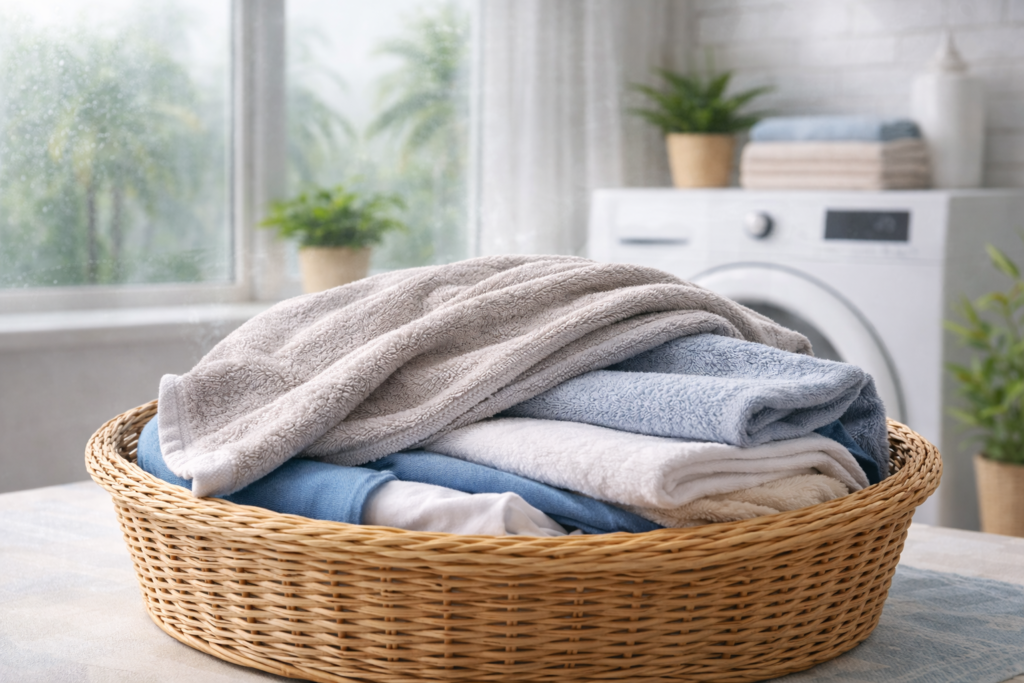
Clean laundry is expected to smell neutral or fresh, but in humid homes, that expectation often doesn’t match reality. Clothes can come out of the washer smelling fine, then develop an off smell after drying. Towels can smell musty even with strong detergent. Laundry can even smell “clean” at first, then shift once it sits for a few hours.
This is one of the more confusing humidity-related problems in a home because it doesn’t always look like a moisture issue. There is no visible water, no obvious dampness, and often no clear mistake in the washing process.
What’s happening instead is a combination of moisture retention, slow drying, and residue interaction, all influenced by how humid air changes the way fabrics behave.
What’s Actually Causing Laundry to Smell Off
Laundry odor in humid homes is rarely caused by a single factor. It usually comes from a combination of conditions that allow moisture to remain in fabrics longer than expected.
The main contributors are:
- Moisture lingering in fabric fibers
- Drying that takes longer than it should
- Residue from detergent or softeners holding odor
- Air that is humid enough to prevent full drying
Fabrics don’t need to feel wet to hold moisture. In humid environments, they can remain slightly damp at a microscopic level, which is enough to affect how they smell.
Why Humid Air Changes How Laundry Dries
Drying is not just about heat. It depends on how much moisture the surrounding air can absorb.
In humid homes:
- The air is already holding a high amount of moisture
- Evaporation slows down
- Fabrics release moisture more slowly
This means laundry may:
- take longer to dry
- feel dry on the surface but not internally
- retain small amounts of moisture after drying
That retained moisture creates conditions where odors can develop or return.
Why Laundry Can Smell Even After Using Strong Detergent or Dryer Sheets
One of the most frustrating parts of this issue is when laundry smells off despite using heavily scented products.
This happens because fragrance does not remove the underlying cause. It interacts with it.
- Detergents and dryer sheets leave behind residue
- Residue can trap moisture within fibers
- Fragrance layers on top of that residue
- Moisture allows underlying odor to persist
The result is often:
- a mix of “clean” scent with a musty undertone
- a smell that changes after a few hours
- laundry that smells stronger, but not cleaner
Adding more detergent or fragrance often makes the problem worse rather than better.
Why Towels, Blankets, and Thick Fabrics Are the Most Affected
Not all laundry behaves the same in humid homes. Thicker, more absorbent fabrics tend to hold onto moisture much longer than lighter materials, even after a full wash and dry cycle.
Towels, blankets, and similar items are designed to absorb and retain water. In humid conditions, that same property makes them slower to fully release moisture back into the air.
This creates a few consistent patterns:
- Moisture remains deeper inside the fabric, even when the surface feels dry
- Drying cycles remove surface moisture first, not internal moisture
- Humid air slows the final stage of drying
- Moisture becomes trapped once items are folded or stacked
Because of this, these fabrics are more likely to:
- develop a musty or sour smell
- smell fine at first, then change later
- hold both moisture and detergent residue
This is why towels are often the first place homeowners notice the issue.
How Different Fabrics Respond to Humidity
| Fabric Type | Why It Holds Odor More Easily |
| Towels | Dense fibers retain moisture longer |
| Blankets | Multiple layers slow evaporation |
| Athletic wear | Synthetic fibers trap residue and moisture |
| Bedding | Thickness prevents full drying |
| Heavy cotton | Absorbs and holds water deeply |
Why the Smell Can Show Up After Drying, Not During
A common pattern is that laundry smells fine immediately after drying, but changes later.
This happens because:
- residual moisture is still present
- airflow stops once laundry is folded or stored
- trapped moisture begins to affect odor
This is why:
- folded laundry can smell worse than freshly dried laundry
- closets and drawers can amplify the problem
The issue is often not the wash cycle, but what happens after.
Why This Problem Keeps Coming Back
Laundry odor in humid homes is not usually caused by a single mistake. It is caused by consistent environmental conditions.
That’s why:
- re-washing improves it temporarily
- switching detergents doesn’t fully solve it
- the issue returns even with good habits
If the surrounding air remains humid, fabrics will continue reacting thea same way.
What Homeowners Can Do to Improve Laundry Results
The goal is not just to clean laundry, but to fully remove moisture and limit residue buildup.
| Adjustment | Why It Helps |
| Avoid overloading the washer | Improves rinsing and reduces residue |
| Use appropriate detergent amounts | Prevents buildup in fibers |
| Dry promptly after washing | Limits moisture sitting in fabrics |
| Ensure full drying before folding | Reduces trapped moisture |
| Improve airflow in laundry areas | Helps moisture escape |
These adjustments help create more consistent results.
Professional Insight: Why Fabrics Hold Moisture and Odor in Humid Air
Because this issue is driven by how materials interact with moisture over time, it helps to understand how fabric behavior is explained in building and material science.
“Textiles, like other porous materials, exchange moisture with the surrounding air until they reach equilibrium. In high-humidity environments, that equilibrium point is elevated, meaning fabrics retain more moisture than expected even after drying. This residual moisture can remain within the fiber structure, where it influences odor retention and release over time. In these conditions, the limiting factor is not cleaning effectiveness, but the ability of the environment to support complete drying.”
This helps explain why laundry can appear clean but still develop odor later. The issue is not just washing, but how moisture behaves inside the fabric after drying.
How This Connects to Other Humidity Problems in the Home
Laundry odor is rarely isolated.
The same conditions can also contribute to:
- musty smells in the home
- slow drying of other materials
- condensation on surfaces
- moisture-related material changes
Addressing humidity often improves multiple issues at once.
When Laundry Odor Is Normal vs. Worth Addressing
Usually normal:
- occasional mild odor in very humid conditions
- thicker fabrics needing more drying time
Worth addressing:
- persistent musty smell after every wash
- odor returning quickly after drying
- laundry smelling worse after storage
The difference is consistency and severity.
Frequently Asked Questions
Why do my clothes smell musty even after washing?
Clothes can retain small amounts of moisture in humid environments, even after washing and drying. That moisture allows odor to develop or return over time.
Why do my towels smell worse than my clothes?
Towels are thicker and more absorbent, so they hold onto moisture longer and release it more slowly, especially in humid air.
Why does laundry smell fine at first, then smell bad later?
Residual moisture remains after drying. Once laundry sits without airflow, that moisture begins to affect odor.
Can too much detergent cause laundry to smell?
Yes. Excess detergent can leave residue in fabrics, which traps moisture and contributes to odor.
Do dryer sheets fix musty smells?
No. They add fragrance but do not remove moisture or residue, so they only mask the issue temporarily.
Is this a washer issue or a humidity issue?
It can be both, but in humid climates, environmental moisture plays a major role in how fabrics dry and hold odor.
The Bottom Line
When clean laundry smells off in humid homes, the issue is rarely about cleanliness alone. It is usually the result of moisture that remains in fabrics longer than expected, combined with residue and slow drying conditions.
Fragrance may temporarily mask the smell, but it does not change how fabrics interact with humid air. Over time, those conditions lead to recurring odor, even when laundry is washed correctly.
The most effective approach is to focus on moisture removal and environmental conditions, so fabrics can fully dry and remain stable after the cycle is complete.