
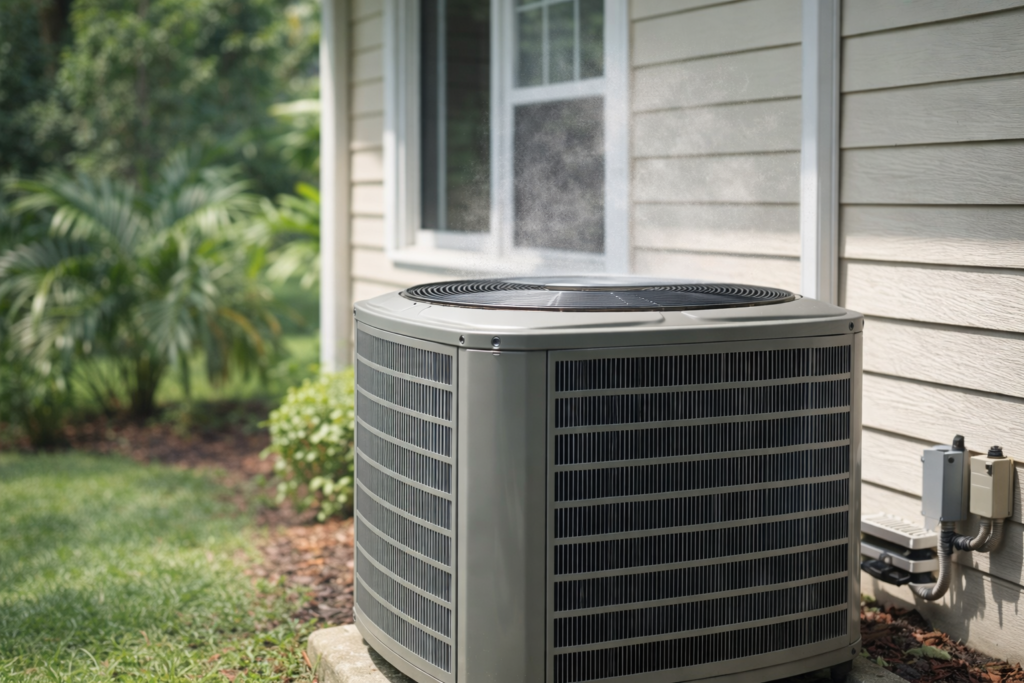
In hot, humid climates, many homeowners notice their air conditioner running for long stretches during the summer. In some homes the system may seem to operate almost continuously throughout much of the day. This often raises a natural concern: if the air conditioner rarely shuts off, does it mean something is wrong?
In many situations, extended run times are actually part of normal summer operation. Air conditioning systems are designed to remove heat from the home while also reducing humidity. When outdoor temperatures and moisture levels remain high, the cooling demand placed on the home may remain steady for long periods of time.
At the same time, continuous operation can occasionally indicate that a cooling system is struggling to keep up with the conditions outside. Understanding the difference between normal summer behavior and potential performance problems requires looking at how air conditioners operate and how homes gain heat during warm weather.
How Air Conditioning Systems Work
Air conditioners regulate indoor temperature by removing heat from indoor air and releasing that heat outdoors. Warm air from inside the home passes across the evaporator coil, where refrigerant absorbs heat from the air.
As heat is removed, the cooled air is circulated back through the home. At the same time, moisture in the air condenses on the cold coil surface and drains away. This condensation process is how air conditioners remove humidity while cooling the home.
Because homes continually gain heat from sunlight, outdoor air, appliances, and occupants, cooling systems must cycle on periodically to maintain indoor temperature. When outdoor conditions become hotter, the amount of heat entering the home increases, which can require longer cooling cycles.
Why AC Systems Often Run Constantly in Summer
In warm climates, outdoor heat and humidity can create a steady cooling load on the home. This means the air conditioner may need to run frequently to maintain the thermostat setting.
Several factors contribute to this demand.
| Condition | How It Influences Cooling |
| High outdoor temperatures | More heat enters the home |
| High humidity | Additional moisture must be removed |
| Solar heat gain | Sun warms roofs, walls, and windows |
| Warm attic spaces | Heat transfers through ceilings |
| Air leakage | Warm outdoor air enters the home |
When these conditions occur simultaneously, cooling demand can remain elevated for much of the day. As a result, the air conditioner may run for extended periods simply to keep indoor conditions stable.
When Continuous Operation Is Normal
During periods of intense summer heat, it is common for air conditioners to run for long stretches throughout the day. In humid climates, systems often run even longer because they must remove both heat and moisture from indoor air.
Building science guidance frequently notes that long cooling cycles are expected during peak conditions. According to the U.S. Department of Energy, air conditioners may operate for extended cycles during extreme heat because the system must continually remove heat entering the home from outdoor temperatures, sunlight, and internal heat sources.
During periods of extreme heat, air conditioners may run for longer cycles or even continuously in order to maintain the thermostat setting. — U.S. Department of Energy
When a system runs frequently but still maintains the thermostat setting, this behavior often reflects the home responding to outdoor heat rather than a malfunction.
Situations Where Constant Running May Signal a Problem
Although long cooling cycles are common during summer, certain situations can cause a system to run constantly while still struggling to cool the home.
This may occur when the system cannot remove heat efficiently enough.
Common causes include:
• Dirty or clogged air filters restricting airflow
• Refrigerant levels that are too low
• Outdoor condenser coils blocked by debris
• Duct leakage reducing airflow to rooms
• Poor insulation allowing excessive heat gain
• Aging equipment losing cooling capacity
In these cases, the system may run continuously while indoor temperatures slowly rise or fail to reach the thermostat setting.
Conditions That Increase Cooling Demand in Homes
Some homes experience higher cooling demand than others due to structural or environmental factors.
Homes most likely to experience long cooling cycles often share several characteristics.
| Home Condition | Why Cooling Demand Increases |
| Large window areas | Solar heat enters the home |
| Limited attic insulation | Heat transfers through ceilings |
| Air leakage in the building envelope | Warm outdoor air enters |
| Older windows and doors | Reduced thermal efficiency |
| High indoor activity | Cooking and appliances add heat |
These factors increase the amount of heat entering the home, which naturally requires longer cooling cycles.
Signs Your AC May Be Struggling
While long cooling cycles are common in summer, certain signs may indicate that the air conditioner is struggling to keep up with cooling demand.
Homeowners sometimes notice:
• Indoor temperatures rising despite constant operation
• Warm or weak airflow from supply vents
• Uneven cooling between rooms
• Higher electricity bills than usual
• Ice forming on refrigerant lines or coils
These observations do not always indicate a major failure, but they may suggest that the system would benefit from inspection or maintenance.
Why Longer Cooling Cycles Help Control Humidity
Humidity plays an important role in how comfortable indoor air feels. Even when temperatures remain moderate, elevated humidity can make the indoor environment feel warmer.
Air conditioners remove moisture through condensation on the cooling coil. When cooling cycles are longer, more humid air passes across the coil surface, allowing more moisture to condense and drain away.
Short cooling cycles remove less moisture because the system shuts off before significant condensation occurs. This is why longer, steadier cooling cycles during summer often improve humidity control in humid climates.
Frequently Asked Questions
Why does my AC run constantly in summer?
Air conditioners often run longer during summer because homes continually gain heat from outdoor temperatures, sunlight, and indoor activity. In hot climates, cooling demand may remain high throughout the day, which can cause the system to operate frequently in order to maintain the thermostat setting.
Is it bad if my AC runs all day?
Not necessarily. If the system is maintaining the thermostat setting and airflow remains normal, long cooling cycles are often expected during periods of extreme heat. However, if indoor temperatures continue rising while the system runs continuously, it may indicate a maintenance or performance issue.
Should an AC cycle on and off frequently?
Frequent short cycling is generally not ideal. When systems turn on and off repeatedly, they remove less moisture from the air and may experience additional mechanical wear. Longer cooling cycles often improve both humidity control and temperature stability.
Why does my house still feel warm even when the AC is running?
This can occur when cooling demand exceeds the system’s capacity or when airflow problems reduce cooling efficiency. Poor insulation, air leaks, or mechanical issues with the system can all contribute to this situation.
The Bottom Line
Air conditioners in humid climates often run for extended periods during summer because homes continually gain heat and moisture from the surrounding environment. When outdoor temperatures and humidity remain elevated, cooling systems may operate frequently simply to maintain stable indoor conditions.
Long cooling cycles are not automatically a sign that something is wrong. In many cases they help the system remove moisture more effectively and stabilize indoor humidity levels.
However, if the air conditioner runs continuously while indoor temperatures continue rising or airflow seems weak, it may indicate that the system is struggling to keep up with cooling demand. Understanding how air conditioners respond to heat and humidity can help homeowners determine whether extended run times are part of normal summer operation or whether the system may benefit from inspection or maintenance.