
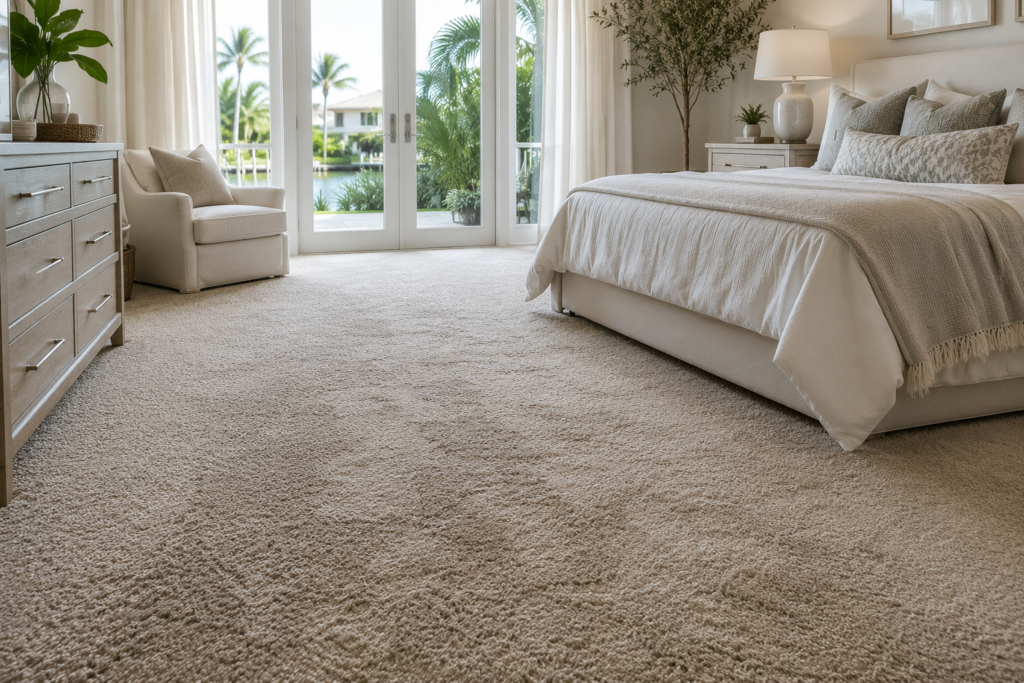
Carpet tends to behave differently in humid homes than many homeowners expect. In some houses, carpet may begin feeling slightly damp, develop a persistent musty smell, or start looking flattened, discolored, or aged surprisingly quickly even without major spills or visible water damage. Many homeowners notice this most strongly during summer, rainy weather, or after a home has been closed up for a period of time.
Unlike hard flooring surfaces, carpet and rugs continuously interact with moisture in the air itself. Over time, humidity can affect not only the carpet fibers, but also the padding underneath, the way odors linger indoors, and how quickly the material dries after normal daily moisture exposure. In humid climates, many carpet problems are not caused by a single dramatic event, but by low-level moisture accumulation happening gradually over months and years.
Why Carpet Holds Moisture More Easily Than Hard Flooring
Carpet contains an enormous amount of surface area compared to hard flooring materials. Thousands of individual fibers trap small pockets of air, dust, oils, and moisture throughout the material. In humid environments, those fibers continuously absorb moisture from the surrounding air even when the carpet does not appear visibly wet.
This does not necessarily mean the carpet is soaked with water. Instead, the carpet slowly reaches moisture equilibrium with the surrounding indoor air. When indoor humidity stays elevated for long periods, carpet fibers and padding may remain slightly moisture-laden almost constantly.
That changes the way carpet feels, smells, and dries.
Unlike tile or vinyl flooring, carpet also slows airflow directly at the flooring surface. Once humidity settles deeper into the fibers and padding, evaporation becomes much slower, especially when indoor air is already humid.
This is one reason carpet in humid homes may:
- feel heavier
- dry more slowly
- hold odor longer
- or develop a stale smell more easily than carpet in drier climates
Why Carpet Can Feel Damp Even When It Is Not Wet
One of the most confusing parts of humid-climate carpet problems is that carpet can feel damp without being truly saturated.
Humidity changes how moisture evaporates from both surfaces and skin. When indoor air already contains a large amount of water vapor, evaporation slows significantly. Carpet fibers may hold enough atmospheric moisture to feel:
- cool
- heavy
- sticky
- or slightly damp underfoot,
without an obvious leak ever occurring
Many homeowners notice this sensation:
- first thing in the morning
- during rainy periods
- in closed rooms
- or in homes where the air conditioner struggles to fully control humidity
In humid climates, the issue is often not standing water. It is the constant presence of slightly elevated moisture inside soft materials that never fully dry out.
Why Musty Carpet Smells Become So Common in Humid Homes
Carpet naturally traps:
- dust
- skin cells
- oils
- pollen
- pet dander
- and microscopic organic debris
Humidity changes the way those materials behave. When moisture lingers inside carpet fibers and padding, odors become trapped more easily and organic material breaks down more slowly. The result is the stale, musty, or “humid house” smell many homeowners recognize immediately.
This often becomes worse after:
- rainy weather
- steam cleaning
- leaving windows open
- turning the AC higher while away
- or closing a home up for long periods
People relocating from drier climates are often surprised by how different carpet smells in humid regions, even in homes that appear visually clean.
In many homes, the smell is strongest:
- after returning from vacation
- in guest bedrooms
- inside closets
- or in rooms with limited airflow
That odor does not always mean there is severe visible mold growth inside the carpet. In many cases, it reflects long-term moisture retention combined with trapped organic material and slow drying conditions.
Carpet Padding Often Holds Moisture Long After the Surface Dries
One of the biggest reasons carpet problems persist in humid homes is that the padding underneath the visible carpet surface often stays damp much longer than homeowners realize.
The upper carpet fibers are exposed to airflow and tend to dry first. Padding underneath is more insulated from moving air, which slows evaporation dramatically.
In humid climates, this becomes even more significant because the surrounding air may already contain so much moisture that very little drying can occur efficiently.
Over time, repeated low-level moisture exposure can allow the padding to:
- retain odor
- compress
- age prematurely
- and contribute to recurring musty smells
This is one reason many homeowners feel frustrated after carpet cleaning. The visible carpet may initially smell better, but lingering moisture deeper within the padding can allow odors to gradually return.
Rugs Can Trap Moisture Against Floors
Area rugs often develop humidity-related problems even faster than wall-to-wall carpet because airflow underneath them is extremely limited.
In humid homes, rugs may trap moisture:
- between the rug and floor
- within dense fibers
- or inside the rug backing itself
Homeowners sometimes notice:
- musty smells underneath rugs
- dampness near the edges
- discoloration
- curling
- or a heavy stale smell after lifting a rug
This becomes especially common in:
- closed homes
- coastal climates
- homes with elevated indoor humidity
- and rooms with little sunlight or airflow
Natural-fiber rugs are often particularly sensitive to humidity because the material itself absorbs and releases moisture more easily than many synthetic fibers.
Concrete Slab Foundations Can Contribute to Carpet Dampness
Many homes in humid climates are built on concrete slab foundations, which naturally exchange small amounts of moisture vapor over time. Carpet padding and rugs placed over slab floors can sometimes trap that moisture near the flooring surface, especially in homes with elevated indoor humidity or limited airflow.
This is one reason some homeowners notice:
- damp-feeling carpet
- musty smells underneath rugs
- or stronger odor near floors during humid weather
In many cases, the issue is not a plumbing leak, but the combined effect of humid air, slow evaporation, and long-term moisture accumulation near soft flooring materials.
Why Carpet May Start Breaking Down Faster in Humid Homes
Humidity affects more than just odor. Over time, persistent moisture exposure can gradually affect the physical structure of carpet and rugs themselves.
Moisture repeatedly softens fibers, padding, and adhesives. Dust and oils become stickier in humid environments and bind more deeply into carpet materials. Carpet fibers may remain compressed longer, while padding slowly loses resilience from repeated moisture exposure.
Homeowners may notice:
- flattened carpet
- discoloration
- yellowing
- matting
- edge curling
- stubborn odor retention
- or a generally older appearance developing faster than expected
This deterioration usually happens slowly rather than all at once. Many homeowners simply feel that carpet in humid climates becomes harder to keep feeling truly fresh over time.
Why Closed-Up Homes Often Develop Carpet Problems Faster
One of the clearest examples of humidity-related carpet problems happens in homes that sit closed up for extended periods.
When homes remain vacant:
- airflow decreases
- humidity accumulates
- indoor air stagnates
- and air conditioning may run inconsistently or at higher temperatures
Soft materials like carpet and rugs absorb that moisture over time.
This is why homes in humid climates may smell noticeably mustier after:
- vacations
- seasonal absences
- real estate vacancy periods
- or long stretches without regular airflow
Even visually clean homes can develop heavy, stale-smelling carpet surprisingly quickly when humidity remains trapped indoors.
Why Cleaning Alone Often Does Not Fully Solve the Problem
Many homeowners repeatedly shampoo, deodorize, or deep clean carpet without fully solving the issue because humidity itself remains part of the underlying problem.
If indoor moisture levels stay elevated, carpet may continue:
- reabsorbing humidity
- drying slowly
- trapping odor
- and retaining moisture within the padding underneath
In some cases, aggressive wet carpet cleaning can temporarily worsen conditions if the carpet cannot dry efficiently afterward.
This is why some homeowners feel trapped in a cycle where:
- carpet smells improve briefly
- then gradually return again during humid weather
What Homeowners Can Do
In many humid homes, improving moisture control is just as important as cleaning the carpet itself.
Helpful strategies may include:
- maintaining lower indoor humidity
- improving airflow
- running bathroom exhaust fans consistently
- addressing AC performance issues early
- avoiding leaving homes closed up for long periods
- drying carpet thoroughly after cleaning
- using dehumidifiers when needed
- and limiting thick rugs directly on slab floors
In some situations, carpet padding may eventually require replacement if odor and moisture have remained trapped for long periods.
Professional Perspective
The EPA has consistently emphasized that moisture control is one of the most important parts of preventing odor and mold-related problems inside homes. Soft materials like carpet and padding retain moisture much longer than many hard surfaces, particularly in humid environments where evaporation slows significantly.
That does not mean every musty carpet contains dangerous mold growth. In many humid homes, the issue is chronic moisture retention and slow drying occurring gradually over time rather than a single severe contamination event.
Signs Humidity May Be Affecting Carpet or Rugs
| Common Sign | What It May Suggest |
| Carpet feels slightly damp | Elevated indoor humidity or slow evaporation |
| Carpet smells musty after rain | Moisture retention inside fibers or padding |
| Odor returns quickly after cleaning | Padding may still be holding moisture |
| Rugs smell underneath | Trapped humidity with poor airflow |
| Carpet looks flattened or aged quickly | Long-term moisture exposure |
| Closed rooms smell stronger | Stagnant humid air accumulating indoors |
| Carpet develops discoloration or yellowing | Gradual material breakdown and trapped debris |
Frequently Asked Questions
Is musty carpet always mold?
No. Carpet can develop musty odors simply from retained humidity, trapped organic material, slow drying, and long-term moisture exposure. However, persistent dampness can eventually contribute to mold growth in some situations.
Why does carpet smell worse during humid weather?
Humidity slows evaporation and allows carpet fibers and padding to retain moisture longer, which intensifies odor.
Can carpet padding stay damp even when the surface feels dry?
Yes. Padding underneath carpet often dries much more slowly than the visible fibers above it.
Are rugs worse in humid climates?
Some rugs hold moisture more easily than others, especially thick rugs or natural-fiber rugs placed in areas with limited airflow.
Does air conditioning always remove enough humidity to protect carpet?
Not always. Some homes maintain elevated indoor humidity even when the AC appears to cool properly.
The Bottom Line
Carpet and rugs naturally absorb and retain more atmospheric moisture than many hard flooring surfaces, which makes them especially sensitive to humid indoor environments. Over time, elevated humidity can contribute to musty odors, dampness, slow drying, discoloration, trapped odor, and gradual material breakdown even without obvious water damage.
In many humid homes, carpet problems are not caused by a single major leak or visible mold event, but by continuous low-level moisture exposure happening slowly over time.