
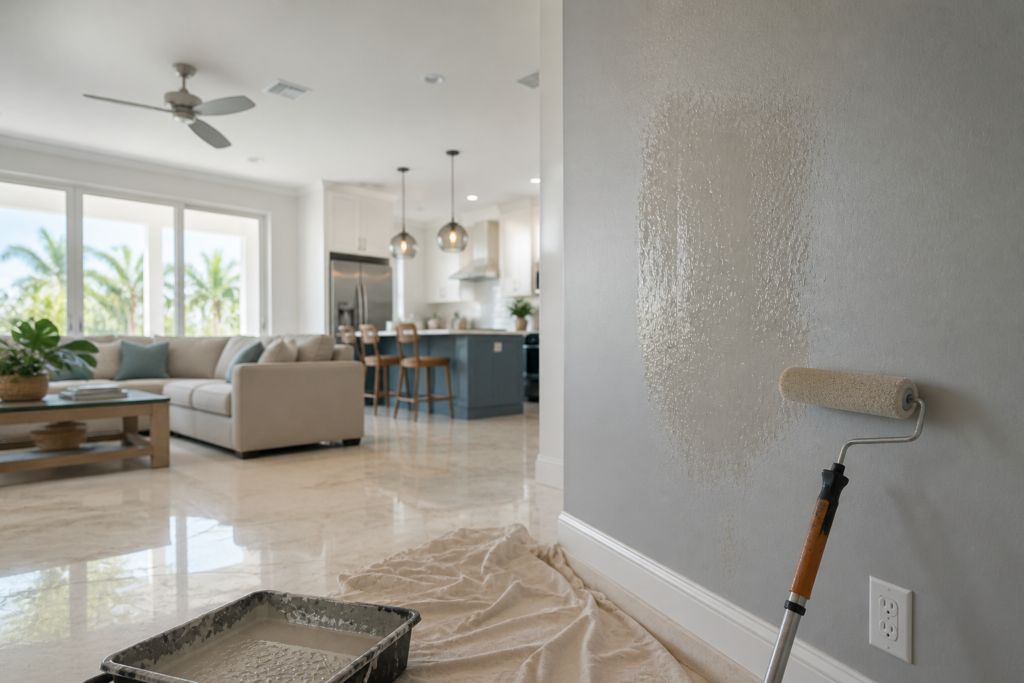
Fresh paint that stays tacky inside a cooled home can feel like something went wrong. The room feels comfortable, the air conditioner is running, and yet the surface does not dry within the expected time. In humid climates, this situation is common because drying depends on more than temperature. The amount of moisture already in the air directly affects how quickly paint can release its own moisture and form a stable film.
Understanding why this happens requires looking at how paint dries, how indoor humidity behaves even with air conditioning, and why results can vary by room, season, paint type, and finish.
This article contains affiliate links. If you make a purchase through one of these links, The Humid House may earn a small commission at no additional cost to you.
How Paint Actually Dries Indoors
Most interior paints are water-based (latex or acrylic) coatings. These paints do not simply “air dry.” They go through two linked processes:
- Evaporation: Water and small co-solvents leave the wet paint film and move into the surrounding air
- Film formation: As moisture leaves, the remaining paint particles move together and fuse into a continuous coating
Oil-based paints follow a different path:
- Solvent evaporation, followed by
- Oxidative curing, where the coating chemically hardens over time
In both cases, evaporation is the limiting step. If moisture cannot leave the surface efficiently, the paint remains soft, tacky, or slow to cure.
What Normal Paint Drying Looks Like In A Drier Climate
In a drier indoor environment, paint behaves more predictably because the surrounding air can absorb moisture quickly.
Typical outcomes:
- Paint becomes dry to the touch within a few hours
- Recoat timing aligns more closely with label guidance
- The surface firms up evenly without lingering tackiness
Manufacturers such as Sherwin-Williams note that many latex paints can dry to the touch in roughly 1–2 hours, while full curing continues over a longer period depending on conditions.
The key factor is that the air has capacity to accept moisture, allowing evaporation to proceed efficiently.
What Paint Drying Looks Like In A Humid Climate
In a humid home, paint can behave very differently—even at the same temperature.
Common observations:
- Paint remains tacky or slightly sticky longer than expected
- The surface may appear dry but still feel soft
- Recoating can disturb the first layer
- Drying varies from room to room
As Benjamin Moore explains, paint takes longer to dry in humid environments and faster in dry ones. In humid climates, this difference is often noticeable during normal indoor projects.
Why Air Conditioning Doesn’t Always Solve It
Air conditioning helps, but it does not guarantee ideal drying conditions.
Key limitations:
- It primarily controls temperature, not continuous humidity
- Short cycles reduce moisture removal
- Oversized systems cool quickly but dehumidify less
- Outdoor humidity continuously re-enters the home
This leads to a common situation:
- Cool indoor air
- But humidity still high enough to slow evaporation
Paint responds to relative humidity at the surface, not how comfortable the room feels.
The Chemistry Behind Slow Drying
Water-based paint relies on moisture leaving the paint film.
When humidity is high:
- The air already holds significant moisture
- The evaporation rate slows
- Water remains in the paint film longer
- Film formation is delayed
This is why the same paint applied the same way can dry differently depending on indoor conditions.
Why Some Rooms Dry Faster Than Others
Paint dries based on local conditions, not whole-house averages.
Rooms that often dry slower:
- Bathrooms
- Kitchens
- Laundry areas
- Closets and enclosed spaces
- Rooms with poor airflow
Rooms that often dry faster:
- Open living areas
- Rooms with active airflow
- Areas farther from moisture sources
Even within the same home, small differences in airflow and humidity can mean one room dries quickly while another room still feels damp.
Why Season Matters In Humid Homes
Seasonal moisture affects indoor drying conditions.
During humid or rainy periods:
- Outdoor air carries more moisture
- Indoor humidity remains elevated
- Drying slows
During drier periods:
- Indoor humidity is lower
- Evaporation improves
- Paint dries more predictably
The same project can behave differently depending on when it is done, not just how.
Dry Climate vs. Humid Climate Paint Behavior
| Condition | Drier Climate | Humid Climate |
| Surface feel | Firms up quickly | May remain tacky longer |
| Recoat timing | Matches label more closely | Often delayed |
| Air movement | Helpful | Very important |
| AC effectiveness | Usually sufficient | Often not enough alone |
| Drying consistency | More uniform | Varies by room |
| Moisture removal need | Lower | Higher |
How Paint Sheen Affects Drying In Humid Homes
Paint sheen changes how the surface behaves as it dries because different finishes contain different amounts of resin.
Lower sheens (flat and matte):
- More porous surface
- Can hold moisture slightly longer
- May feel uneven or soft in humid conditions
Mid sheens (eggshell and satin):
- Balanced performance
- Moderate moisture resistance
- Often dry more evenly than flat finishes
Higher sheens (semi-gloss and gloss):
- Higher resin content
- Less porous surface
- Can feel dry to the touch sooner
- Still require full curing underneath
In humid environments, higher sheens are often used in bathrooms and kitchens because they handle moisture exposure better after drying, not because they eliminate humidity-related drying delays.
Why Paint Quality Matters
Not all paints perform the same under humidity.
Higher-quality paints typically:
- Use more refined resins and binders
- Form a more consistent film
- Handle moisture exposure more effectively
- Provide more predictable drying behavior
Lower-quality paints may:
- Contain less consistent formulations
- Struggle more with film formation
- Be more sensitive to humidity fluctuations
Quality does not eliminate the effects of humidity, but it can influence how evenly and reliably the paint dries under less-than-ideal conditions.
What Actually Helps Paint Dry Indoors
Improving drying conditions requires reducing moisture and improving airflow.
Air movement
- Fans move air across the surface
- Helps moisture leave the paint film
Dehumidification
- A standalone dehumidifier lowers indoor moisture
- Often one of the most effective tools
Air conditioning adjustments
- Longer cycles improve moisture removal
- Slightly lower temperature can increase runtime
Controlled airflow
- Keeping doors open improves circulation
- Avoid bringing in humid outdoor air unnecessarily
Application technique
- Apply thinner coats
- Allow proper time between coats
If you are unsure whether indoor humidity is contributing to slow drying, the ThermPro TP50 provides a way to monitor relative humidity in the room while you work.
If humidity is elevated, a dehumidifier such as the Midea 35-Pint Dehumidifier can provide supplemental moisture removal while the paint cures. You can also improve air movement across the painted surface, with the help of a portable fan such as the XPOWER P-230AT Mini Air Mover.
When It’s Not Just Humidity
Other factors can contribute to slow drying:
- Thick paint application
- Painting over damp surfaces
- Poor surface preparation
- Recoating too soon
- Incompatible coatings
Humidity is often the main driver, but these factors can compound the issue.
Professional Perspective
Paint performance is directly tied to environmental conditions.
“Water-based coatings rely on evaporation to form a film, and high humidity slows that process by reducing the rate at which moisture can leave the surface.” — Sherwin-Williams
This reflects what homeowners experience: drying depends on how effectively moisture can leave the paint film.
Frequently Asked Questions
Why is my paint still tacky after 24 hours?
High humidity is the most common cause. The air cannot absorb moisture quickly, so evaporation slows. Thick coats, low airflow, or cool conditions can also contribute.
Does air conditioning help paint dry?
Yes, but only partially. It cools the air and removes some moisture, but it may not lower humidity enough to fully support drying.
Is a fan or dehumidifier better?
A dehumidifier typically has the larger impact because it removes moisture from the air when indoor humidity is high. Fans help improve airflow and work best when combined with humidity control.
Should I open windows to help paint dry?
Only if outdoor air is drier than indoor air. In humid climates, opening windows can slow drying by adding more moisture.
Why does paint dry faster in one room than another?
Differences in airflow, humidity, and moisture sources cause variation. Bathrooms, kitchens, and enclosed spaces often dry slower.
Does paint sheen affect drying?
Yes. Higher sheens may feel dry faster due to lower porosity, while lower sheens can hold moisture slightly longer. However, sheen does not eliminate the effects of humidity.
Does paint quality matter for drying?
Yes. Higher-quality paints tend to form more consistent films and handle humidity better, though they are still affected by environmental conditions.
How long does paint take to fully cure?
Paint may feel dry within hours, but full curing can take weeks depending on paint type and conditions.
The Bottom Line
If paint is not drying even with the air conditioner on, the issue is usually not the paint itself but the environment. Air conditioning can cool a room without removing enough moisture for proper evaporation.
In drier climates, paint dries more predictably because the air can absorb moisture quickly. In humid homes, evaporation slows, and paint can remain tacky longer. Managing humidity, improving airflow, choosing appropriate paint types and finishes, and allowing adequate drying time are the key factors that determine how well paint performs indoors.