
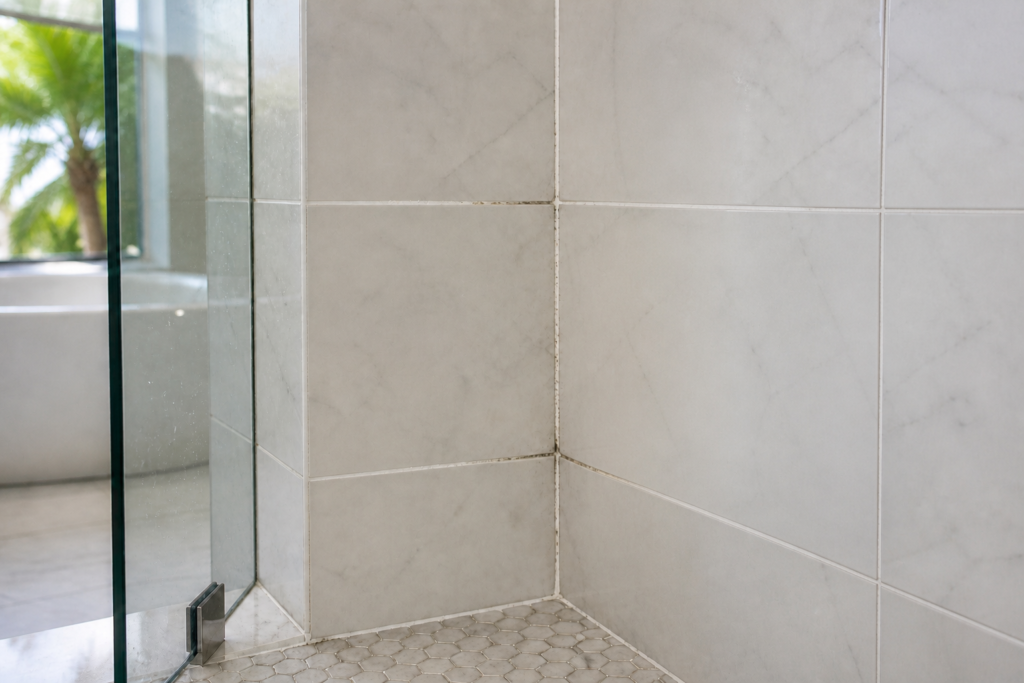
White mold in showers often creates uncertainty for homeowners, especially when it appears lighter or less noticeable than darker staining. In humid climates, however, mold growth is driven less by color and more by how moisture interacts with surfaces over time. Warm air, lingering humidity, and slow drying conditions allow different types of mold to develop along grout lines, caulk, and corners, sometimes without obvious warning signs. What shows up in these areas reflects the environment more than the type of mold itself, making appearance alone a poor indicator of what’s actually happening.
What White Shower Mold Actually Is
White mold in showers isn’t a single, specific type of mold. The lighter or whitish appearance usually comes from early-stage growth, mineral residue, or the way moisture interacts with surfaces like grout and caulk. In humid bathrooms, where surfaces stay damp longer, mold can develop before it darkens or becomes more visible.
In many cases, what appears white may include a mix of mold, mildew, and soap or mineral buildup. These conditions often overlap in areas that don’t fully dry, making color an unreliable way to identify what’s present. The environment—warm air, moisture, and slow drying—plays a larger role than the specific type of mold itself.
Because of this, white mold is better understood as a surface-level sign of ongoing moisture exposure, rather than a distinct category with its own behavior.
Why Showers Support Mold of Any Color
Mold growth in bathrooms is driven by repeated moisture exposure and slow drying.
Showers introduce warm water, steam, and condensation daily, and in humid climates, these surfaces often remain damp longer than expected, which creates the ideal environment for mold to survive.
| Shower Area | Why Moisture Persists | Mold Likelihood |
| Grout lines | Porous material absorbs water | High |
| Silicone caulk | Traps moisture beneath surface | High |
| Tile corners | Limited airflow | Moderate |
| Painted ceilings | Condensation collects | Moderate |
| Shower niches | Standing water exposure | Highest |
Is White Mold Actually Less Harmful Than Black Mold?
White mold is often assumed to be less harmful than black mold because it appears lighter and less noticeable. In reality, color alone isn’t a reliable way to determine how mold behaves or what it may affect. In humid environments, mold growth is driven by moisture, surface conditions, and time—not by appearance.
Many types of mold can appear white in early stages or under certain conditions, especially in bathrooms where surfaces stay damp. As growth develops, some molds may darken, while others remain light depending on the material and environment. Because of this, the distinction between “white” and “black” mold is often less meaningful than it seems.
What matters more is the presence of ongoing moisture and the conditions allowing mold to persist. In showers, that typically means surfaces that stay wet, slow drying, and repeated exposure to humidity—factors that support mold growth regardless of color.
Why Color Doesn’t Define Impact
Indoor environmental specialists consistently emphasize that visible mold reflects moisture imbalance rather than biological severity.
According to the American College of Occupational and Environmental Medicine:
Indoor mold growth indicates the presence of excess moisture that allows fungal colonization to occur. The potential impact of mold exposure is influenced more by the amount and persistence of growth than by visual characteristics such as color. Moisture control remains the most effective way to limit indoor mold development.
This perspective reinforces a key distinction for homeowners: mold behavior is governed by environmental conditions, not by its shade.
Why White Mold Often Appears First
White mold often shows up first because many molds begin as light or nearly colorless growth in their early stages. In a humid shower environment, where surfaces stay damp and airflow is limited, mold can start forming before it becomes visibly darker or more defined.
As growth develops over time, some molds produce pigments that cause them to appear darker, while others remain light depending on the surface and conditions. This means what looks like “white mold” is often just early-stage growth or a less pigmented form, rather than a completely different type.
In bathrooms that stay consistently humid, this progression can happen gradually, with light growth appearing first in grout lines, caulk, or corners where moisture lingers the longest, even when surfaces are cleaned regularly.
How White and Black Shower Mold Compare
| Feature | White Shower Mold | Black Shower Mold |
| Indicates moisture issue | Yes | Yes |
| May cause irritation | Possible | Possible |
| Requires damp surfaces | Yes | Yes |
| Always more dangerous | No | No |
| Common in bathrooms | Yes | Yes |
| Signals drying problem | Yes | Yes |
The shared characteristics matter more than the visual differences.
What Helps Reduce Shower Mold
Shower mold is largely driven by how long moisture stays on surfaces. In humid environments, reducing that moisture exposure matters more than frequent cleaning alone.
Reducing persistence usually involves:
- Allowing surfaces to fully dry between uses
- Improving airflow to remove humid air more quickly
- Limiting areas where water can sit or collect
- Replacing materials like aging caulk that trap moisture
When moisture is reduced and drying improves, mold has fewer conditions to re-establish — regardless of color.
Frequently Asked Questions
Is white mold in the shower dangerous?
White mold is not automatically harmless simply because it appears lighter in color. Like other indoor molds, it can release spores that may contribute to irritation or allergic responses in sensitive individuals. The level of concern typically depends on how extensive and persistent the growth is rather than how it looks. Small, localized areas are often manageable when moisture is controlled, but recurring growth suggests that surfaces are staying damp long enough to support continued colonization.
Why does mold keep coming back even after cleaning?
Mold often returns when underlying moisture conditions remain unchanged. Cleaning removes visible growth, but if grout, caulk, or ceiling surfaces continue to experience repeated wetting without sufficient drying, mold can reappear. In humid environments, this cycle may continue unless airflow or drying time improves. Addressing moisture persistence usually has more lasting impact than repeated surface treatments.
Does black mold grow faster than white mold?
Growth speed depends on moisture conditions rather than color. Both white and dark molds can develop quickly when surfaces remain damp for extended periods. In many cases, what appears as white mold may simply represent an earlier stage of growth that could darken over time. Environmental conditions — such as humidity levels and drying time — play a greater role than mold type in determining how rapidly it spreads.
The Bottom Line
White shower mold is not a milder version of black mold. Both indicate that moisture is lingering long enough to support growth. While the appearance may differ, the environmental message is the same: surfaces are not drying as quickly as they should. When drying improves, persistence often decreases — making prevention more about moisture behavior than visual classification.