
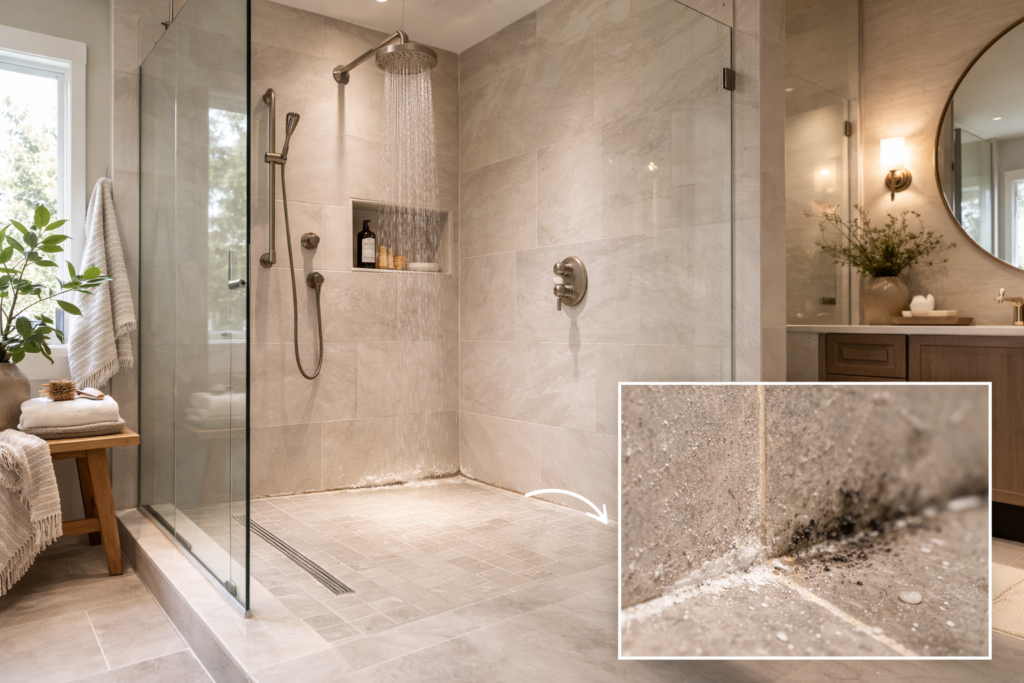
White mold in showers often causes uncertainty for homeowners. Because it lacks the dark staining typically associated with “black mold,” it is frequently dismissed as cosmetic or assumed to be less concerning. In humid homes, however, mold appearance does not always reflect mold behavior. What develops along grout lines, ceilings, or caulk is less about color and more about how moisture interacts with surfaces over time. Understanding how different molds form in bathrooms — and what their presence actually signals — helps shift the focus away from appearance and toward the underlying conditions that allow growth to persist.
What White Shower Mold Actually Is
White mold is not a single type of mold. It is simply a visual description of fungal growth that appears pale, chalky, or fuzzy in early stages.
Inside showers, it often develops on:
- Grout lines
- Silicone caulk
- Painted ceilings
- Porous tile or stone
In many cases, what begins as white growth may later darken as spores mature. This means color can reflect growth stage rather than mold type.
Why Showers Support Mold of Any Color
Mold growth in bathrooms is driven by repeated moisture exposure and slow drying.
Showers introduce warm water, steam, and condensation daily. In humid climates, these surfaces often remain damp longer than expected.
| Shower Area | Why Moisture Persists | Mold Likelihood |
| Grout lines | Porous material absorbs water | High |
| Silicone caulk | Traps moisture beneath surface | High |
| Tile corners | Limited airflow | Moderate |
| Painted ceilings | Condensation collects | Moderate |
| Shower niches | Standing water exposure | Highest |
When surfaces stay wet between uses, mold — regardless of color — gains an opportunity to establish.
Is White Mold Actually Less Harmful Than Black Mold?
From a building standpoint, color is not a reliable indicator of risk.
Some white molds release allergens or irritants. Some darker molds are common environmental species with limited health significance. Both forms can signal that moisture is lingering longer than intended.
The presence of mold in showers — pale or dark — typically reflects:
- Repeated wetting
- Slow drying
- Micro-surfaces where moisture collects
Why Color Doesn’t Define Impact
Indoor environmental specialists consistently emphasize that visible mold reflects moisture imbalance rather than biological severity.
According to the American College of Occupational and Environmental Medicine:
Indoor mold growth indicates the presence of excess moisture that allows fungal colonization to occur. The potential impact of mold exposure is influenced more by the amount and persistence of growth than by visual characteristics such as color. Moisture control remains the most effective way to limit indoor mold development.
This perspective reinforces a key distinction for homeowners: mold behavior is governed by environmental conditions, not by its shade.
Why White Mold Often Appears First
White mold frequently represents early colonization.
Bathrooms that experience daily humidity cycles may allow mold to remain in this lighter phase for extended periods. Over time, the same growth may change in appearance.
This is why persistent “white buildup” can return even when surfaces are cleaned regularly.
How White and Black Shower Mold Compare
| Feature | White Shower Mold | Black Shower Mold |
| Indicates moisture issue | Yes | Yes |
| May cause irritation | Possible | Possible |
| Requires damp surfaces | Yes | Yes |
| Always more dangerous | No | No |
| Common in bathrooms | Yes | Yes |
| Signals drying problem | Yes | Yes |
The shared characteristics matter more than the visual differences.
Why Cleaning Alone Doesn’t Stop It
Surface removal does not change drying behavior.
Mold returns when:
- Grout stays damp
- Caulk traps moisture
- Ceilings collect condensation
- Airflow is limited
Without faster drying between uses, recolonization can occur.
What Helps Reduce Shower Mold
Reducing persistence usually involves:
- Allowing full drying between uses
- Improving airflow
- Replacing aging caulk
- Limiting standing moisture
When surfaces dry efficiently, mold struggles to re-establish — regardless of color.
Frequently Asked Questions
Is white mold in the shower dangerous?
White mold is not automatically harmless simply because it appears lighter in color. Like other indoor molds, it can release spores that may contribute to irritation or allergic responses in sensitive individuals. The level of concern typically depends on how extensive and persistent the growth is rather than how it looks. Small, localized areas are often manageable when moisture is controlled, but recurring growth suggests that surfaces are staying damp long enough to support continued colonization.
Why does mold keep coming back even after cleaning?
Mold often returns when underlying moisture conditions remain unchanged. Cleaning removes visible growth, but if grout, caulk, or ceiling surfaces continue to experience repeated wetting without sufficient drying, mold can reappear. In humid environments, this cycle may continue unless airflow or drying time improves. Addressing moisture persistence usually has more lasting impact than repeated surface treatments.
Does black mold grow faster than white mold?
Growth speed depends on moisture conditions rather than color. Both white and dark molds can develop quickly when surfaces remain damp for extended periods. In many cases, what appears as white mold may simply represent an earlier stage of growth that could darken over time. Environmental conditions — such as humidity levels and drying time — play a greater role than mold type in determining how rapidly it spreads.
The Bottom Line
White shower mold is not a milder version of black mold. Both indicate that moisture is lingering long enough to support growth. While the appearance may differ, the environmental message is the same: surfaces are not drying as quickly as they should. When drying improves, persistence often decreases — making prevention more about moisture behavior than visual classification.