
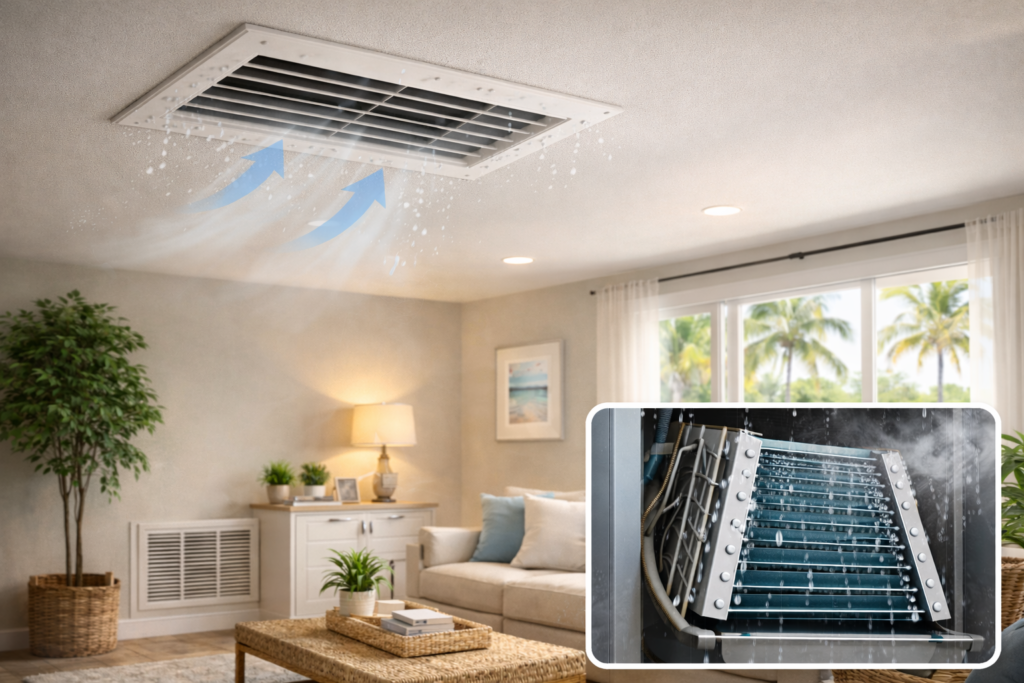
Mold inside HVAC ductwork is one of the most misunderstood moisture issues in humid climates. Homeowners often hear conflicting claims — some are told it’s inevitable, while others are assured it “never really happens.” The truth sits squarely in between. This guide explains how common mold in HVAC ducts actually is in humid regions, why it develops in some homes but not others, how to recognize real risk versus normal conditions, and what practical steps help prevent it. The goal is clarity, not alarm — so you can make informed decisions about your home.
Is Mold in HVAC Ductwork Actually Common in Humid Climates?
Mold in HVAC ducts is possible in humid climates, but it is not universally common in properly functioning systems. In most homes, duct interiors remain dry enough to prevent active mold growth. Problems arise when moisture is consistently introduced and allowed to linger.
Humid climates increase the risk conditions for mold, but mold growth inside ducts typically requires a combination of high humidity, surface moisture, organic debris, and inadequate airflow. When those factors overlap, ducts can become a favorable environment. When they don’t, mold struggles to establish itself — even in very humid regions.
Why Humid Climates Increase Mold Risk in HVAC Systems
Humidity alone does not cause mold. What matters is condensation — moisture that collects on surfaces inside the system.
In humid climates, warm, moisture-laden air frequently contacts cooler HVAC components. When duct surfaces fall below the dew point, condensation forms. Over time, repeated wetting creates the conditions mold needs to grow, particularly if dust or insulation fibers are present as a food source.
This is why homes in humid regions may see duct mold issues while similar systems in drier climates do not, even when equipment is the same.
Where Mold Is Most Likely to Develop in an HVAC System
Mold does not usually spread evenly throughout ductwork. It tends to appear in specific locations where moisture is most likely to accumulate.
| HVAC Area | Why Moisture Builds Up | Mold Risk Level |
| Supply duct near air handler | Cold air lowers surface temperature | Moderate |
| Return duct near humid spaces | Pulls moist air into system | Moderate |
| Duct boots at ceiling | Temperature differential causes condensation | Moderate |
| Air handler cabinet | Frequent cooling cycles and trapped moisture | High |
| Evaporator coil & drain pan | Constant moisture exposure | Highest |
Most confirmed mold growth in HVAC systems is found near the air handler or evaporator coil, not deep within long duct runs.
How Dust, Insulation, and Airflow Contribute to Mold Growth
Mold requires more than moisture. It also needs a surface it can attach to and feed from.
Dust buildup inside ducts provides organic material. Damaged or exposed duct liner insulation can trap moisture and nutrients. Low airflow allows damp areas to stay wet longer than they should. Together, these factors create a micro-environment that favors mold persistence.
Well-sealed, properly sized ducts with consistent airflow dry quickly after cooling cycles — even in humid climates — which limits mold potential.
What Mold in HVAC Ducts Usually Looks Like (and What It Doesn’t)
One of the biggest sources of confusion is mistaking normal residue for mold.
Dark staining, dust accumulation, or oily buildup near vents is common and not automatically mold. True mold growth typically appears as fuzzy or patchy areas that spread irregularly and persist even after cleaning.
Visual inspection alone is often insufficient. Context — moisture history, system performance, and surface condition — matters more than appearance by itself.
Professional Insight: Why Mold Isn’t Inevitable in Humid Climates
U.S. Environmental Protection Agency — Mold Growth is fundamentally a moisture problem, not a cleanliness problem. In heating and cooling systems, mold develops when moisture is allowed to accumulate on surfaces for extended periods of time. HVAC systems that are properly designed, installed, and maintained should manage condensation effectively and dry out between operating cycles. When moisture is controlled, mold growth inside ductwork is not expected, even in humid climates.
How to Tell the Difference Between Duct Mold and a Moisture Smell
Many homeowners notice musty odors and assume mold in the ducts. In reality, odors often originate from temporary moisture, not active growth.
Short-lived smells after the system turns on — especially in the morning or during seasonal transitions — usually point to damp dust or condensation on coils. Persistent odors that worsen over time and remain despite cleaning may warrant closer inspection.
Understanding this distinction helps prevent unnecessary duct cleaning or remediation.
What Actually Prevents Mold in HVAC Ducts in Humid Regions
Prevention focuses on drying time, not sterilization.
Key protective measures include:
- Consistent airflow to prevent stagnant, damp areas
- Proper duct insulation to reduce condensation
- Well-designed drainage so moisture leaves the system quickly
- Clean coils and pans that do not hold standing water
When systems dry fully between cooling cycles, mold struggles to survive — even when outdoor humidity is high.
Should HVAC Ducts Be Cleaned to Prevent Mold?
Routine duct cleaning is not a mold prevention strategy on its own. Cleaning removes dust, but it does not address moisture sources.
If condensation continues, mold can return regardless of how clean the ducts are. Duct cleaning is most useful after moisture problems are corrected, not as a standalone solution.
When Mold in Ducts Is a Real Problem
Not all mold findings require aggressive action. The severity depends on extent, location, and cause.
- Localized growth near coils often responds to moisture correction and targeted cleaning
- Widespread growth inside lined ducts may require replacement
- Recurring growth signals unresolved humidity or airflow issues
The focus should always be on why moisture is present — not just removing visible growth.
Frequently Asked Questions
Is mold in HVAC ducts dangerous?
Most cases are not immediately dangerous, but they indicate a moisture problem that should be addressed. Long-term exposure to mold spores can worsen indoor air quality, especially for sensitive individuals.
Can high indoor humidity alone cause duct mold?
No. Mold requires surface moisture. High humidity increases risk, but condensation and poor drying are the determining factors.
Does replacing ducts eliminate mold permanently?
Only if the moisture source is corrected. New ducts exposed to the same condensation conditions can develop mold again.
Do UV lights prevent mold in ducts?
UV lights can help control microbial growth near coils but do not solve condensation or airflow problems. They are supportive tools, not primary fixes.
How often should ducts be inspected in humid climates?
Visual inspection every few years — or sooner if persistent odors, moisture issues, or HVAC performance problems appear — is typically sufficient.
The Bottom Line
Mold in HVAC ducts is possible but not inevitable in humid climates. It develops when condensation, dust, and poor airflow intersect — not simply because humidity exists. Homes with well-designed, properly maintained HVAC systems often remain mold-free for decades, even in challenging environments. The most effective approach is moisture control, not fear-based remediation. When you understand how and why mold forms, prevention becomes practical and manageable rather than overwhelming.